{"title":"Interregional fiscal transfers resulting from central government debt: New insights and consequences for political economy","authors":"Geert Jennes","doi":"10.1111/kykl.12258","DOIUrl":null,"url":null,"abstract":"<p>The political geography of central government debt has hardly been investigated. We propose a method for calculating implicit interregional transfers stemming from central government debt.</p><p>We apply this method to Belgium over the 1970-2016 period. The share of poorer Francophone Belgium in debt-financed central government <i>spending</i> was persistently larger than its share in central government <i>revenue</i> used to pay the resulting interest bills. The opposite holds for richer Flanders. Also, a primary deficit in <i>one particular year</i> leads to an interest bill in <i>each of the following years</i> as long as debt caused by that primary deficit is not repaid. All the above caused debt-related transfers from Flanders to Francophone Belgium of over 7% of Flemish GDP during many years.</p><p>Interregional interest transfers may also be large in the many other democracies suffering from both high central government debt and considerable geographic income disparities.</p><p>The size of these transfers may <i>in turn explain</i> the size and persistence of central government deficits. This is also because poorer, less densely populated regions such as Francophone Belgium tend to be overrepresented within central governments. This strengthens their ability to cause deficits.</p><p>We recommend more fiscal decentralisation or at least smaller central government deficits.</p>","PeriodicalId":47739,"journal":{"name":"Kyklos","volume":"74 2","pages":"196-223"},"PeriodicalIF":1.3000,"publicationDate":"2021-02-26","publicationTypes":"Journal Article","fieldsOfStudy":null,"isOpenAccess":false,"openAccessPdf":"https://sci-hub-pdf.com/10.1111/kykl.12258","citationCount":"0","resultStr":null,"platform":"Semanticscholar","paperid":null,"PeriodicalName":"Kyklos","FirstCategoryId":"96","ListUrlMain":"https://onlinelibrary.wiley.com/doi/10.1111/kykl.12258","RegionNum":3,"RegionCategory":"经济学","ArticlePicture":[],"TitleCN":null,"AbstractTextCN":null,"PMCID":null,"EPubDate":"","PubModel":"","JCR":"Q2","JCRName":"ECONOMICS","Score":null,"Total":0}
引用次数: 0
Abstract
The political geography of central government debt has hardly been investigated. We propose a method for calculating implicit interregional transfers stemming from central government debt.
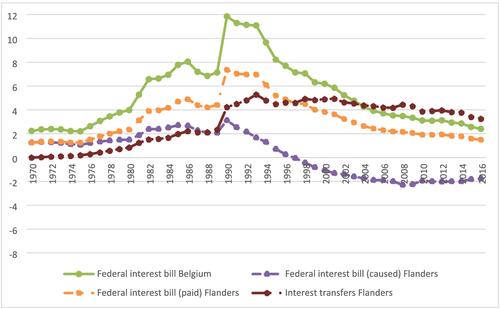
We apply this method to Belgium over the 1970-2016 period. The share of poorer Francophone Belgium in debt-financed central government spending was persistently larger than its share in central government revenue used to pay the resulting interest bills. The opposite holds for richer Flanders. Also, a primary deficit in one particular year leads to an interest bill in each of the following years as long as debt caused by that primary deficit is not repaid. All the above caused debt-related transfers from Flanders to Francophone Belgium of over 7% of Flemish GDP during many years.
Interregional interest transfers may also be large in the many other democracies suffering from both high central government debt and considerable geographic income disparities.
The size of these transfers may in turn explain the size and persistence of central government deficits. This is also because poorer, less densely populated regions such as Francophone Belgium tend to be overrepresented within central governments. This strengthens their ability to cause deficits.
We recommend more fiscal decentralisation or at least smaller central government deficits.
期刊介绍:
KYKLOS views economics as a social science and as such favours contributions dealing with issues relevant to contemporary society, as well as economic policy applications. Since its inception nearly 60 years ago, KYKLOS has earned a worldwide reputation for publishing a broad range of articles from international scholars on real world issues. KYKLOS encourages unorthodox, original approaches to topical economic and social issues with a multinational application, and promises to give fresh insights into topics of worldwide interest




 京公网安备 11010802042870号
京ICP备2023020795号-1
京公网安备 11010802042870号
京ICP备2023020795号-1

 分享
分享
 求助内容:
求助内容: 应助结果提醒方式:
 扫码关注我们
