{"title":"Geodigest","authors":"","doi":"10.1046/j.1365-2451.1999.1502003.x","DOIUrl":null,"url":null,"abstract":"As geologists, we perform best with the full consent and understanding of our fellows who live and work in the countryside. We also perform within a context in which others are very jealous of the countryside as they have known it over the years. Damage it visually, even by new building rather than out-and-out excavation, and we are in trouble. Conservation and greenness are important issues in our way of life these days, and we do well to recognize as much. So whats this all about, this sermon on behaviour? Well, believe it or not, we have currently one of the worst examples of crude sampling with the use of rock-coring machines. Geotermites have struck in that most scenic of places, the Isle of Skye, to an extent which incenses hill-walkers and climbers who traverse the slopes of Beinn an Dubhaich. With luck, other more casual visitors may not notice the damage or attribute it to geologists, but we know the tell-tale signs of small round holes in a close-set pattern, and cringe lest this brings down retribution which could be exclusion in future, or even fines if the culprits are identifiable. Beinn an Dubhaich must be one of the best-known field areas for the determination of the effects of granite intruded into a limestone country rock, so much so that it has at least SSSI status in the hierarchy of Earth-science conservation. It isnt just good, it is First Class, Grade One-Listed a Rolls-Royce in geological standing. Too late, you may be saying, the vandal has long since gone from the scene and isnt around to be prosecuted. What can be done to expose a crime? Well, more than you might expect. The cores this time are hardly likely to be the work of our palaeomagnetist colleagues. This is a prime site for orthodox petrologists interested in the growth of new minerals in altered limestones. Those who have a serious research interest in this field and in this prime locality are small in number, a band of enthusiasts known to one another to an extent that can narrow down any list of possible culprits. Suffice it to say that one name is being pencilled in and the pages of published work scrutinized for the tell-tale evidence of field research involving close-spaced sampling! All of this came to light when others of the brotherhood came upon the visual damage and were sickened by the sight. Years ago, the Geologists Associations Geological Fieldwork Code included A code of conduct for rock coring (Fig. 1) when the habit of small-bore coring caught on as a field technique. As the method is visually damaging, or can be, there is strict need for prior permission for coring from the landowner. After that, there are self-imposed disciplines which could make the sampling acceptable. Emphasis is put upon coring from least exposed faces of natural exposures (quarries, if active, dont need such rules). A minimum number, as opposed to a close-spaced cluster, was another advised approach, as was a plea that holes should be plugged with debris afterwards. The final point, however, sums up in full the restraints which should be uppermost in our minds if we core or collect at all. It reads: Respect the feelings of other geologists, who may have curbed their natural instincts and adhered to a no hammering rule at the same locality. Clearly, our Beinn an Dubhaich vandal had no time for such niceties in the research being followed. If, in the course of time, we see in print a definitive work on the contact metamorphism of this Holy Ground, depend upon it, it may allow prosecution, as has done in the past over stolen osprey eggs. Even so, coring damage on this scale is truly irreparable and a cause for grief. It flouts that need for courtesy which has always been our key to the countryside. One last word: enough is known by processes of elimination to be able to say that, no, this time it wasnt the English who were to blame. SNP please note. [ER] Fig. 1. Coring etiquette from the Geologists Association.","PeriodicalId":100581,"journal":{"name":"Geology Today","volume":"15 2","pages":"54-59"},"PeriodicalIF":0.0000,"publicationDate":"2001-12-24","publicationTypes":"Journal Article","fieldsOfStudy":null,"isOpenAccess":false,"openAccessPdf":"https://sci-hub-pdf.com/10.1046/j.1365-2451.1999.1502003.x","citationCount":"0","resultStr":null,"platform":"Semanticscholar","paperid":null,"PeriodicalName":"Geology Today","FirstCategoryId":"1085","ListUrlMain":"https://onlinelibrary.wiley.com/doi/10.1046/j.1365-2451.1999.1502003.x","RegionNum":0,"RegionCategory":null,"ArticlePicture":[],"TitleCN":null,"AbstractTextCN":null,"PMCID":null,"EPubDate":"","PubModel":"","JCR":"","JCRName":"","Score":null,"Total":0}
引用次数: 0
Abstract
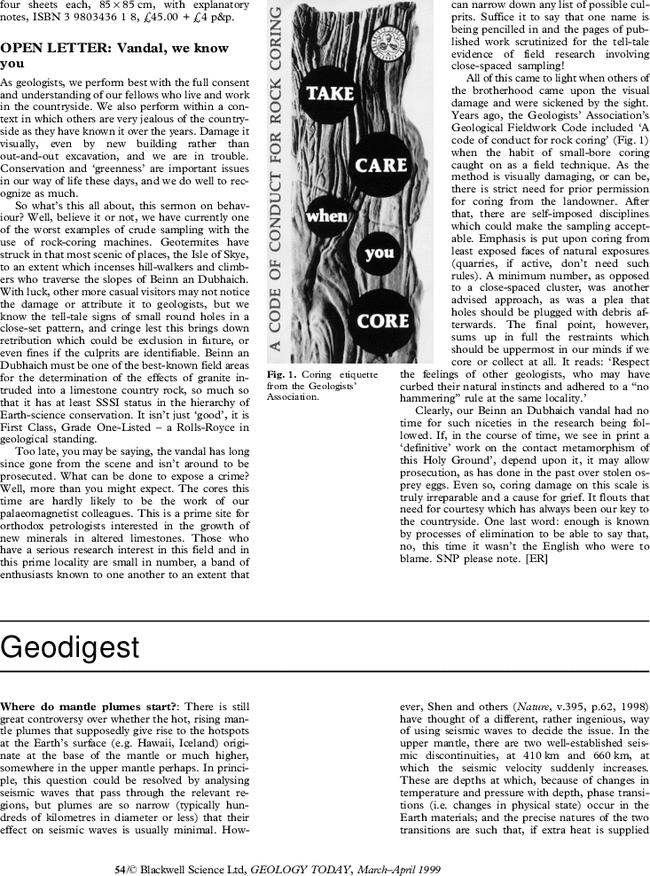
As geologists, we perform best with the full consent and understanding of our fellows who live and work in the countryside. We also perform within a context in which others are very jealous of the countryside as they have known it over the years. Damage it visually, even by new building rather than out-and-out excavation, and we are in trouble. Conservation and greenness are important issues in our way of life these days, and we do well to recognize as much. So whats this all about, this sermon on behaviour? Well, believe it or not, we have currently one of the worst examples of crude sampling with the use of rock-coring machines. Geotermites have struck in that most scenic of places, the Isle of Skye, to an extent which incenses hill-walkers and climbers who traverse the slopes of Beinn an Dubhaich. With luck, other more casual visitors may not notice the damage or attribute it to geologists, but we know the tell-tale signs of small round holes in a close-set pattern, and cringe lest this brings down retribution which could be exclusion in future, or even fines if the culprits are identifiable. Beinn an Dubhaich must be one of the best-known field areas for the determination of the effects of granite intruded into a limestone country rock, so much so that it has at least SSSI status in the hierarchy of Earth-science conservation. It isnt just good, it is First Class, Grade One-Listed a Rolls-Royce in geological standing. Too late, you may be saying, the vandal has long since gone from the scene and isnt around to be prosecuted. What can be done to expose a crime? Well, more than you might expect. The cores this time are hardly likely to be the work of our palaeomagnetist colleagues. This is a prime site for orthodox petrologists interested in the growth of new minerals in altered limestones. Those who have a serious research interest in this field and in this prime locality are small in number, a band of enthusiasts known to one another to an extent that can narrow down any list of possible culprits. Suffice it to say that one name is being pencilled in and the pages of published work scrutinized for the tell-tale evidence of field research involving close-spaced sampling! All of this came to light when others of the brotherhood came upon the visual damage and were sickened by the sight. Years ago, the Geologists Associations Geological Fieldwork Code included A code of conduct for rock coring (Fig. 1) when the habit of small-bore coring caught on as a field technique. As the method is visually damaging, or can be, there is strict need for prior permission for coring from the landowner. After that, there are self-imposed disciplines which could make the sampling acceptable. Emphasis is put upon coring from least exposed faces of natural exposures (quarries, if active, dont need such rules). A minimum number, as opposed to a close-spaced cluster, was another advised approach, as was a plea that holes should be plugged with debris afterwards. The final point, however, sums up in full the restraints which should be uppermost in our minds if we core or collect at all. It reads: Respect the feelings of other geologists, who may have curbed their natural instincts and adhered to a no hammering rule at the same locality. Clearly, our Beinn an Dubhaich vandal had no time for such niceties in the research being followed. If, in the course of time, we see in print a definitive work on the contact metamorphism of this Holy Ground, depend upon it, it may allow prosecution, as has done in the past over stolen osprey eggs. Even so, coring damage on this scale is truly irreparable and a cause for grief. It flouts that need for courtesy which has always been our key to the countryside. One last word: enough is known by processes of elimination to be able to say that, no, this time it wasnt the English who were to blame. SNP please note. [ER] Fig. 1. Coring etiquette from the Geologists Association.



 京公网安备 11010802042870号
京ICP备2023020795号-1
京公网安备 11010802042870号
京ICP备2023020795号-1

 分享
分享

 求助内容:
求助内容: 应助结果提醒方式:
 扫码关注我们
