{"title":"Typology of civic identity.","authors":"Inha Petrovska","doi":"10.5114/cipp.2022.116324","DOIUrl":null,"url":null,"abstract":"<p><strong>Background: </strong>Civic identity is considered a kind of organizational identity, which is a value-semantic experience of the individual's identity with themself as a citizen of the state. It is manifested in the institutional, community, and individual dimensions. Each of the mentioned dimensions of civic identity can be differently developed (actualized) in a particular individual, which suggests the existence of certain types of civic identity. The article aims to empirically verify the typology of the civic identity of an individual and identify both the most common and least common types among Ukrainian citizens.</p><p><strong>Participants and procedure: </strong>The study involved 965 citizens of Ukraine aged 16-60, of whom 377 were men (39.1%) and 588 women (60.9%). To assess the dimensions of civic identity and establish the development degree of each of them, the author's questionnaire \"Diagnosis of maturity and type of civic identity\" was used.</p><p><strong>Results: </strong>The existence of 8 main types of civic identity inherent in Ukrainians has been empirically established, namely Institutional-community (17%), Latent (16%), Game (16%), Community-game (15%), Institutional-game (12%), Community (11%), Versatile (8%), and Institutional (5%).</p><p><strong>Conclusions: </strong>Most citizens of Ukraine tend to engage in game interaction with the state, which is dominated by subject-object paradigms. The orientation of the game interaction with the state is also societal, which indicates that games and scenarios are borrowed from others and conditioned mainly by conformity rather than conscious choice. The prevalence of the Latent (indeterminate) type of civic identity coincides with the study subjects' relatively low level of civic identity maturity.</p>","PeriodicalId":20122,"journal":{"name":"Physical Review C","volume":"84 1","pages":"150-161"},"PeriodicalIF":3.4000,"publicationDate":"2022-11-09","publicationTypes":"Journal Article","fieldsOfStudy":null,"isOpenAccess":false,"openAccessPdf":"https://www.ncbi.nlm.nih.gov/pmc/articles/PMC10654344/pdf/","citationCount":"1","resultStr":null,"platform":"Semanticscholar","paperid":null,"PeriodicalName":"Physical Review C","FirstCategoryId":"1085","ListUrlMain":"https://doi.org/10.5114/cipp.2022.116324","RegionNum":2,"RegionCategory":"物理与天体物理","ArticlePicture":[],"TitleCN":null,"AbstractTextCN":null,"PMCID":null,"EPubDate":"2023/1/1 0:00:00","PubModel":"eCollection","JCR":"Q1","JCRName":"Physics and Astronomy","Score":null,"Total":0}
引用次数: 1
Abstract
Background: Civic identity is considered a kind of organizational identity, which is a value-semantic experience of the individual's identity with themself as a citizen of the state. It is manifested in the institutional, community, and individual dimensions. Each of the mentioned dimensions of civic identity can be differently developed (actualized) in a particular individual, which suggests the existence of certain types of civic identity. The article aims to empirically verify the typology of the civic identity of an individual and identify both the most common and least common types among Ukrainian citizens.
Participants and procedure: The study involved 965 citizens of Ukraine aged 16-60, of whom 377 were men (39.1%) and 588 women (60.9%). To assess the dimensions of civic identity and establish the development degree of each of them, the author's questionnaire "Diagnosis of maturity and type of civic identity" was used.
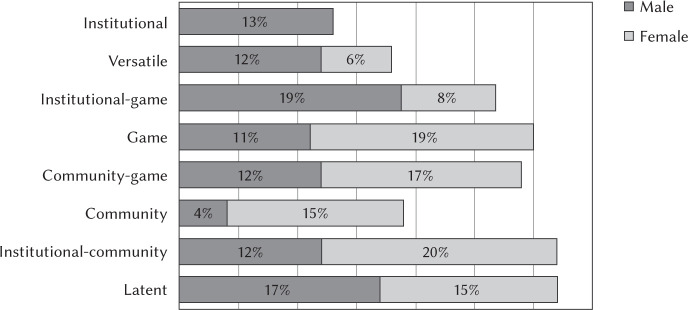
Results: The existence of 8 main types of civic identity inherent in Ukrainians has been empirically established, namely Institutional-community (17%), Latent (16%), Game (16%), Community-game (15%), Institutional-game (12%), Community (11%), Versatile (8%), and Institutional (5%).
Conclusions: Most citizens of Ukraine tend to engage in game interaction with the state, which is dominated by subject-object paradigms. The orientation of the game interaction with the state is also societal, which indicates that games and scenarios are borrowed from others and conditioned mainly by conformity rather than conscious choice. The prevalence of the Latent (indeterminate) type of civic identity coincides with the study subjects' relatively low level of civic identity maturity.
期刊介绍:
Physical Review C (PRC) is a leading journal in theoretical and experimental nuclear physics, publishing more than two-thirds of the research literature in the field.
PRC covers experimental and theoretical results in all aspects of nuclear physics, including:
Nucleon-nucleon interaction, few-body systems
Nuclear structure
Nuclear reactions
Relativistic nuclear collisions
Hadronic physics and QCD
Electroweak interaction, symmetries
Nuclear astrophysics






 京公网安备 11010802042870号
京ICP备2023020795号-1
京公网安备 11010802042870号
京ICP备2023020795号-1

 分享
分享
 求助内容:
求助内容: 应助结果提醒方式:
 扫码关注我们
