Multimodal Integrative Genomics and Pathology Analyses in Neoadjuvant Nivolumab Treatment for Intermediate and Locally Advanced Hepatocellular Carcinoma.
Tan-To Cheung, Daniel Wai-Hung Ho, Shirley Xueying Lyu, Qingyang Zhang, Yu-Man Tsui, Tiffany Ching-Yun Yu, Karen Man-Fong Sze, Joyce Man-Fong Lee, Vince Wing-Hang Lau, Edward Yin-Lun Chu, Simon Hing-Yin Tsang, Wong-Hoi She, Roland Ching-Yu Leung, Thomas Chung-Cheung Yau, Irene Oi-Lin Ng
{"title":"Multimodal Integrative Genomics and Pathology Analyses in Neoadjuvant Nivolumab Treatment for Intermediate and Locally Advanced Hepatocellular Carcinoma.","authors":"Tan-To Cheung, Daniel Wai-Hung Ho, Shirley Xueying Lyu, Qingyang Zhang, Yu-Man Tsui, Tiffany Ching-Yun Yu, Karen Man-Fong Sze, Joyce Man-Fong Lee, Vince Wing-Hang Lau, Edward Yin-Lun Chu, Simon Hing-Yin Tsang, Wong-Hoi She, Roland Ching-Yu Leung, Thomas Chung-Cheung Yau, Irene Oi-Lin Ng","doi":"10.1159/000531176","DOIUrl":null,"url":null,"abstract":"<p><strong>Introduction: </strong>Immunotherapy has resulted in pathologic responses in hepatocellular carcinoma (HCC), but the benefits and molecular mechanisms of neoadjuvant immune checkpoint blockade are largely unknown.</p><p><strong>Methods: </strong>In this study, we evaluated the efficacy and safety of preoperative nivolumab (anti-PD-1) in patients with intermediate and locally advanced HCC and determined the molecular markers for predicting treatment response.</p><p><strong>Results: </strong>Between July 2020 and November 2021, 20 treatment-naive HCC patients with intermediate and locally advanced tumors received preoperative nivolumab at 3 mg/kg for 3 cycles prior to surgical resection. Nineteen patients underwent surgical resection on trial. Seven (36.8%) of the 19 patients had major pathologic tumor necrosis (≥60%) in the post-nivolumab resection specimens, with 3 having almost complete (>90%) tumor necrosis. The tumor necrosis was hemorrhagic and often accompanied by increased or dense immune cell infiltrate at the border of the tumors. None of the patients developed major adverse reactions contradicting hepatectomy. RNA-sequencing analysis on both pre-nivolumab tumor biopsies and post-nivolumab resected specimens showed that, in cases with major pathologic necrosis, the proportion of CD8 T cells in the HCC tissues predominantly increased after treatment. Moreover, to investigate noninvasive biomarker for nivolumab response, we evaluated the copy number variation (CNV) using target-panel sequencing on plasma cell-free DNA of the patients and derived a CNV-based anti-PD-1 score. The score correlated with the extent of tumor necrosis and was validated in a Korean patient cohort with anti-PD-1 treatment.</p><p><strong>Conclusion: </strong>Neoadjuvant nivolumab demonstrated promising clinical activity in intermediate and locally advanced HCC patients. We also identified useful noninvasive biomarker predicting responsiveness.</p>","PeriodicalId":48701,"journal":{"name":"Physical Review B","volume":"73 1","pages":"70-88"},"PeriodicalIF":3.7000,"publicationDate":"2023-05-23","publicationTypes":"Journal Article","fieldsOfStudy":null,"isOpenAccess":false,"openAccessPdf":"https://www.ncbi.nlm.nih.gov/pmc/articles/PMC10857832/pdf/","citationCount":"0","resultStr":null,"platform":"Semanticscholar","paperid":null,"PeriodicalName":"Physical Review B","FirstCategoryId":"3","ListUrlMain":"https://doi.org/10.1159/000531176","RegionNum":2,"RegionCategory":"物理与天体物理","ArticlePicture":[],"TitleCN":null,"AbstractTextCN":null,"PMCID":null,"EPubDate":"2024/2/1 0:00:00","PubModel":"eCollection","JCR":"Q2","JCRName":"MATERIALS SCIENCE, MULTIDISCIPLINARY","Score":null,"Total":0}
引用次数: 0
Abstract
Introduction: Immunotherapy has resulted in pathologic responses in hepatocellular carcinoma (HCC), but the benefits and molecular mechanisms of neoadjuvant immune checkpoint blockade are largely unknown.
Methods: In this study, we evaluated the efficacy and safety of preoperative nivolumab (anti-PD-1) in patients with intermediate and locally advanced HCC and determined the molecular markers for predicting treatment response.
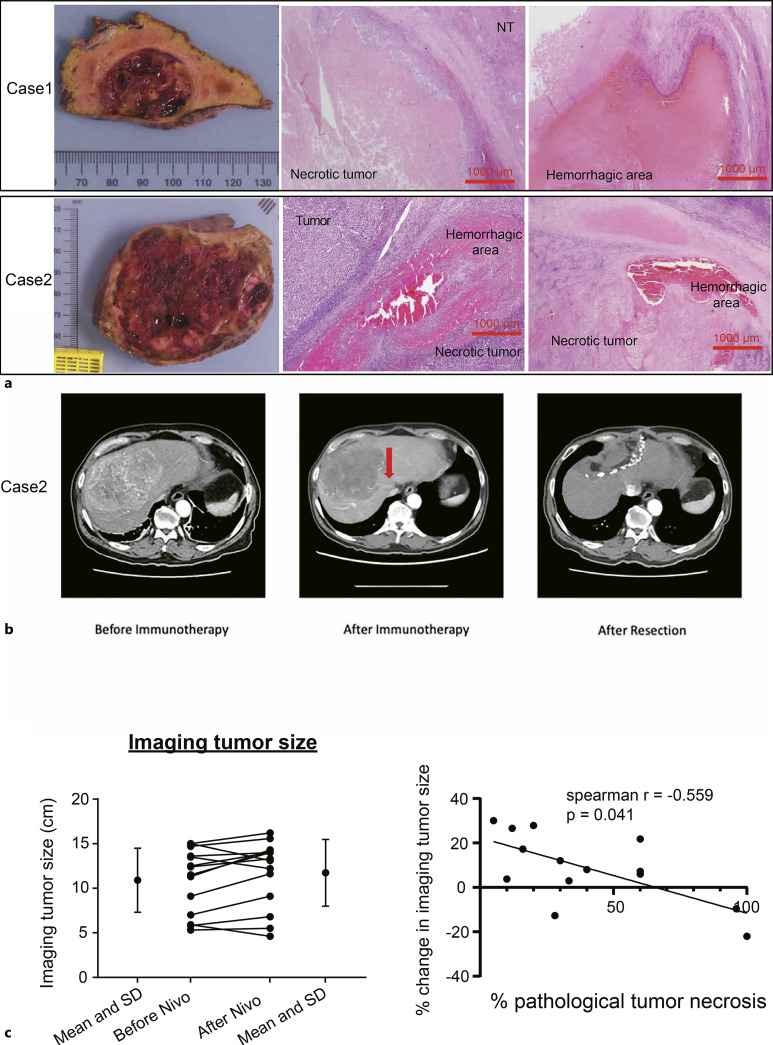
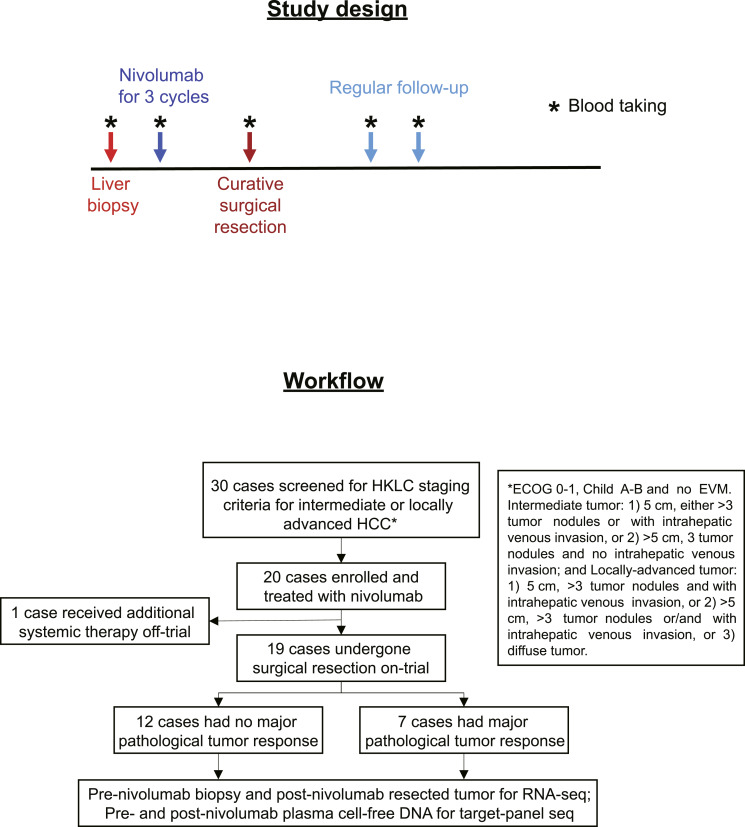
Results: Between July 2020 and November 2021, 20 treatment-naive HCC patients with intermediate and locally advanced tumors received preoperative nivolumab at 3 mg/kg for 3 cycles prior to surgical resection. Nineteen patients underwent surgical resection on trial. Seven (36.8%) of the 19 patients had major pathologic tumor necrosis (≥60%) in the post-nivolumab resection specimens, with 3 having almost complete (>90%) tumor necrosis. The tumor necrosis was hemorrhagic and often accompanied by increased or dense immune cell infiltrate at the border of the tumors. None of the patients developed major adverse reactions contradicting hepatectomy. RNA-sequencing analysis on both pre-nivolumab tumor biopsies and post-nivolumab resected specimens showed that, in cases with major pathologic necrosis, the proportion of CD8 T cells in the HCC tissues predominantly increased after treatment. Moreover, to investigate noninvasive biomarker for nivolumab response, we evaluated the copy number variation (CNV) using target-panel sequencing on plasma cell-free DNA of the patients and derived a CNV-based anti-PD-1 score. The score correlated with the extent of tumor necrosis and was validated in a Korean patient cohort with anti-PD-1 treatment.
Conclusion: Neoadjuvant nivolumab demonstrated promising clinical activity in intermediate and locally advanced HCC patients. We also identified useful noninvasive biomarker predicting responsiveness.
期刊介绍:
Physical Review B (PRB) is the world’s largest dedicated physics journal, publishing approximately 100 new, high-quality papers each week. The most highly cited journal in condensed matter physics, PRB provides outstanding depth and breadth of coverage, combined with unrivaled context and background for ongoing research by scientists worldwide.
PRB covers the full range of condensed matter, materials physics, and related subfields, including:
-Structure and phase transitions
-Ferroelectrics and multiferroics
-Disordered systems and alloys
-Magnetism
-Superconductivity
-Electronic structure, photonics, and metamaterials
-Semiconductors and mesoscopic systems
-Surfaces, nanoscience, and two-dimensional materials
-Topological states of matter




 京公网安备 11010802042870号
京ICP备2023020795号-1
京公网安备 11010802042870号
京ICP备2023020795号-1

 分享
分享
 求助内容:
求助内容: 应助结果提醒方式:
 扫码关注我们
