{"title":"Abdominal Closure With Reinforcing Suture Decreases Incisional Hernia Incidence After CRS/HIPEC.","authors":"Charlotta Wenzelberg, Ulf Petersson, Ingvar Syk, Olle Ekberg, Peder Rogmark","doi":"10.3389/jaws.2023.11188","DOIUrl":null,"url":null,"abstract":"<p><p><b>Background:</b> Cytoreductive surgery (CRS) and hyperthermic intraperitoneal chemotherapy (HIPEC) entails several risk factors for incisional hernia (IH). A few reports available showing incidences between 7% and 17%. At our institution fascia closure has been performed in a 4:1 suture to wound length manner, with a continuous 2-0 polydiaxanone suture (PDS-group) or with a 2-0 polypropylene suture preceded by a reinforced tension line (RTL) suture (RTL-group). Our hypothesis was that these patients might benefit from reinforcing the suture line with a lower IH incidence in this group. The aim was to evaluate the 1-year IH-incidence of the two different closures. <b>Methods:</b> Patients eligible for inclusion were treated with CRS/HIPEC between 2004 and 2019. IH was diagnosed by scrutinizing CT-scans 1 year ±3 months after surgery. Additional data was retrieved from clinical records and a prospective CRS/HIPEC-database. <b>Results:</b> Of 193 patients, 129 were included, 82 in the PDS- and 47 in the RTL-group. RTL-patients were 5 years younger, had less blood loss and more frequent postoperative neutropenia. No difference regarding sex, BMI, recent midline incisions, excision of midline scars, peritoneal cancer index score, complications (≥Clavien-Dindo 3b), or chemotherapy. Ten IH (7.8%) were found, 9 (11%) in the PDS- and 1 (2.1%) in the RTL-group (<i>p</i> = 0.071). <b>Conclusion:</b> An IH incidence of 7.8% in patients undergoing CRS/HIPEC is not higher than after laparotomies in general. The IH incidence in the PDS-group was 11% compared to 2% in the RTL-group. Even though significance was not reached, the difference is clinically relevant, suggesting an advantage with RTL suture.</p>","PeriodicalId":18930,"journal":{"name":"Monthly Notices of the Royal Astronomical Society","volume":"380 1","pages":"11188"},"PeriodicalIF":4.8000,"publicationDate":"2023-03-09","publicationTypes":"Journal Article","fieldsOfStudy":null,"isOpenAccess":false,"openAccessPdf":"https://www.ncbi.nlm.nih.gov/pmc/articles/PMC10831658/pdf/","citationCount":"0","resultStr":null,"platform":"Semanticscholar","paperid":null,"PeriodicalName":"Monthly Notices of the Royal Astronomical Society","FirstCategoryId":"1085","ListUrlMain":"https://doi.org/10.3389/jaws.2023.11188","RegionNum":3,"RegionCategory":"物理与天体物理","ArticlePicture":[],"TitleCN":null,"AbstractTextCN":null,"PMCID":null,"EPubDate":"2023/1/1 0:00:00","PubModel":"eCollection","JCR":"Q1","JCRName":"ASTRONOMY & ASTROPHYSICS","Score":null,"Total":0}
引用次数: 0
Abstract
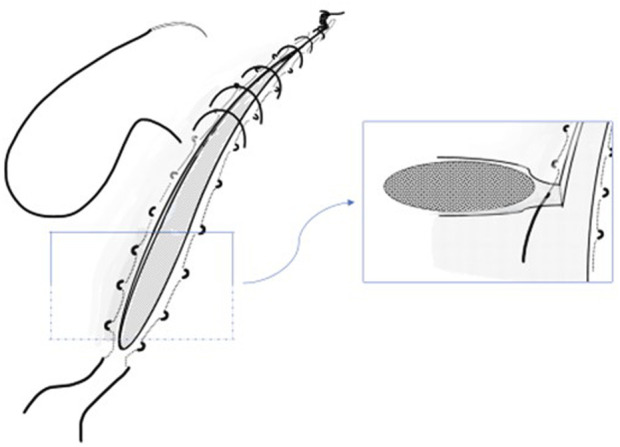
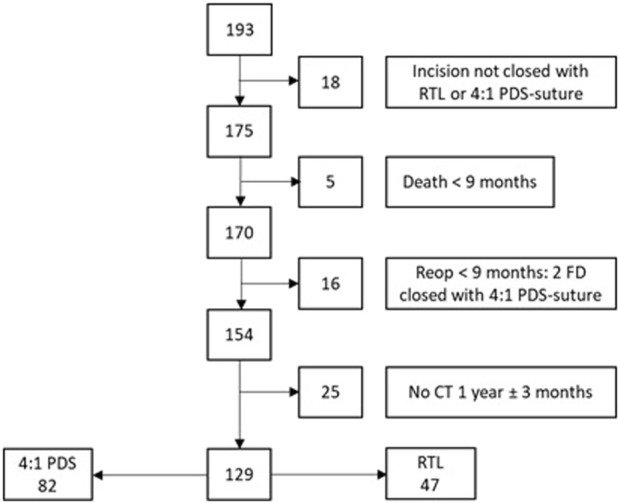
Background: Cytoreductive surgery (CRS) and hyperthermic intraperitoneal chemotherapy (HIPEC) entails several risk factors for incisional hernia (IH). A few reports available showing incidences between 7% and 17%. At our institution fascia closure has been performed in a 4:1 suture to wound length manner, with a continuous 2-0 polydiaxanone suture (PDS-group) or with a 2-0 polypropylene suture preceded by a reinforced tension line (RTL) suture (RTL-group). Our hypothesis was that these patients might benefit from reinforcing the suture line with a lower IH incidence in this group. The aim was to evaluate the 1-year IH-incidence of the two different closures. Methods: Patients eligible for inclusion were treated with CRS/HIPEC between 2004 and 2019. IH was diagnosed by scrutinizing CT-scans 1 year ±3 months after surgery. Additional data was retrieved from clinical records and a prospective CRS/HIPEC-database. Results: Of 193 patients, 129 were included, 82 in the PDS- and 47 in the RTL-group. RTL-patients were 5 years younger, had less blood loss and more frequent postoperative neutropenia. No difference regarding sex, BMI, recent midline incisions, excision of midline scars, peritoneal cancer index score, complications (≥Clavien-Dindo 3b), or chemotherapy. Ten IH (7.8%) were found, 9 (11%) in the PDS- and 1 (2.1%) in the RTL-group (p = 0.071). Conclusion: An IH incidence of 7.8% in patients undergoing CRS/HIPEC is not higher than after laparotomies in general. The IH incidence in the PDS-group was 11% compared to 2% in the RTL-group. Even though significance was not reached, the difference is clinically relevant, suggesting an advantage with RTL suture.
期刊介绍:
Monthly Notices of the Royal Astronomical Society is one of the world''s leading primary research journals in astronomy and astrophysics, as well as one of the longest established. It publishes the results of original research in positional and dynamical astronomy, astrophysics, radio astronomy, cosmology, space research and the design of astronomical instruments.



 京公网安备 11010802042870号
京ICP备2023020795号-1
京公网安备 11010802042870号
京ICP备2023020795号-1

 分享
分享
 求助内容:
求助内容: 应助结果提醒方式:
 扫码关注我们
