Mindfulness-based therapy for insomnia alleviates insomnia, depression, and cognitive arousal in treatment-resistant insomnia: A single-arm telemedicine trial.
David A Kalmbach, Philip Cheng, Jason C Ong, Anthony N Reffi, David M Fresco, Cynthia Fellman-Couture, Melissa K Ruprich, Zain Sultan, Chaewon Sagong, Christopher L Drake
{"title":"Mindfulness-based therapy for insomnia alleviates insomnia, depression, and cognitive arousal in treatment-resistant insomnia: A single-arm telemedicine trial.","authors":"David A Kalmbach, Philip Cheng, Jason C Ong, Anthony N Reffi, David M Fresco, Cynthia Fellman-Couture, Melissa K Ruprich, Zain Sultan, Chaewon Sagong, Christopher L Drake","doi":"10.3389/frsle.2023.1072752","DOIUrl":null,"url":null,"abstract":"<p><strong>Objectives: </strong>Cognitive-behavioral therapy and pharmacotherapy are effective insomnia treatments, yet half of patients do not remit. Emerging evidence indicates refractory cognitive arousal is associated with poor insomnia treatment outcomes, giving rise to the concept that therapeutic approaches directly aimed at reducing cognitive arousal may benefit patients with a history of inadequate response to intervention. This proof-of-concept study examined the effects of mindfulness-based therapy for insomnia (MBTI) delivered individually <i>via</i> telemedicine on insomnia, depression, and cognitive arousal in patients with treatment-resistant insomnia.</p><p><strong>Methods: </strong>A single-arm trial wherein 19 patients whose insomnia did not remit with prior psychotherapy and/or pharmacotherapy received a course of MBTI as second-stage therapy, which included eight weekly 1-h sessions in an individual format <i>via</i> telemedicine video. Study outcomes included the 15-item version of the five-facet mindfulness questionnaire (FFMQ-15), insomnia severity index (ISI), Patient Health Questionnaire-9 to assess depression (PHQ-9), and three cognitive arousal indices: pre-sleep arousal scale's cognitive factor, perseverative thinking questionnaire, and the daytime insomnia symptom response scale.</p><p><strong>Results: </strong>Patients reported increased mindfulness from pretreatment to posttreatment (FFMQ-15: 52.95 ± 8.30 to 57.47 ± 9.82, <i>p</i> = 0.008). Patients also reported large reductions in ISI (16.42 ± 3.95 to 8.37 ± 4.19, <i>p</i> < 0.001, Cohen's dz = 1.73; 57.9% remission), PHQ-9 (6.42 ± 3.47 to 3.32 ± 2.93, <i>p</i> = 0.001, Cohen's dz = 0.93), and all cognitive arousal indices (Cohen's dzs = 0.82-1.30) at posttreatment. Six months later, ISI scores and cognitive arousal levels remained significantly lower than pretreatment, although effect sizes decreased for ISI (Cohen's dz = 1.11) and cognitive arousal (Cohen's dzs = 0.63-0.68). Antidepressant effects were no longer significant at follow-up.</p><p><strong>Conclusion: </strong>Treatment-resistant insomnia patients are engaged in MBTI, which produces large acute reductions in insomnia, depression, and cognitive arousal. MBTI effects on insomnia and cognitive arousal were moderate to large 6 months after treatment. These findings support the concept and feasibility of MBTI for treatment-resistant patients along with indication that longer-term strategies are needed to help maintain acute treatment gains.</p><p><strong>Clinical trial registration: </strong>ClinicalTrials.gov, identifier NCT03724305.</p>","PeriodicalId":73106,"journal":{"name":"Frontiers in sleep","volume":"99 1","pages":"1072752"},"PeriodicalIF":0.0000,"publicationDate":"2023-03-08","publicationTypes":"Journal Article","fieldsOfStudy":null,"isOpenAccess":false,"openAccessPdf":"https://www.ncbi.nlm.nih.gov/pmc/articles/PMC12713880/pdf/","citationCount":"0","resultStr":null,"platform":"Semanticscholar","paperid":null,"PeriodicalName":"Frontiers in sleep","FirstCategoryId":"1085","ListUrlMain":"https://doi.org/10.3389/frsle.2023.1072752","RegionNum":0,"RegionCategory":null,"ArticlePicture":[],"TitleCN":null,"AbstractTextCN":null,"PMCID":null,"EPubDate":"2023/1/1 0:00:00","PubModel":"eCollection","JCR":"","JCRName":"","Score":null,"Total":0}
引用次数: 0
Abstract
Objectives: Cognitive-behavioral therapy and pharmacotherapy are effective insomnia treatments, yet half of patients do not remit. Emerging evidence indicates refractory cognitive arousal is associated with poor insomnia treatment outcomes, giving rise to the concept that therapeutic approaches directly aimed at reducing cognitive arousal may benefit patients with a history of inadequate response to intervention. This proof-of-concept study examined the effects of mindfulness-based therapy for insomnia (MBTI) delivered individually via telemedicine on insomnia, depression, and cognitive arousal in patients with treatment-resistant insomnia.
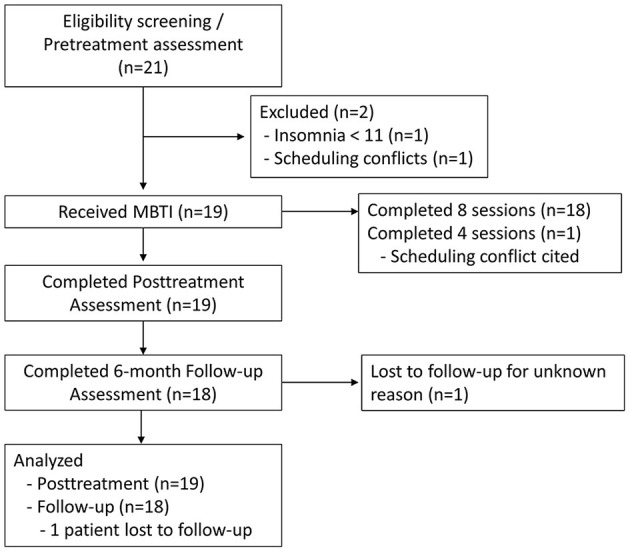
Methods: A single-arm trial wherein 19 patients whose insomnia did not remit with prior psychotherapy and/or pharmacotherapy received a course of MBTI as second-stage therapy, which included eight weekly 1-h sessions in an individual format via telemedicine video. Study outcomes included the 15-item version of the five-facet mindfulness questionnaire (FFMQ-15), insomnia severity index (ISI), Patient Health Questionnaire-9 to assess depression (PHQ-9), and three cognitive arousal indices: pre-sleep arousal scale's cognitive factor, perseverative thinking questionnaire, and the daytime insomnia symptom response scale.
Results: Patients reported increased mindfulness from pretreatment to posttreatment (FFMQ-15: 52.95 ± 8.30 to 57.47 ± 9.82, p = 0.008). Patients also reported large reductions in ISI (16.42 ± 3.95 to 8.37 ± 4.19, p < 0.001, Cohen's dz = 1.73; 57.9% remission), PHQ-9 (6.42 ± 3.47 to 3.32 ± 2.93, p = 0.001, Cohen's dz = 0.93), and all cognitive arousal indices (Cohen's dzs = 0.82-1.30) at posttreatment. Six months later, ISI scores and cognitive arousal levels remained significantly lower than pretreatment, although effect sizes decreased for ISI (Cohen's dz = 1.11) and cognitive arousal (Cohen's dzs = 0.63-0.68). Antidepressant effects were no longer significant at follow-up.
Conclusion: Treatment-resistant insomnia patients are engaged in MBTI, which produces large acute reductions in insomnia, depression, and cognitive arousal. MBTI effects on insomnia and cognitive arousal were moderate to large 6 months after treatment. These findings support the concept and feasibility of MBTI for treatment-resistant patients along with indication that longer-term strategies are needed to help maintain acute treatment gains.



 京公网安备 11010802042870号
京ICP备2023020795号-1
京公网安备 11010802042870号
京ICP备2023020795号-1

 分享
分享

 求助内容:
求助内容: 应助结果提醒方式:
 扫码关注我们
