Georg Fahland, Marco Atzori, Annika Frede, Alexander Stroh, Bettina Frohnapfel, Davide Gatti
{"title":"Drag Assessment for Boundary Layer Control Schemes with Mass Injection","authors":"Georg Fahland, Marco Atzori, Annika Frede, Alexander Stroh, Bettina Frohnapfel, Davide Gatti","doi":"10.1007/s10494-023-00462-x","DOIUrl":null,"url":null,"abstract":"<div><p>The present study considers uniform blowing in turbulent boundary layers as active flow control scheme for drag reduction on airfoils. The focus lies on the important question of how to quantify the drag reduction potential of this control scheme correctly. It is demonstrated that mass injection causes the <i>body drag</i> (the drag resulting from the stresses on the body) to differ from the <i>wake survey drag</i> (the momentum deficit in the wake of an airfoil), which is classically used in experiments as a surrogate for the former. This difference is related to the <i>boundary layer control (BLC) penalty</i>, an unavoidable drag portion which reflects the effort of a mass-injecting boundary layer control scheme. This is independent of how the control is implemented. With an integral momentum budget, we show that for the present control scheme, the wake survey drag contains the BLC penalty and is thus a measure for the <i>inclusive drag</i> of the airfoil, i.e. the one required to determine net drag reduction. The concept of the inclusive drag is extended also to boundary layers using the von Kàrmàn equation. This means that with mass injection the friction drag only is not sufficient to assess drag reduction also in canonical flows. Large Eddy Simulations and Reynolds-averaged Navier–Stokes simulations of the flow around airfoils are utilized to demonstrate the significance of this distinction for the scheme of uniform blowing. When the inclusive drag is properly accounted for, control scenarios previously considered to yield drag reduction actually show drag increase.</p></div>","PeriodicalId":559,"journal":{"name":"Flow, Turbulence and Combustion","volume":"113 1","pages":"119 - 138"},"PeriodicalIF":2.4000,"publicationDate":"2023-08-15","publicationTypes":"Journal Article","fieldsOfStudy":null,"isOpenAccess":false,"openAccessPdf":"https://link.springer.com/content/pdf/10.1007/s10494-023-00462-x.pdf","citationCount":"0","resultStr":null,"platform":"Semanticscholar","paperid":null,"PeriodicalName":"Flow, Turbulence and Combustion","FirstCategoryId":"5","ListUrlMain":"https://link.springer.com/article/10.1007/s10494-023-00462-x","RegionNum":3,"RegionCategory":"工程技术","ArticlePicture":[],"TitleCN":null,"AbstractTextCN":null,"PMCID":null,"EPubDate":"","PubModel":"","JCR":"Q3","JCRName":"MECHANICS","Score":null,"Total":0}
引用次数: 0
Abstract
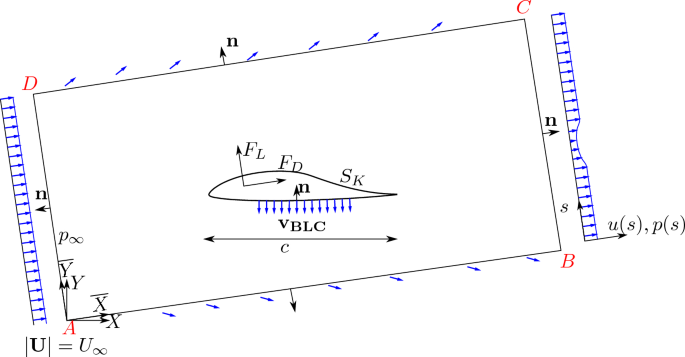
The present study considers uniform blowing in turbulent boundary layers as active flow control scheme for drag reduction on airfoils. The focus lies on the important question of how to quantify the drag reduction potential of this control scheme correctly. It is demonstrated that mass injection causes the body drag (the drag resulting from the stresses on the body) to differ from the wake survey drag (the momentum deficit in the wake of an airfoil), which is classically used in experiments as a surrogate for the former. This difference is related to the boundary layer control (BLC) penalty, an unavoidable drag portion which reflects the effort of a mass-injecting boundary layer control scheme. This is independent of how the control is implemented. With an integral momentum budget, we show that for the present control scheme, the wake survey drag contains the BLC penalty and is thus a measure for the inclusive drag of the airfoil, i.e. the one required to determine net drag reduction. The concept of the inclusive drag is extended also to boundary layers using the von Kàrmàn equation. This means that with mass injection the friction drag only is not sufficient to assess drag reduction also in canonical flows. Large Eddy Simulations and Reynolds-averaged Navier–Stokes simulations of the flow around airfoils are utilized to demonstrate the significance of this distinction for the scheme of uniform blowing. When the inclusive drag is properly accounted for, control scenarios previously considered to yield drag reduction actually show drag increase.
期刊介绍:
Flow, Turbulence and Combustion provides a global forum for the publication of original and innovative research results that contribute to the solution of fundamental and applied problems encountered in single-phase, multi-phase and reacting flows, in both idealized and real systems. The scope of coverage encompasses topics in fluid dynamics, scalar transport, multi-physics interactions and flow control. From time to time the journal publishes Special or Theme Issues featuring invited articles.
Contributions may report research that falls within the broad spectrum of analytical, computational and experimental methods. This includes research conducted in academia, industry and a variety of environmental and geophysical sectors. Turbulence, transition and associated phenomena are expected to play a significant role in the majority of studies reported, although non-turbulent flows, typical of those in micro-devices, would be regarded as falling within the scope covered. The emphasis is on originality, timeliness, quality and thematic fit, as exemplified by the title of the journal and the qualifications described above. Relevance to real-world problems and industrial applications are regarded as strengths.