Guiping Gong, Bo Wu, Linpei Liu, Jianting Li, Qili Zhu, Mingxiong He, Guoquan Hu
{"title":"Metabolic engineering using acetate as a promising building block for the production of bio-based chemicals.","authors":"Guiping Gong, Bo Wu, Linpei Liu, Jianting Li, Qili Zhu, Mingxiong He, Guoquan Hu","doi":"10.1016/j.engmic.2022.100036","DOIUrl":null,"url":null,"abstract":"<p><p>The production of biofuels and biochemicals derived from microbial fermentation has received a lot of attention and interest in light of concerns about the depletion of fossil fuel resources and climatic degeneration. However, the economic viability of feedstocks for biological conversion remains a barrier, urging researchers to develop renewable and sustainable low-cost carbon sources for future bioindustries. Owing to the numerous advantages, acetate has been regarded as a promising feedstock targeting the production of acetyl-CoA-derived chemicals. This review aims to highlight the potential of acetate as a building block in industrial biotechnology for the production of bio-based chemicals with metabolic engineering. Different alternative approaches and routes comprised of lignocellulosic biomass, waste streams, and C1 gas for acetate generation are briefly described and evaluated. Then, a thorough explanation of the metabolic pathway for biotechnological acetate conversion, cellular transport, and toxin tolerance is described. Particularly, current developments in metabolic engineering of the manufacture of biochemicals from acetate are summarized in detail, with various microbial cell factories and strategies proposed to improve acetate assimilation and enhance product formation. Challenges and future development for acetate generation and assimilation as well as chemicals production from acetate is eventually shown. This review provides an overview of the current status of acetate utilization and proves the great potential of acetate with metabolic engineering in industrial biotechnology.</p>","PeriodicalId":100478,"journal":{"name":"Engineering Microbiology","volume":"153 1","pages":"100036"},"PeriodicalIF":0.0000,"publicationDate":"2022-07-26","publicationTypes":"Journal Article","fieldsOfStudy":null,"isOpenAccess":false,"openAccessPdf":"https://www.ncbi.nlm.nih.gov/pmc/articles/PMC11610983/pdf/","citationCount":"0","resultStr":null,"platform":"Semanticscholar","paperid":null,"PeriodicalName":"Engineering Microbiology","FirstCategoryId":"1085","ListUrlMain":"https://doi.org/10.1016/j.engmic.2022.100036","RegionNum":0,"RegionCategory":null,"ArticlePicture":[],"TitleCN":null,"AbstractTextCN":null,"PMCID":null,"EPubDate":"2022/12/1 0:00:00","PubModel":"eCollection","JCR":"","JCRName":"","Score":null,"Total":0}
引用次数: 0
Abstract
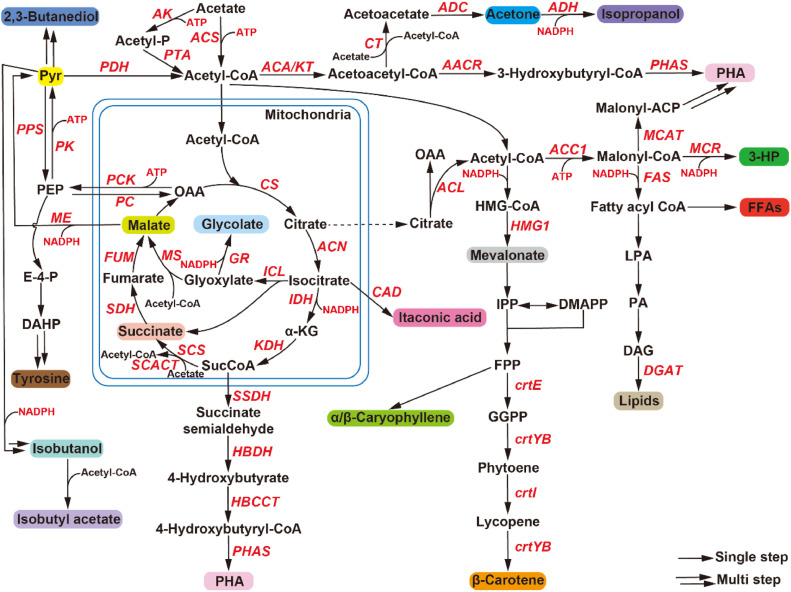
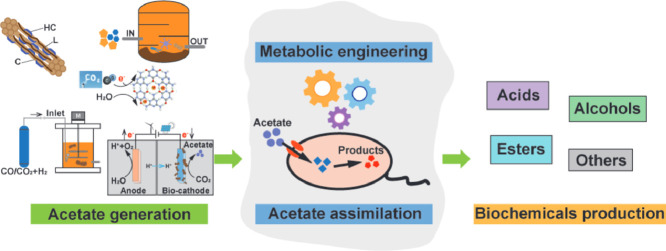
The production of biofuels and biochemicals derived from microbial fermentation has received a lot of attention and interest in light of concerns about the depletion of fossil fuel resources and climatic degeneration. However, the economic viability of feedstocks for biological conversion remains a barrier, urging researchers to develop renewable and sustainable low-cost carbon sources for future bioindustries. Owing to the numerous advantages, acetate has been regarded as a promising feedstock targeting the production of acetyl-CoA-derived chemicals. This review aims to highlight the potential of acetate as a building block in industrial biotechnology for the production of bio-based chemicals with metabolic engineering. Different alternative approaches and routes comprised of lignocellulosic biomass, waste streams, and C1 gas for acetate generation are briefly described and evaluated. Then, a thorough explanation of the metabolic pathway for biotechnological acetate conversion, cellular transport, and toxin tolerance is described. Particularly, current developments in metabolic engineering of the manufacture of biochemicals from acetate are summarized in detail, with various microbial cell factories and strategies proposed to improve acetate assimilation and enhance product formation. Challenges and future development for acetate generation and assimilation as well as chemicals production from acetate is eventually shown. This review provides an overview of the current status of acetate utilization and proves the great potential of acetate with metabolic engineering in industrial biotechnology.




 京公网安备 11010802042870号
京ICP备2023020795号-1
京公网安备 11010802042870号
京ICP备2023020795号-1

 分享
分享

 求助内容:
求助内容: 应助结果提醒方式:
 扫码关注我们
