{"title":"<i>Lactiplantibacillus plantarum</i> 06CC2 upregulates intestinal ZO-1 protein and bile acid metabolism in Balb/c mice fed high-fat diet.","authors":"Masao Yamasaki, Yuko Miyamoto, Kenjirou Ogawa, Kazuo Nishiyama, Chuluunbat Tsend-Ayush, Yiran Li, Tatsuya Matsusaki, Tomoki Nakano, Masahiko Takeshita, Yuo Arima","doi":"10.12938/bmfh.2023-002","DOIUrl":null,"url":null,"abstract":"<p><p>The effects of <i>Lactiplantibacillus plantarum</i> 06CC2 (LP06CC2), which was isolated from a Mongolian dairy product, on lipid metabolism and intestinal tight junction-related proteins in Balb/c mice fed a high-fat diet (HFD) were evaluated. The mice were fed the HFD for eight weeks, and the plasma and hepatic lipid parameters, as well as the intestinal tight junction-related factors, were evaluated. LP06CC2 slightly reduced the adipose tissue mass. Further, it dose-dependently decreased plasma total cholesterol (TC). The HFD tended to increase the plasma level of endotoxin and suppressed intestinal ZO-1 expression, whereas a low LP06CC2 dose increased ZO-1 expression and tended to reduce the plasma lipopolysaccharide level. Furthermore, a low LP06CC2 dose facilitated a moderate accumulation of Lactobacillales, a significant decrease in <i>Clostridium</i> cluste<i>r</i> IV, and an increase in <i>Clostridium</i> cluster XVIII. The results obtained from analyzing the bile acids (BAs) in feces and cecum contents exhibited a decreasing trend for secondary and conjugated BAs in the low LP06CC2-dose group. Moreover, a high LP06CC2 dose caused excess accumulation of Lactobacillales and failed to increase intestinal ZO-1 and occludin expression, while the fecal butyrate level increased dose dependently in the LP06CC2-fed mice. Finally, an appropriate LP06CC2 dose protected the intestinal barrier function from the HFD and modulated BA metabolism.</p>","PeriodicalId":12760,"journal":{"name":"Gland surgery","volume":"8 2 1","pages":"13-22"},"PeriodicalIF":1.6000,"publicationDate":"2024-01-01","publicationTypes":"Journal Article","fieldsOfStudy":null,"isOpenAccess":false,"openAccessPdf":"https://www.ncbi.nlm.nih.gov/pmc/articles/PMC10767321/pdf/","citationCount":"0","resultStr":null,"platform":"Semanticscholar","paperid":null,"PeriodicalName":"Gland surgery","FirstCategoryId":"3","ListUrlMain":"https://doi.org/10.12938/bmfh.2023-002","RegionNum":3,"RegionCategory":"医学","ArticlePicture":[],"TitleCN":null,"AbstractTextCN":null,"PMCID":null,"EPubDate":"2023/7/31 0:00:00","PubModel":"Epub","JCR":"Q3","JCRName":"SURGERY","Score":null,"Total":0}
引用次数: 0
Abstract
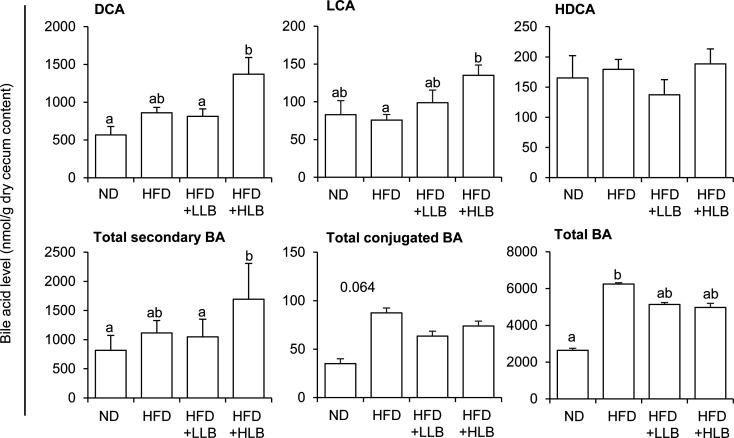
The effects of Lactiplantibacillus plantarum 06CC2 (LP06CC2), which was isolated from a Mongolian dairy product, on lipid metabolism and intestinal tight junction-related proteins in Balb/c mice fed a high-fat diet (HFD) were evaluated. The mice were fed the HFD for eight weeks, and the plasma and hepatic lipid parameters, as well as the intestinal tight junction-related factors, were evaluated. LP06CC2 slightly reduced the adipose tissue mass. Further, it dose-dependently decreased plasma total cholesterol (TC). The HFD tended to increase the plasma level of endotoxin and suppressed intestinal ZO-1 expression, whereas a low LP06CC2 dose increased ZO-1 expression and tended to reduce the plasma lipopolysaccharide level. Furthermore, a low LP06CC2 dose facilitated a moderate accumulation of Lactobacillales, a significant decrease in Clostridium cluster IV, and an increase in Clostridium cluster XVIII. The results obtained from analyzing the bile acids (BAs) in feces and cecum contents exhibited a decreasing trend for secondary and conjugated BAs in the low LP06CC2-dose group. Moreover, a high LP06CC2 dose caused excess accumulation of Lactobacillales and failed to increase intestinal ZO-1 and occludin expression, while the fecal butyrate level increased dose dependently in the LP06CC2-fed mice. Finally, an appropriate LP06CC2 dose protected the intestinal barrier function from the HFD and modulated BA metabolism.
期刊介绍:
Gland Surgery (Gland Surg; GS, Print ISSN 2227-684X; Online ISSN 2227-8575) being indexed by PubMed/PubMed Central, is an open access, peer-review journal launched at May of 2012, published bio-monthly since February 2015.





 京公网安备 11010802042870号
京ICP备2023020795号-1
京公网安备 11010802042870号
京ICP备2023020795号-1

 分享
分享
 求助内容:
求助内容: 应助结果提醒方式:
 扫码关注我们
