Mackenzie Buchanan , Christopher Spence MD , Michelle Keir MD, MSc , Michael Khoury MD
{"title":"Physical Activity Promotion Among Individuals With Tetralogy of Fallot","authors":"Mackenzie Buchanan , Christopher Spence MD , Michelle Keir MD, MSc , Michael Khoury MD","doi":"10.1016/j.cjcpc.2023.08.002","DOIUrl":null,"url":null,"abstract":"<div><p>In the general population, the most cited barriers to physical activity (PA) are time, energy, and motivation. Consequently, despite the significant contribution of PA to health and well-being, many individuals are insufficiently active. Physical inactivity and sedentary lifestyles increase the risk of acquired cardiometabolic disease, a risk that may complicate and is compounded by the anatomic and physiologic features inherent in the patient with repaired tetralogy of Fallot (ToF). Individuals with ToF commonly present with reduced exercise capacity and PA levels. In light of historically PA restrictive management of their heart disease, known reductions in exercise capacity among individuals with ToF are combined with psychosocial barriers to their participation, potentially establishing a cycle of further detraining, inactivity, and disease progression/health decline. To this end, children and young adults with ToF are known to have reduced self-efficacy towards PA, defined as their confidence in their ability to participate. In this review, we apply self-efficacy as an overarching mediator of PA participation and explore trends and determinants of PA participation among individuals with ToF and its subsequent impact on exercise capacity, disease risk, and health-related quality of life. We outline the rationale and strategies aimed at improving PA in children and adults with ToF and highlight current knowledge gaps and future directions in the promotion of PA in the population with ToF.</p></div>","PeriodicalId":100249,"journal":{"name":"CJC Pediatric and Congenital Heart Disease","volume":"2 6","pages":"Pages 322-334"},"PeriodicalIF":0.0000,"publicationDate":"2023-12-01","publicationTypes":"Journal Article","fieldsOfStudy":null,"isOpenAccess":false,"openAccessPdf":"https://www.sciencedirect.com/science/article/pii/S2772812923001215/pdfft?md5=f1ec1a52d32b06e1ab4f2b597017bb95&pid=1-s2.0-S2772812923001215-main.pdf","citationCount":"1","resultStr":null,"platform":"Semanticscholar","paperid":null,"PeriodicalName":"CJC Pediatric and Congenital Heart Disease","FirstCategoryId":"1085","ListUrlMain":"https://www.sciencedirect.com/science/article/pii/S2772812923001215","RegionNum":0,"RegionCategory":null,"ArticlePicture":[],"TitleCN":null,"AbstractTextCN":null,"PMCID":null,"EPubDate":"","PubModel":"","JCR":"","JCRName":"","Score":null,"Total":0}
引用次数: 1
Abstract
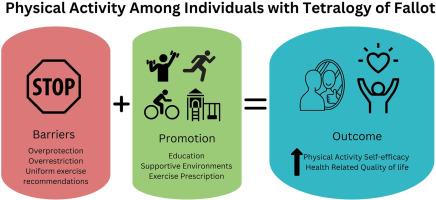
In the general population, the most cited barriers to physical activity (PA) are time, energy, and motivation. Consequently, despite the significant contribution of PA to health and well-being, many individuals are insufficiently active. Physical inactivity and sedentary lifestyles increase the risk of acquired cardiometabolic disease, a risk that may complicate and is compounded by the anatomic and physiologic features inherent in the patient with repaired tetralogy of Fallot (ToF). Individuals with ToF commonly present with reduced exercise capacity and PA levels. In light of historically PA restrictive management of their heart disease, known reductions in exercise capacity among individuals with ToF are combined with psychosocial barriers to their participation, potentially establishing a cycle of further detraining, inactivity, and disease progression/health decline. To this end, children and young adults with ToF are known to have reduced self-efficacy towards PA, defined as their confidence in their ability to participate. In this review, we apply self-efficacy as an overarching mediator of PA participation and explore trends and determinants of PA participation among individuals with ToF and its subsequent impact on exercise capacity, disease risk, and health-related quality of life. We outline the rationale and strategies aimed at improving PA in children and adults with ToF and highlight current knowledge gaps and future directions in the promotion of PA in the population with ToF.



 京公网安备 11010802042870号
京ICP备2023020795号-1
京公网安备 11010802042870号
京ICP备2023020795号-1

 分享
分享

 求助内容:
求助内容: 应助结果提醒方式:
 扫码关注我们
