Pablo Viveros, Marco Espinoza, Rodrigo Mena, Fredy Kristjanpoller
{"title":"Extended Framework for Preventive Maintenance Planning: Risk and Behaviour Analysis of a Proposed Optimization Model","authors":"Pablo Viveros, Marco Espinoza, Rodrigo Mena, Fredy Kristjanpoller","doi":"10.1155/2023/2701439","DOIUrl":null,"url":null,"abstract":"<div>\n <p>The considerable increase in the complexity associated with the formulation of maintenance plans has enabled the development of new techniques to bring maintenance scheduling optimization models to more realistic environments. In this sense, a previous optimization model was proposed considering the use of time windows for the formation of grouping schemes under an opportunistic strategy for maintenance activities considering non-negligible execution times, thus offering the possibility of analysing scenarios with limited resources. This article proposes a risk analysis based on the failure probability of each component involved in the maintenance scheduling optimization model, which has the particularity of enabling a greater number of combinations of grouped PM activities. Moreover, it seeks to identify the general behaviour of the optimization model against different scenarios of periodicities and execution times of each maintenance activity. The proposed optimization model is formulated under a mixed integer linear programming (MILP) paradigm and its objective function seeks to minimize the unavailability of the system associated with the execution times of the activities developed, generating different experimental cases, and varying the start time scheduling under a tolerance factor from 0% up to a maximum of 25% for advance or delay. Results show in contrast with the base optimization model, an 8% less unavailability when the tolerance factor is 10%. Finally, it was possible to quantify the risk present in each maintenance schedule, at the same time a behaviour towards advancing PM activities is evidenced by the optimization model proposed over the delay.</p>\n </div>","PeriodicalId":50653,"journal":{"name":"Complexity","volume":"2023 1","pages":""},"PeriodicalIF":1.7000,"publicationDate":"2023-02-08","publicationTypes":"Journal Article","fieldsOfStudy":null,"isOpenAccess":false,"openAccessPdf":"https://onlinelibrary.wiley.com/doi/epdf/10.1155/2023/2701439","citationCount":"0","resultStr":null,"platform":"Semanticscholar","paperid":null,"PeriodicalName":"Complexity","FirstCategoryId":"5","ListUrlMain":"https://onlinelibrary.wiley.com/doi/10.1155/2023/2701439","RegionNum":4,"RegionCategory":"工程技术","ArticlePicture":[],"TitleCN":null,"AbstractTextCN":null,"PMCID":null,"EPubDate":"","PubModel":"","JCR":"Q2","JCRName":"MATHEMATICS, INTERDISCIPLINARY APPLICATIONS","Score":null,"Total":0}
引用次数: 0
Abstract
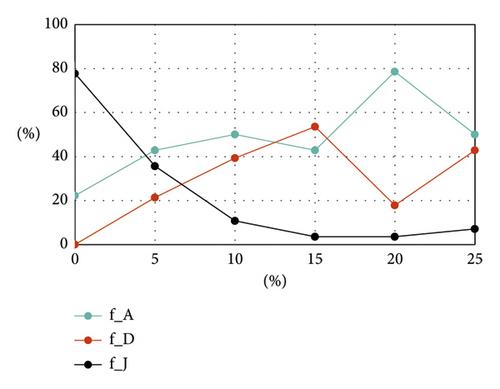
The considerable increase in the complexity associated with the formulation of maintenance plans has enabled the development of new techniques to bring maintenance scheduling optimization models to more realistic environments. In this sense, a previous optimization model was proposed considering the use of time windows for the formation of grouping schemes under an opportunistic strategy for maintenance activities considering non-negligible execution times, thus offering the possibility of analysing scenarios with limited resources. This article proposes a risk analysis based on the failure probability of each component involved in the maintenance scheduling optimization model, which has the particularity of enabling a greater number of combinations of grouped PM activities. Moreover, it seeks to identify the general behaviour of the optimization model against different scenarios of periodicities and execution times of each maintenance activity. The proposed optimization model is formulated under a mixed integer linear programming (MILP) paradigm and its objective function seeks to minimize the unavailability of the system associated with the execution times of the activities developed, generating different experimental cases, and varying the start time scheduling under a tolerance factor from 0% up to a maximum of 25% for advance or delay. Results show in contrast with the base optimization model, an 8% less unavailability when the tolerance factor is 10%. Finally, it was possible to quantify the risk present in each maintenance schedule, at the same time a behaviour towards advancing PM activities is evidenced by the optimization model proposed over the delay.
期刊介绍:
Complexity is a cross-disciplinary journal focusing on the rapidly expanding science of complex adaptive systems. The purpose of the journal is to advance the science of complexity. Articles may deal with such methodological themes as chaos, genetic algorithms, cellular automata, neural networks, and evolutionary game theory. Papers treating applications in any area of natural science or human endeavor are welcome, and especially encouraged are papers integrating conceptual themes and applications that cross traditional disciplinary boundaries. Complexity is not meant to serve as a forum for speculation and vague analogies between words like “chaos,” “self-organization,” and “emergence” that are often used in completely different ways in science and in daily life.




 京公网安备 11010802042870号
京ICP备2023020795号-1
京公网安备 11010802042870号
京ICP备2023020795号-1

 分享
分享
 求助内容:
求助内容: 应助结果提醒方式:
 扫码关注我们
