Juliana A Duarte, Jaisa Q de Araújo E Silva, André A Goldani, Raffael Massuda, Clarissa S Gama
{"title":"Neurobiological underpinnings of bipolar disorder focusing on findings of diffusion tensor imaging: a systematic review.","authors":"Juliana A Duarte, Jaisa Q de Araújo E Silva, André A Goldani, Raffael Massuda, Clarissa S Gama","doi":"10.1590/1516-4446-2015-1793","DOIUrl":null,"url":null,"abstract":"<p><strong>Objective: </strong>To review the available data on diffusion tensor imaging (DTI) of subjects with bipolar disorder (BD), with a particular focus on fractional anisotropy (FA) in white matter (WM) tracts.</p><p><strong>Methods: </strong>The PubMed/MEDLINE database was searched for relevant articles, which were included in a systematic review of the literature. FA reductions and WM abnormalities were divided anatomically into three groups: commissural tracts, association tracts, and projection tracts.</p><p><strong>Results: </strong>Eighteen studies met the inclusion criteria. The corpus callosum was the main impaired commissural tract as demonstrated by FA reductions. Five studies reported FA reductions in the cingulum. Two studies reported decreased FA in the anterior thalamic radiation, and one in the corticospinal tract. Conversely, three studies found increased FA values in WM tracts involved in BD pathophysiology.</p><p><strong>Conclusion: </strong>Despite considerable heterogeneity, these results indicate a direct link between executive cognitive functioning and abnormal WM microstructural integrity of fronto-limbic tracts in patients with remitted BD, providing further evidence of the neuronal disruption that underlies BD symptomatology.</p>","PeriodicalId":21123,"journal":{"name":"Retrovirology","volume":"8 1","pages":"167-75"},"PeriodicalIF":3.9000,"publicationDate":"2016-03-22","publicationTypes":"Journal Article","fieldsOfStudy":null,"isOpenAccess":false,"openAccessPdf":"https://www.ncbi.nlm.nih.gov/pmc/articles/PMC7111360/pdf/","citationCount":"0","resultStr":null,"platform":"Semanticscholar","paperid":null,"PeriodicalName":"Retrovirology","FirstCategoryId":"3","ListUrlMain":"https://doi.org/10.1590/1516-4446-2015-1793","RegionNum":3,"RegionCategory":"医学","ArticlePicture":[],"TitleCN":null,"AbstractTextCN":null,"PMCID":null,"EPubDate":"","PubModel":"","JCR":"Q3","JCRName":"VIROLOGY","Score":null,"Total":0}
引用次数: 0
Abstract
Objective: To review the available data on diffusion tensor imaging (DTI) of subjects with bipolar disorder (BD), with a particular focus on fractional anisotropy (FA) in white matter (WM) tracts.
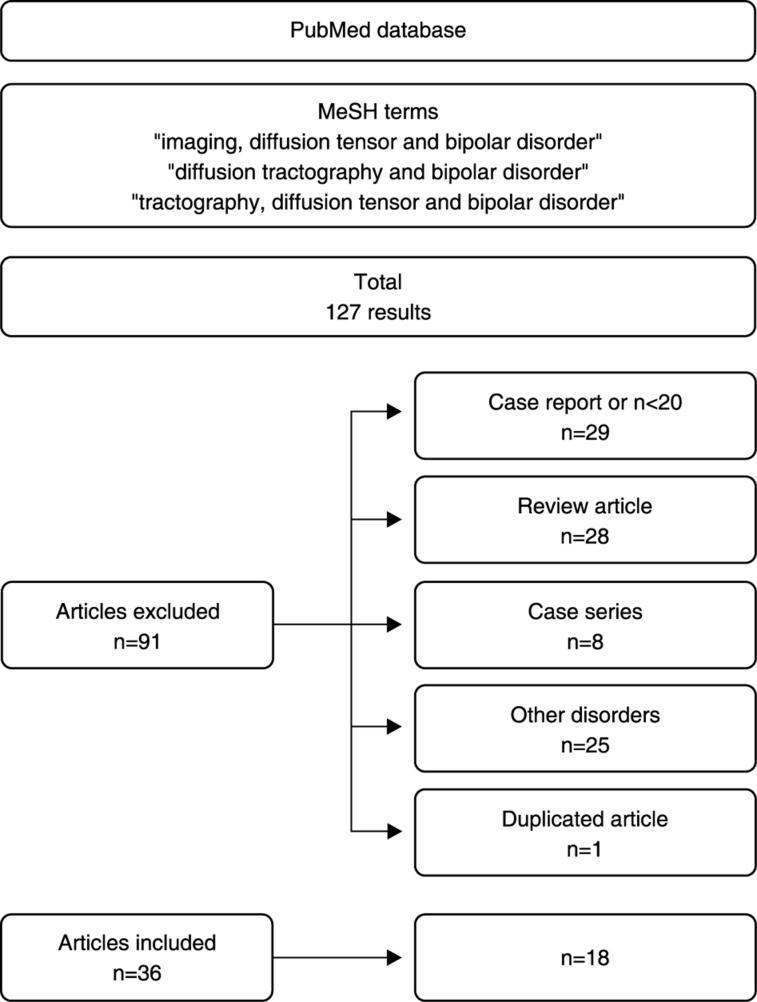
Methods: The PubMed/MEDLINE database was searched for relevant articles, which were included in a systematic review of the literature. FA reductions and WM abnormalities were divided anatomically into three groups: commissural tracts, association tracts, and projection tracts.
Results: Eighteen studies met the inclusion criteria. The corpus callosum was the main impaired commissural tract as demonstrated by FA reductions. Five studies reported FA reductions in the cingulum. Two studies reported decreased FA in the anterior thalamic radiation, and one in the corticospinal tract. Conversely, three studies found increased FA values in WM tracts involved in BD pathophysiology.
Conclusion: Despite considerable heterogeneity, these results indicate a direct link between executive cognitive functioning and abnormal WM microstructural integrity of fronto-limbic tracts in patients with remitted BD, providing further evidence of the neuronal disruption that underlies BD symptomatology.
期刊介绍:
Retrovirology is an open access, online journal that publishes stringently peer-reviewed, high-impact articles on host-pathogen interactions, fundamental mechanisms of replication, immune defenses, animal models, and clinical science relating to retroviruses. Retroviruses are pleiotropically found in animals. Well-described examples include avian, murine and primate retroviruses.
Two human retroviruses are especially important pathogens. These are the human immunodeficiency virus, HIV, and the human T-cell leukemia virus, HTLV. HIV causes AIDS while HTLV-1 is the etiological agent for adult T-cell leukemia and HTLV-1-associated myelopathy/tropical spastic paraparesis. Retrovirology aims to cover comprehensively all aspects of human and animal retrovirus research.




 京公网安备 11010802042870号
京ICP备2023020795号-1
京公网安备 11010802042870号
京ICP备2023020795号-1

 分享
分享
 求助内容:
求助内容: 应助结果提醒方式:
 扫码关注我们
