M Magyar, P Akhtar, G Sipka, W Han, X Li, G Han, J-R Shen, P H Lambrev, G Garab
{"title":"Dependence of the rate-limiting steps in the dark-to-light transition of photosystem II on the lipidic environment of the reaction center.","authors":"M Magyar, P Akhtar, G Sipka, W Han, X Li, G Han, J-R Shen, P H Lambrev, G Garab","doi":"10.32615/ps.2022.016","DOIUrl":null,"url":null,"abstract":"<p><p>In our earlier works, we have identified rate-limiting steps in the dark-to-light transition of PSII. By measuring chlorophyll <i>a</i> fluorescence transients elicited by single-turnover saturating flashes (STSFs) we have shown that in diuron-treated samples an STSF generates only F<sub>1</sub> (< F<sub>m</sub>) fluorescence level, and to produce the maximum (F<sub>m</sub>) level, additional excitations are required, which, however, can only be effective if sufficiently long Δ<i>τ</i> waiting times are allowed between the excitations. Biological variations in the half-rise time (Δ<i>τ</i> <sub>1/2</sub>) of the fluorescence increment suggest that it may be sensitive to the physicochemical environment of PSII. Here, we investigated the influence of the lipidic environment on Δ<i>τ</i> <sub>1/2</sub> of PSII core complexes of <i>Thermosynechococcus vulcanus</i>. We found that while non-native lipids had no noticeable effects, thylakoid membrane lipids considerably shortened the Δ<i>τ</i> <sub>1/2</sub>, from ~ 1 ms to ~ 0.2 ms. The importance of the presence of native lipids was confirmed by obtaining similarly short Δ<i>τ</i> <sub>1/2</sub> values in the whole <i>T. vulcanus</i> cells and isolated pea thylakoid membranes. Minor, lipid-dependent reorganizations were also observed by steady-state and time-resolved spectroscopic measurements. These data show that the processes beyond the dark-to-light transition of PSII depend significantly on the lipid matrix of the reaction center.</p>","PeriodicalId":20157,"journal":{"name":"Photosynthetica","volume":"13 1","pages":"147-156"},"PeriodicalIF":1.6000,"publicationDate":"2022-03-14","publicationTypes":"Journal Article","fieldsOfStudy":null,"isOpenAccess":false,"openAccessPdf":"https://www.ncbi.nlm.nih.gov/pmc/articles/PMC11559480/pdf/","citationCount":"0","resultStr":null,"platform":"Semanticscholar","paperid":null,"PeriodicalName":"Photosynthetica","FirstCategoryId":"99","ListUrlMain":"https://doi.org/10.32615/ps.2022.016","RegionNum":4,"RegionCategory":"生物学","ArticlePicture":[],"TitleCN":null,"AbstractTextCN":null,"PMCID":null,"EPubDate":"2022/1/1 0:00:00","PubModel":"eCollection","JCR":"Q2","JCRName":"PLANT SCIENCES","Score":null,"Total":0}
引用次数: 0
Abstract
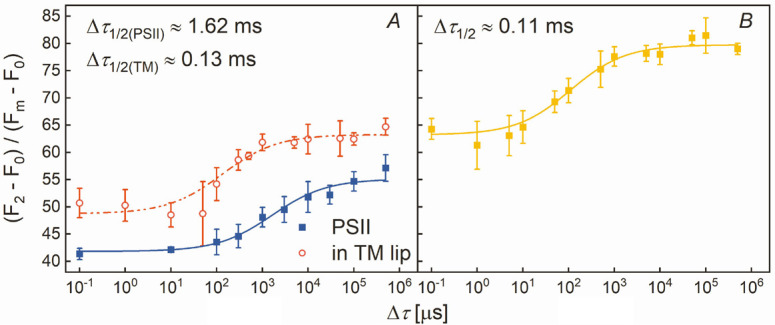
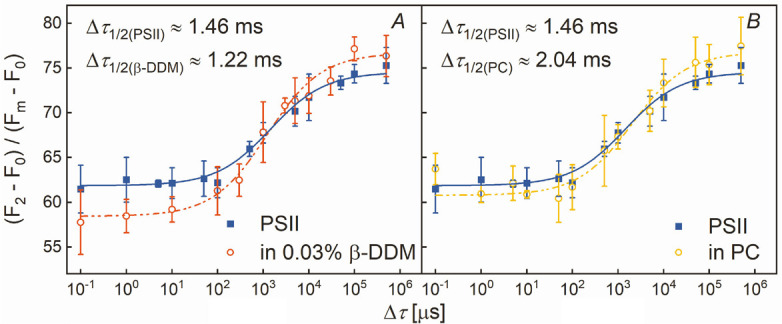
In our earlier works, we have identified rate-limiting steps in the dark-to-light transition of PSII. By measuring chlorophyll a fluorescence transients elicited by single-turnover saturating flashes (STSFs) we have shown that in diuron-treated samples an STSF generates only F1 (< Fm) fluorescence level, and to produce the maximum (Fm) level, additional excitations are required, which, however, can only be effective if sufficiently long Δτ waiting times are allowed between the excitations. Biological variations in the half-rise time (Δτ1/2) of the fluorescence increment suggest that it may be sensitive to the physicochemical environment of PSII. Here, we investigated the influence of the lipidic environment on Δτ1/2 of PSII core complexes of Thermosynechococcus vulcanus. We found that while non-native lipids had no noticeable effects, thylakoid membrane lipids considerably shortened the Δτ1/2, from ~ 1 ms to ~ 0.2 ms. The importance of the presence of native lipids was confirmed by obtaining similarly short Δτ1/2 values in the whole T. vulcanus cells and isolated pea thylakoid membranes. Minor, lipid-dependent reorganizations were also observed by steady-state and time-resolved spectroscopic measurements. These data show that the processes beyond the dark-to-light transition of PSII depend significantly on the lipid matrix of the reaction center.
期刊介绍:
Photosynthetica publishes original scientific papers and brief communications, reviews on specialized topics, book reviews and announcements and reports covering wide range of photosynthesis research or research including photosynthetic parameters of both experimental and theoretical nature and dealing with physiology, biophysics, biochemistry, molecular biology on one side and leaf optics, stress physiology and ecology of photosynthesis on the other side.
The language of journal is English (British or American). Papers should not be published or under consideration for publication elsewhere.




 京公网安备 11010802042870号
京ICP备2023020795号-1
京公网安备 11010802042870号
京ICP备2023020795号-1

 分享
分享
 求助内容:
求助内容: 应助结果提醒方式:
 扫码关注我们
