{"title":"Are multiple types of associative memory differently impacted by emotion?","authors":"Emilie de Montpellier, Deborah Talmi","doi":"10.1080/02699931.2023.2279182","DOIUrl":null,"url":null,"abstract":"<p><p>The effect of emotion on associative memory is still an open question. Our aim was to test whether discrepant findings are due to differential impact of emotion on different types of associative memory or to differences in the way participants encoded stimuli across studies. We examined the effect of negative content on multiple forms of associative memory, using the same encoding task. Two registered experiments were conducted in parallel with random allocation of participants to experiments. Each experiment included 4 encoding blocks, in which participants read a neutral text comprised of 6 paragraphs, which were interleaved with neutral or negative images. Images were controlled for visual properties and semantic similarity. Memory tests included recognition memory, Remember/Know, order memory, temporal source memory and contextual memory. Analyses showed that emotion decreased contextual memory but not order memory or temporal source memory. We also found that temporal source memory and contextual memory were correlated. Recognition accuracy and subjective recollection were not impacted by emotion. In agreement with previous work, participants self-reported a reduced ability to integrate blocks containing negative images with paragraphs. In contrast to our hypothesis, results suggest that emotion does not impact all types of associative memory when stimuli are controlled.</p>","PeriodicalId":48412,"journal":{"name":"Cognition & Emotion","volume":" ","pages":"156-179"},"PeriodicalIF":2.2000,"publicationDate":"2025-02-01","publicationTypes":"Journal Article","fieldsOfStudy":null,"isOpenAccess":false,"openAccessPdf":"https://www.ncbi.nlm.nih.gov/pmc/articles/PMC11875440/pdf/","citationCount":"0","resultStr":null,"platform":"Semanticscholar","paperid":null,"PeriodicalName":"Cognition & Emotion","FirstCategoryId":"102","ListUrlMain":"https://doi.org/10.1080/02699931.2023.2279182","RegionNum":3,"RegionCategory":"心理学","ArticlePicture":[],"TitleCN":null,"AbstractTextCN":null,"PMCID":null,"EPubDate":"2023/11/13 0:00:00","PubModel":"Epub","JCR":"Q2","JCRName":"PSYCHOLOGY, EXPERIMENTAL","Score":null,"Total":0}
引用次数: 0
Abstract
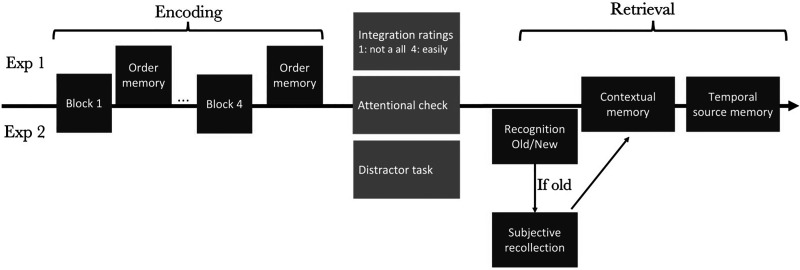
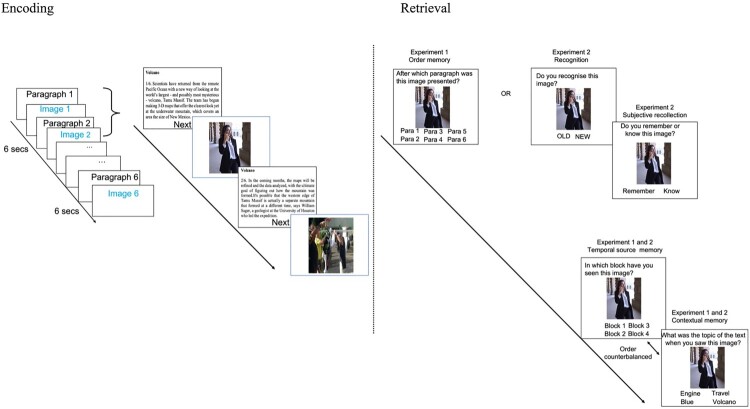
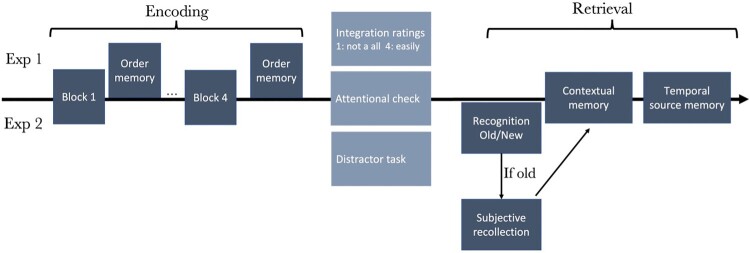
The effect of emotion on associative memory is still an open question. Our aim was to test whether discrepant findings are due to differential impact of emotion on different types of associative memory or to differences in the way participants encoded stimuli across studies. We examined the effect of negative content on multiple forms of associative memory, using the same encoding task. Two registered experiments were conducted in parallel with random allocation of participants to experiments. Each experiment included 4 encoding blocks, in which participants read a neutral text comprised of 6 paragraphs, which were interleaved with neutral or negative images. Images were controlled for visual properties and semantic similarity. Memory tests included recognition memory, Remember/Know, order memory, temporal source memory and contextual memory. Analyses showed that emotion decreased contextual memory but not order memory or temporal source memory. We also found that temporal source memory and contextual memory were correlated. Recognition accuracy and subjective recollection were not impacted by emotion. In agreement with previous work, participants self-reported a reduced ability to integrate blocks containing negative images with paragraphs. In contrast to our hypothesis, results suggest that emotion does not impact all types of associative memory when stimuli are controlled.
期刊介绍:
Cognition & Emotion is devoted to the study of emotion, especially to those aspects of emotion related to cognitive processes. The journal aims to bring together work on emotion undertaken by researchers in cognitive, social, clinical, and developmental psychology, neuropsychology, and cognitive science. Examples of topics appropriate for the journal include the role of cognitive processes in emotion elicitation, regulation, and expression; the impact of emotion on attention, memory, learning, motivation, judgements, and decisions.




 京公网安备 11010802042870号
京ICP备2023020795号-1
京公网安备 11010802042870号
京ICP备2023020795号-1

 分享
分享
 求助内容:
求助内容: 应助结果提醒方式:
 扫码关注我们
