Association between opioid prescription profiles and adverse health outcomes in opioid users referred for sleep disorder assessment: a secondary analysis of health administrative data.
Tetyana Kendzerska, Atul Malhotra, Andrea S Gershon, Marcus Povitz, Daniel I McIsaac, Shawn D Aaron, Gregory L Bryson, Robert Talarico, Michael Godbout, Peter Tanuseputro, Frances Chung
{"title":"Association between opioid prescription profiles and adverse health outcomes in opioid users referred for sleep disorder assessment: a secondary analysis of health administrative data.","authors":"Tetyana Kendzerska, Atul Malhotra, Andrea S Gershon, Marcus Povitz, Daniel I McIsaac, Shawn D Aaron, Gregory L Bryson, Robert Talarico, Michael Godbout, Peter Tanuseputro, Frances Chung","doi":"10.3389/frsle.2023.1161857","DOIUrl":null,"url":null,"abstract":"<p><strong>Background: </strong>Information is needed to guide safe opioid prescribing in adults referred for a sleep disorder assessment. Previous studies have shown that individuals referred for a sleep disorder assessment have a higher likelihood of long-acting opioids and higher opioid dosages prescription than the general population, suggesting that these individuals are more at risk for opioid-related adverse health consequences.</p><p><strong>Methods: </strong>We included all adults who underwent a diagnostic sleep study (index date) in Ontario, Canada, between 2013 and 2016 (<i>n</i> = 300,663) and filled an opioid prescription overlapping the index date (<i>n</i> = 15,713). Through provincial health administrative databases, individuals were followed over time to assess the association between opioid use characteristics and 1-year all-cause mortality, hospitalizations and emergency department (ED) visits, and opioid-related hospitalizations and ED visits within extended follow-up to 2018.</p><p><strong>Results: </strong>Controlling for covariates, chronic opioid use (vs. not) was significantly associated with increased hazards of all-cause mortality [adjusted hazard ratio(aHR): 1.84; 95% confidence interval (CI): 1.12-3.02], hospitalization (aHR: 1.14; 95% CI: 1.02-1.28) and ED visit (aHR: 1.09; 95% CI: 1.01-1.17). A higher opioid dosage [morphine equivalent daily dose (MED) >90 vs. ≤ 90 mg/day] was significantly associated with increased hazards of all-cause or opioid-related hospitalization (aHR: 1.13; 95% CI: 1.02-1.26 and aHR: 2.27; 95% CI: 1.53-3.37, respectively). Morphine or hydromorphone prescription (vs. oxycodone) was significantly associated with an increased hazard of all-cause hospitalization (aHR: 1.30; 1.07-1.59 and aHR: 1.43; 95% CI: 1.20-1.70, respectively). Hydromorphone or fentanyl prescription (vs. oxycodone) was significantly associated with an increased hazard of opioid-related ED visit and/or hospitalization (aHR: 2.28, 95% CI: 1.16-4.47 and aHR: 2.47, 95% CI: 1.16-5.26, respectively).</p><p><strong>Conclusion: </strong>Findings from this retrospective study may inform the safe prescribing of opioids in adults referred for a sleep disorder assessment.</p>","PeriodicalId":73106,"journal":{"name":"Frontiers in sleep","volume":"4 1","pages":"1161857"},"PeriodicalIF":0.0000,"publicationDate":"2023-07-07","publicationTypes":"Journal Article","fieldsOfStudy":null,"isOpenAccess":false,"openAccessPdf":"https://www.ncbi.nlm.nih.gov/pmc/articles/PMC12713942/pdf/","citationCount":"0","resultStr":null,"platform":"Semanticscholar","paperid":null,"PeriodicalName":"Frontiers in sleep","FirstCategoryId":"1085","ListUrlMain":"https://doi.org/10.3389/frsle.2023.1161857","RegionNum":0,"RegionCategory":null,"ArticlePicture":[],"TitleCN":null,"AbstractTextCN":null,"PMCID":null,"EPubDate":"2023/1/1 0:00:00","PubModel":"eCollection","JCR":"","JCRName":"","Score":null,"Total":0}
引用次数: 0
Abstract
Background: Information is needed to guide safe opioid prescribing in adults referred for a sleep disorder assessment. Previous studies have shown that individuals referred for a sleep disorder assessment have a higher likelihood of long-acting opioids and higher opioid dosages prescription than the general population, suggesting that these individuals are more at risk for opioid-related adverse health consequences.
Methods: We included all adults who underwent a diagnostic sleep study (index date) in Ontario, Canada, between 2013 and 2016 (n = 300,663) and filled an opioid prescription overlapping the index date (n = 15,713). Through provincial health administrative databases, individuals were followed over time to assess the association between opioid use characteristics and 1-year all-cause mortality, hospitalizations and emergency department (ED) visits, and opioid-related hospitalizations and ED visits within extended follow-up to 2018.
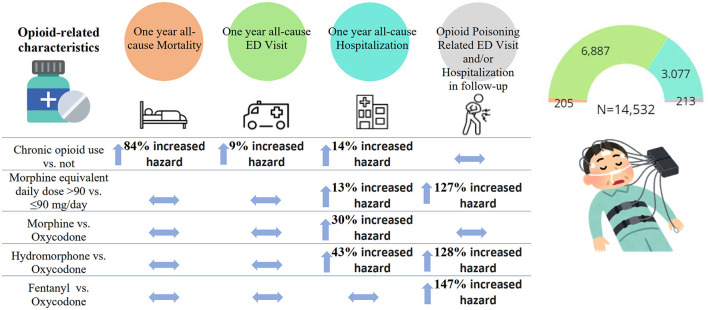
Results: Controlling for covariates, chronic opioid use (vs. not) was significantly associated with increased hazards of all-cause mortality [adjusted hazard ratio(aHR): 1.84; 95% confidence interval (CI): 1.12-3.02], hospitalization (aHR: 1.14; 95% CI: 1.02-1.28) and ED visit (aHR: 1.09; 95% CI: 1.01-1.17). A higher opioid dosage [morphine equivalent daily dose (MED) >90 vs. ≤ 90 mg/day] was significantly associated with increased hazards of all-cause or opioid-related hospitalization (aHR: 1.13; 95% CI: 1.02-1.26 and aHR: 2.27; 95% CI: 1.53-3.37, respectively). Morphine or hydromorphone prescription (vs. oxycodone) was significantly associated with an increased hazard of all-cause hospitalization (aHR: 1.30; 1.07-1.59 and aHR: 1.43; 95% CI: 1.20-1.70, respectively). Hydromorphone or fentanyl prescription (vs. oxycodone) was significantly associated with an increased hazard of opioid-related ED visit and/or hospitalization (aHR: 2.28, 95% CI: 1.16-4.47 and aHR: 2.47, 95% CI: 1.16-5.26, respectively).
Conclusion: Findings from this retrospective study may inform the safe prescribing of opioids in adults referred for a sleep disorder assessment.




 京公网安备 11010802042870号
京ICP备2023020795号-1
京公网安备 11010802042870号
京ICP备2023020795号-1

 分享
分享

 求助内容:
求助内容: 应助结果提醒方式:
 扫码关注我们
