The Harbin Medical University nephrectomy score: a quantitative system for evaluating the complexity of laparoscopic retroperitoneal simple nephrectomy.
Yiwen Liu, Chunyang Wang, Xiuhai Wu, Linglong Kong, Shaobin Ni
{"title":"The Harbin Medical University nephrectomy score: a quantitative system for evaluating the complexity of laparoscopic retroperitoneal simple nephrectomy.","authors":"Yiwen Liu, Chunyang Wang, Xiuhai Wu, Linglong Kong, Shaobin Ni","doi":"10.1590/S1677-5538.IBJU.2018.0634","DOIUrl":null,"url":null,"abstract":"<p><strong>Background: </strong>Laparoscopic retroperitoneal simple nephrectomy (LRSN) has been widely accepted as a mainstay option for benign non-functioning kidney. The complexity of the procedure, however, differs and remains a subject of controversy.</p><p><strong>Objective: </strong>To develop a standardised Harbin Medical University nephrectomy score (HMUNS) system for evaluating LRSN complexity.</p><p><strong>Subjects and methods: </strong>A total of 6 variables with different factors comprising primary diseases, history of upper urinary tract surgery, body mass index (BMI), surgeon's learning curve, kidney volume, and Mayo Adhesive Probability (MAP) scores were included in the HMUN score. 95 consecutive patients who underwent LRSN at our institution were divided into low (2 to 6 points) and high (7 to 17 points) complexity groups with HMUNS and investigated the differences of operative time (OT), estimated blood loss (EBL), postoperative hospitalisation time (PHT), rate of intraoperative conversion to open surgery, and the Clavien-Dindo classifi cation (CDC) between both groups.</p><p><strong>Results: </strong>Longer mean operative times (193.2±69.3 min vs. 151.9±46.3 min, p <0.05), more median estimated blood loss (100.0mL vs. 50.0mL, p <0.05), and higher rates of conversion to open surgery (1.2% vs. 25%, p <0.05) were observed in the high-complexity group (n=12) than in the low-complexity group (n=83). However, there were no remarkable differences between the two groups related to the baseline characteristics, post-surgical hospitalisation times, and postoperative complications.</p><p><strong>Conclusions: </strong>The HMUNS can effectively reflect LRSN complexity, thus providing a quantitative system for risk estimation and treatment decisions. Because of some limitations, further well-designed studies are necessary to confirm our fi ndings. Patient summary: The HMUNS, including primary diseases, history of upper urinary tract surgery, BMI, surgeon's learning curve, kidney volume, and MAP score, can provide an effective quantitative tool to evaluate the complexity of LRSN.</p>","PeriodicalId":45399,"journal":{"name":"MODERN LANGUAGE REVIEW","volume":"64 1","pages":"1144-1152"},"PeriodicalIF":0.1000,"publicationDate":"2019-11-01","publicationTypes":"Journal Article","fieldsOfStudy":null,"isOpenAccess":false,"openAccessPdf":"https://www.ncbi.nlm.nih.gov/pmc/articles/PMC6909875/pdf/","citationCount":"0","resultStr":null,"platform":"Semanticscholar","paperid":null,"PeriodicalName":"MODERN LANGUAGE REVIEW","FirstCategoryId":"1085","ListUrlMain":"https://doi.org/10.1590/S1677-5538.IBJU.2018.0634","RegionNum":4,"RegionCategory":"文学","ArticlePicture":[],"TitleCN":null,"AbstractTextCN":null,"PMCID":null,"EPubDate":"","PubModel":"","JCR":"0","JCRName":"LANGUAGE & LINGUISTICS","Score":null,"Total":0}
引用次数: 0
Abstract
Background: Laparoscopic retroperitoneal simple nephrectomy (LRSN) has been widely accepted as a mainstay option for benign non-functioning kidney. The complexity of the procedure, however, differs and remains a subject of controversy.
Objective: To develop a standardised Harbin Medical University nephrectomy score (HMUNS) system for evaluating LRSN complexity.
Subjects and methods: A total of 6 variables with different factors comprising primary diseases, history of upper urinary tract surgery, body mass index (BMI), surgeon's learning curve, kidney volume, and Mayo Adhesive Probability (MAP) scores were included in the HMUN score. 95 consecutive patients who underwent LRSN at our institution were divided into low (2 to 6 points) and high (7 to 17 points) complexity groups with HMUNS and investigated the differences of operative time (OT), estimated blood loss (EBL), postoperative hospitalisation time (PHT), rate of intraoperative conversion to open surgery, and the Clavien-Dindo classifi cation (CDC) between both groups.
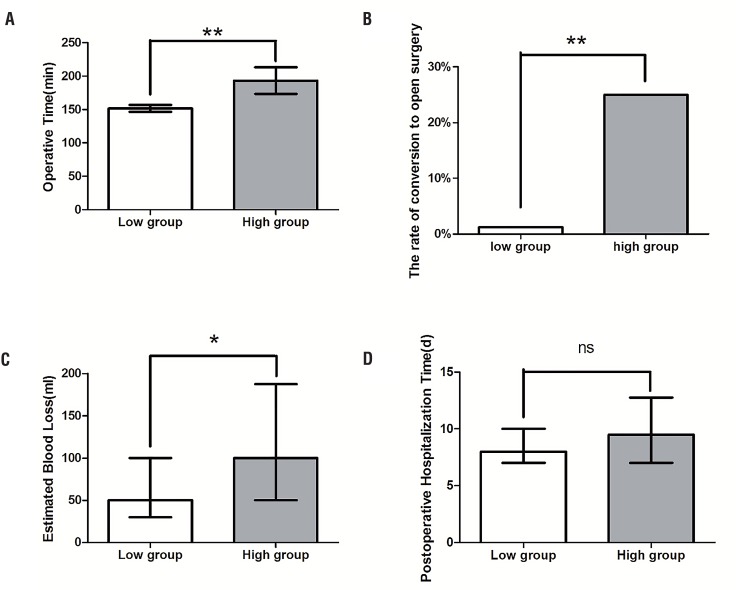
Results: Longer mean operative times (193.2±69.3 min vs. 151.9±46.3 min, p <0.05), more median estimated blood loss (100.0mL vs. 50.0mL, p <0.05), and higher rates of conversion to open surgery (1.2% vs. 25%, p <0.05) were observed in the high-complexity group (n=12) than in the low-complexity group (n=83). However, there were no remarkable differences between the two groups related to the baseline characteristics, post-surgical hospitalisation times, and postoperative complications.
Conclusions: The HMUNS can effectively reflect LRSN complexity, thus providing a quantitative system for risk estimation and treatment decisions. Because of some limitations, further well-designed studies are necessary to confirm our fi ndings. Patient summary: The HMUNS, including primary diseases, history of upper urinary tract surgery, BMI, surgeon's learning curve, kidney volume, and MAP score, can provide an effective quantitative tool to evaluate the complexity of LRSN.
期刊介绍:
With an unbroken publication record since 1905, its 1248 pages are divided between articles, predominantly on medieval and modern literature, in the languages of continental Europe, together with English (including the United States and the Commonwealth), Francophone Africa and Canada, and Latin America. In addition, MLR reviews over five hundred books each year The MLR Supplement The Modern Language Review was founded in 1905 and has included well over 3,000 articles and some 20,000 book reviews. This supplement to Volume 100 is published by the Modern Humanities Research Association in celebration of the centenary of its flagship journal.




 京公网安备 11010802042870号
京ICP备2023020795号-1
京公网安备 11010802042870号
京ICP备2023020795号-1

 分享
分享
 求助内容:
求助内容: 应助结果提醒方式:
 扫码关注我们
