R A Voloshin, S M Shumilova, E V Zadneprovskaya, S K Zharmukhamedov, S Alwasel, H J M Hou, S I Allakhverdiev
{"title":"Photosystem II in bio-photovoltaic devices.","authors":"R A Voloshin, S M Shumilova, E V Zadneprovskaya, S K Zharmukhamedov, S Alwasel, H J M Hou, S I Allakhverdiev","doi":"10.32615/ps.2022.010","DOIUrl":null,"url":null,"abstract":"<p><p>Hybrid photoelectrodes containing biological pigment-protein complexes can be used for environmentally friendly solar energy conversion, herbicide detection, and other applications. The total number of scientific publications on hybrid bio-based devices has grown rapidly over the past decades. Particular attention is paid to the integration of the complexes of PSII into photoelectrochemical devices. A notable feature of these complexes from a practical point of view is their ability to obtain electrons from abundant water. The utilization or imitation of the PSII functionality seems promising for all of the following: generating photoelectricity, photo-producing hydrogen, and detecting herbicides. This review summarizes recent advances in the development of hybrid devices based on PSII. In a brief historical review, we also highlighted the use of quinone-type bacterial reaction centers in hybrid devices. These proteins are the first from which the photoelectricity signal was detected. The photocurrent in these first systems, developed in the 70s-80s, was about 1 nA cm<sup>-2</sup>. In the latest work, by Güzel <i>et al</i>. (2020), a stable current of about 888 μA cm<sup>-2</sup> as achieved in a PSII-based solar cell. The present review is inspired by this impressive progress. The advantages, disadvantages, and future endeavors of PSII-inspired bio-photovoltaic devices are also presented.</p>","PeriodicalId":20157,"journal":{"name":"Photosynthetica","volume":"22 1","pages":"121-135"},"PeriodicalIF":1.6000,"publicationDate":"2022-03-07","publicationTypes":"Journal Article","fieldsOfStudy":null,"isOpenAccess":false,"openAccessPdf":"https://www.ncbi.nlm.nih.gov/pmc/articles/PMC11559483/pdf/","citationCount":"0","resultStr":null,"platform":"Semanticscholar","paperid":null,"PeriodicalName":"Photosynthetica","FirstCategoryId":"99","ListUrlMain":"https://doi.org/10.32615/ps.2022.010","RegionNum":4,"RegionCategory":"生物学","ArticlePicture":[],"TitleCN":null,"AbstractTextCN":null,"PMCID":null,"EPubDate":"2022/1/1 0:00:00","PubModel":"eCollection","JCR":"Q2","JCRName":"PLANT SCIENCES","Score":null,"Total":0}
引用次数: 0
Abstract
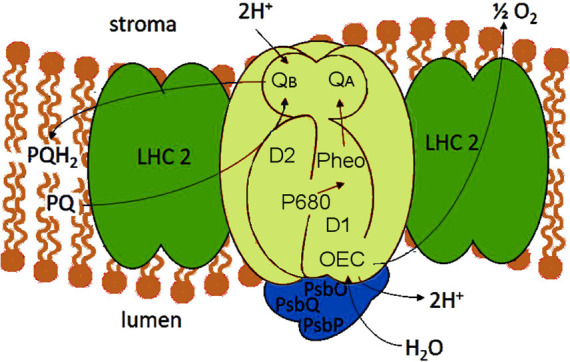
Hybrid photoelectrodes containing biological pigment-protein complexes can be used for environmentally friendly solar energy conversion, herbicide detection, and other applications. The total number of scientific publications on hybrid bio-based devices has grown rapidly over the past decades. Particular attention is paid to the integration of the complexes of PSII into photoelectrochemical devices. A notable feature of these complexes from a practical point of view is their ability to obtain electrons from abundant water. The utilization or imitation of the PSII functionality seems promising for all of the following: generating photoelectricity, photo-producing hydrogen, and detecting herbicides. This review summarizes recent advances in the development of hybrid devices based on PSII. In a brief historical review, we also highlighted the use of quinone-type bacterial reaction centers in hybrid devices. These proteins are the first from which the photoelectricity signal was detected. The photocurrent in these first systems, developed in the 70s-80s, was about 1 nA cm-2. In the latest work, by Güzel et al. (2020), a stable current of about 888 μA cm-2 as achieved in a PSII-based solar cell. The present review is inspired by this impressive progress. The advantages, disadvantages, and future endeavors of PSII-inspired bio-photovoltaic devices are also presented.
期刊介绍:
Photosynthetica publishes original scientific papers and brief communications, reviews on specialized topics, book reviews and announcements and reports covering wide range of photosynthesis research or research including photosynthetic parameters of both experimental and theoretical nature and dealing with physiology, biophysics, biochemistry, molecular biology on one side and leaf optics, stress physiology and ecology of photosynthesis on the other side.
The language of journal is English (British or American). Papers should not be published or under consideration for publication elsewhere.





 京公网安备 11010802042870号
京ICP备2023020795号-1
京公网安备 11010802042870号
京ICP备2023020795号-1

 分享
分享
 求助内容:
求助内容: 应助结果提醒方式:
 扫码关注我们
