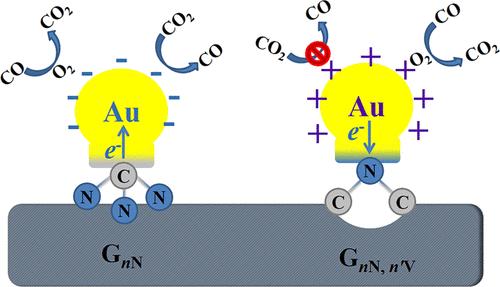
{"title":"Structure and Catalytic Activity of Gold Clusters Supported on Nitrogen-Doped Graphene","authors":"Jing Li, Xiaomei Zhao, Zhongyun Ma*, Yong Pei*","doi":"10.1021/acs.jpcc.0c08356","DOIUrl":null,"url":null,"abstract":"<p >Controlling the charge types of metal clusters on supports is of great importance in designing a noble-metal-free catalyst. Here, we designed two different types of N-doped graphene surfaces, the graphitic-like nitrogen-doped graphene G<sub><i>n</i>N</sub> and the pyridinic-like nitrogen-doped graphene G<sub><i>n</i>N,<i>n</i>′V</sub>. We found that in the Au<sub>28</sub>/G<sub><i>n</i>N</sub> system, the Au atoms interact with C atoms. However, in the Au<sub>28</sub>/G<sub><i>n</i>N,<i>n</i>′V</sub> system, the Au atoms interact with the N atoms. Specifically, the different bonding modes result in the charge state of the Au cluster being negative on the G<sub><i>n</i>N</sub> surface, whereas on the G<sub><i>n</i>N,<i>n</i>′V</sub> surface, the Au cluster is of positive charge. Therefore, it is possible to change the type of carbon–nitrogen bonding structure to control the charge types of gold clusters on nitrogen-doped graphene. In these two systems, the O<sub>2</sub> molecules prefer to be activated at the unsaturated and electron-rich bridge sites of the Au cluster. O<sub>2</sub> adsorption further enhances the charge transfer along the original directions at the Au<sub>28</sub> cluster/N-doped graphene substrate interfaces. However, the charge states of Au clusters slightly affect the activation of O–O bonds. The negatively charged Au cluster surface (Au<sub>28</sub>/G<sub><i>n</i>N</sub>) exhibits better catalytic activity to CO oxidation under the trimolecular Eley–Rideal (3ER) mechanism and electrocatalytic reduction of CO<sub>2</sub> compared with the positively charged Au cluster surface (Au<sub>28</sub>/G<sub><i>n</i>N,<i>n</i>′V</sub>). Our results are beneficial for accelerating the industrial application of nanometer-sized gold catalysts and provide a theoretical basis for the design and development of new catalysts.</p>","PeriodicalId":61,"journal":{"name":"The Journal of Physical Chemistry C","volume":"125 9","pages":"5006–5019"},"PeriodicalIF":3.2000,"publicationDate":"2021-03-01","publicationTypes":"Journal Article","fieldsOfStudy":null,"isOpenAccess":false,"openAccessPdf":"https://sci-hub-pdf.com/10.1021/acs.jpcc.0c08356","citationCount":"10","resultStr":null,"platform":"Semanticscholar","paperid":null,"PeriodicalName":"The Journal of Physical Chemistry C","FirstCategoryId":"1","ListUrlMain":"https://pubs.acs.org/doi/10.1021/acs.jpcc.0c08356","RegionNum":3,"RegionCategory":"化学","ArticlePicture":[],"TitleCN":null,"AbstractTextCN":null,"PMCID":null,"EPubDate":"","PubModel":"","JCR":"Q2","JCRName":"CHEMISTRY, PHYSICAL","Score":null,"Total":0}
引用次数: 10
Abstract
Controlling the charge types of metal clusters on supports is of great importance in designing a noble-metal-free catalyst. Here, we designed two different types of N-doped graphene surfaces, the graphitic-like nitrogen-doped graphene GnN and the pyridinic-like nitrogen-doped graphene GnN,n′V. We found that in the Au28/GnN system, the Au atoms interact with C atoms. However, in the Au28/GnN,n′V system, the Au atoms interact with the N atoms. Specifically, the different bonding modes result in the charge state of the Au cluster being negative on the GnN surface, whereas on the GnN,n′V surface, the Au cluster is of positive charge. Therefore, it is possible to change the type of carbon–nitrogen bonding structure to control the charge types of gold clusters on nitrogen-doped graphene. In these two systems, the O2 molecules prefer to be activated at the unsaturated and electron-rich bridge sites of the Au cluster. O2 adsorption further enhances the charge transfer along the original directions at the Au28 cluster/N-doped graphene substrate interfaces. However, the charge states of Au clusters slightly affect the activation of O–O bonds. The negatively charged Au cluster surface (Au28/GnN) exhibits better catalytic activity to CO oxidation under the trimolecular Eley–Rideal (3ER) mechanism and electrocatalytic reduction of CO2 compared with the positively charged Au cluster surface (Au28/GnN,n′V). Our results are beneficial for accelerating the industrial application of nanometer-sized gold catalysts and provide a theoretical basis for the design and development of new catalysts.
期刊介绍:
The Journal of Physical Chemistry A/B/C is devoted to reporting new and original experimental and theoretical basic research of interest to physical chemists, biophysical chemists, and chemical physicists.



 京公网安备 11010802042870号
京ICP备2023020795号-1
京公网安备 11010802042870号
京ICP备2023020795号-1

 分享
分享
 求助内容:
求助内容: 应助结果提醒方式:
 扫码关注我们
