Chadia Haddad, Angela Chamoun, Hala Sacre, Souheil Hallit, Pascale Salameh, Benjamin Calvet
{"title":"Cognitive function in recovered COVID-19 Lebanese patients with schizophrenia.","authors":"Chadia Haddad, Angela Chamoun, Hala Sacre, Souheil Hallit, Pascale Salameh, Benjamin Calvet","doi":"10.1186/s12991-023-00435-4","DOIUrl":null,"url":null,"abstract":"<p><strong>Introduction: </strong>It remains unclear whether COVID-19 which is an infectious disease caused by the SARS-CoV-2 virus is associated with the deterioration of cognitive function among patients with schizophrenia. This study aimed to evaluate changes in cognitive function before and after COVID-19 and associated factors among patients with schizophrenia at the Psychiatric Hospital of the Cross (HPC).</p><p><strong>Methods: </strong>A prospective cohort study was conducted among 95 patients with schizophrenia followed from mid-2019 until June 2021 at the Psychiatric Hospital of the Cross (HPC). This cohort was divided into a group diagnosed with COVID-19 (n = 71) and another not diagnosed with COVID-19 (n = 24). The questionnaire included the Brief Assessment of Cognition in Schizophrenia (BACS), Positive and Negative Syndrome Scale (PANSS), Calgary Depression Scale for Schizophrenia (CDSS), and Activities of Daily Living (ADL).</p><p><strong>Results: </strong>The repeated-measures ANOVA showed no significant effect of time and the interaction between time and being diagnosed or not with COVID-19 on cognition. However, being diagnosed or not with COVID-19 had a significant effect on global cognitive function (p = 0.046), verbal memory (p = 0.046), and working memory (p = 0.047). The interaction between being diagnosed with COVID-19 and cognitive impairment at baseline was significantly associated with a higher cognitive deficit (Beta = 0.81; p = 0.005). Clinical symptoms, autonomy, and depression were not associated with the cognition (p > 0.05 for all).</p><p><strong>Conclusion: </strong>COVID-19 disease affected global cognition and memory: patients diagnosed with COVID-19 had more deficits in these domains than those without COVID-19. Further studies are necessary to clarify the variation of cognitive function among schizophrenic patients with COVID-19.</p>","PeriodicalId":7942,"journal":{"name":"Annals of General Psychiatry","volume":"22 1","pages":"7"},"PeriodicalIF":3.6000,"publicationDate":"2023-03-11","publicationTypes":"Journal Article","fieldsOfStudy":null,"isOpenAccess":false,"openAccessPdf":"https://www.ncbi.nlm.nih.gov/pmc/articles/PMC10008071/pdf/","citationCount":"1","resultStr":null,"platform":"Semanticscholar","paperid":null,"PeriodicalName":"Annals of General Psychiatry","FirstCategoryId":"3","ListUrlMain":"https://doi.org/10.1186/s12991-023-00435-4","RegionNum":3,"RegionCategory":"医学","ArticlePicture":[],"TitleCN":null,"AbstractTextCN":null,"PMCID":null,"EPubDate":"","PubModel":"","JCR":"Q1","JCRName":"PSYCHIATRY","Score":null,"Total":0}
引用次数: 1
Abstract
Introduction: It remains unclear whether COVID-19 which is an infectious disease caused by the SARS-CoV-2 virus is associated with the deterioration of cognitive function among patients with schizophrenia. This study aimed to evaluate changes in cognitive function before and after COVID-19 and associated factors among patients with schizophrenia at the Psychiatric Hospital of the Cross (HPC).
Methods: A prospective cohort study was conducted among 95 patients with schizophrenia followed from mid-2019 until June 2021 at the Psychiatric Hospital of the Cross (HPC). This cohort was divided into a group diagnosed with COVID-19 (n = 71) and another not diagnosed with COVID-19 (n = 24). The questionnaire included the Brief Assessment of Cognition in Schizophrenia (BACS), Positive and Negative Syndrome Scale (PANSS), Calgary Depression Scale for Schizophrenia (CDSS), and Activities of Daily Living (ADL).
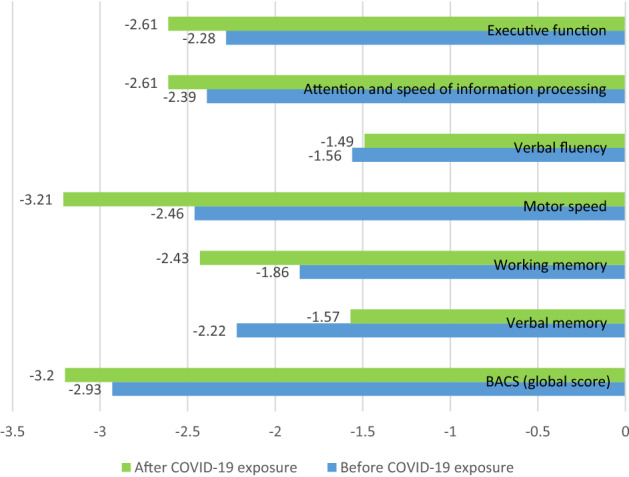
Results: The repeated-measures ANOVA showed no significant effect of time and the interaction between time and being diagnosed or not with COVID-19 on cognition. However, being diagnosed or not with COVID-19 had a significant effect on global cognitive function (p = 0.046), verbal memory (p = 0.046), and working memory (p = 0.047). The interaction between being diagnosed with COVID-19 and cognitive impairment at baseline was significantly associated with a higher cognitive deficit (Beta = 0.81; p = 0.005). Clinical symptoms, autonomy, and depression were not associated with the cognition (p > 0.05 for all).
Conclusion: COVID-19 disease affected global cognition and memory: patients diagnosed with COVID-19 had more deficits in these domains than those without COVID-19. Further studies are necessary to clarify the variation of cognitive function among schizophrenic patients with COVID-19.
期刊介绍:
Annals of General Psychiatry considers manuscripts on all aspects of psychiatry, including neuroscience and psychological medicine. Both basic and clinical neuroscience contributions are encouraged.
Annals of General Psychiatry emphasizes a biopsychosocial approach to illness and health and strongly supports and follows the principles of evidence-based medicine. As an open access journal, Annals of General Psychiatry facilitates the worldwide distribution of high quality psychiatry and mental health research. The journal considers submissions on a wide range of topics including, but not limited to, psychopharmacology, forensic psychiatry, psychotic disorders, psychiatric genetics, and mood and anxiety disorders.




 京公网安备 11010802042870号
京ICP备2023020795号-1
京公网安备 11010802042870号
京ICP备2023020795号-1

 分享
分享
 求助内容:
求助内容: 应助结果提醒方式:
 扫码关注我们
