Axial Chirality in the Sotorasib Drug Substance, Part 1: Development of a Classical Resolution to Prepare an Atropisomerically Pure Sotorasib Intermediate
Andrew T. Parsons*, Seb Caille, Marc A. Caporini, Daniel J. Griffin, Michael A. Lovette, William Powazinik IV and Gabrielle St-Pierre,
{"title":"Axial Chirality in the Sotorasib Drug Substance, Part 1: Development of a Classical Resolution to Prepare an Atropisomerically Pure Sotorasib Intermediate","authors":"Andrew T. Parsons*, Seb Caille, Marc A. Caporini, Daniel J. Griffin, Michael A. Lovette, William Powazinik IV and Gabrielle St-Pierre, ","doi":"10.1021/acs.oprd.2c00176","DOIUrl":null,"url":null,"abstract":"<p >Described herein is the discovery and development of a process to prepare an atropisomeric intermediate in the synthesis of the KRAS G12C inhibitor sotorasib. Using high-throughput experimentation, (+)-2,3-dibenzoyl-<span>d</span>-tartaric acid [(+)-DBTA] was identified as an inexpensive and readily available resolving agent that enables separation and isolation of the desired atropisomer through a classical resolution. Subsequent optimization and characterization studies led to a highly selective process, providing the desired atropisomer as a unique three-component cocrystal solvate with a selectivity of >2000:1. This classical resolution has been performed successfully on >500 kg scale and was critical to the commercialization of the sotorasib manufacturing process.</p>","PeriodicalId":55,"journal":{"name":"Organic Process Research & Development","volume":"26 9","pages":"2629–2635"},"PeriodicalIF":3.5000,"publicationDate":"2022-08-23","publicationTypes":"Journal Article","fieldsOfStudy":null,"isOpenAccess":false,"openAccessPdf":"","citationCount":"9","resultStr":null,"platform":"Semanticscholar","paperid":null,"PeriodicalName":"Organic Process Research & Development","FirstCategoryId":"92","ListUrlMain":"https://pubs.acs.org/doi/10.1021/acs.oprd.2c00176","RegionNum":3,"RegionCategory":"化学","ArticlePicture":[],"TitleCN":null,"AbstractTextCN":null,"PMCID":null,"EPubDate":"","PubModel":"","JCR":"Q2","JCRName":"CHEMISTRY, APPLIED","Score":null,"Total":0}
引用次数: 9
Abstract
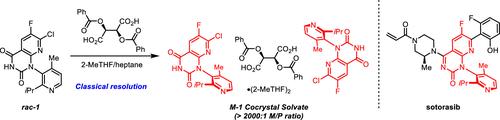
Described herein is the discovery and development of a process to prepare an atropisomeric intermediate in the synthesis of the KRAS G12C inhibitor sotorasib. Using high-throughput experimentation, (+)-2,3-dibenzoyl-d-tartaric acid [(+)-DBTA] was identified as an inexpensive and readily available resolving agent that enables separation and isolation of the desired atropisomer through a classical resolution. Subsequent optimization and characterization studies led to a highly selective process, providing the desired atropisomer as a unique three-component cocrystal solvate with a selectivity of >2000:1. This classical resolution has been performed successfully on >500 kg scale and was critical to the commercialization of the sotorasib manufacturing process.
期刊介绍:
The journal Organic Process Research & Development serves as a communication tool between industrial chemists and chemists working in universities and research institutes. As such, it reports original work from the broad field of industrial process chemistry but also presents academic results that are relevant, or potentially relevant, to industrial applications. Process chemistry is the science that enables the safe, environmentally benign and ultimately economical manufacturing of organic compounds that are required in larger amounts to help address the needs of society. Consequently, the Journal encompasses every aspect of organic chemistry, including all aspects of catalysis, synthetic methodology development and synthetic strategy exploration, but also includes aspects from analytical and solid-state chemistry and chemical engineering, such as work-up tools,process safety, or flow-chemistry. The goal of development and optimization of chemical reactions and processes is their transfer to a larger scale; original work describing such studies and the actual implementation on scale is highly relevant to the journal. However, studies on new developments from either industry, research institutes or academia that have not yet been demonstrated on scale, but where an industrial utility can be expected and where the study has addressed important prerequisites for a scale-up and has given confidence into the reliability and practicality of the chemistry, also serve the mission of OPR&D as a communication tool between the different contributors to the field.



 京公网安备 11010802042870号
京ICP备2023020795号-1
京公网安备 11010802042870号
京ICP备2023020795号-1

 分享
分享
 求助内容:
求助内容: 应助结果提醒方式:
 扫码关注我们
