{"title":"Nutlin-3 suppresses tumorigenesis and progression of oral squamous cell carcinoma and enhances chemosensitivity to cisplatin.","authors":"Kai Zheng, Zexi Li, Xu Ding, Huaiqi Li","doi":"10.1007/s10616-022-00556-w","DOIUrl":null,"url":null,"abstract":"<p><p>Oral squamous cell carcinoma (OSCC) is an epithelial malignant tumor with great challenges of tumor metastasis and drug resistance. Nutlin-3 is a MDM2 inhibitor that can potently activate tumor suppressor gene p53. However, the exact role of Nutlin-3 in OSCC has not been identified yet. SCC-9 cells were treated with 0, 2.5, 5, 10, 20 μM Nutlin3. MDM2 and p53 protein levels were assessed using western blot analysis. Then, CCK8 assay, clone formation assay, TUNEL staining, wound healing and transwell assays were conducted to analyze the influences of Nutlin3 on the proliferation, apoptosis, migration, and invasion in SCC-9 cells. Moreover, SCC-9 cells were co-treated with 0, 0.5, 1, 2.5, 5 μM cisplatin and Nutlin3 to determine the effect of Nutlin3 on cisplatin chemosensitivity in OSCC. As expected, Nutlin-3 inhibited MDM2 but restored p53 in OSCC in a concentration-dependent manner. Meanwhile, Nutlin-3 suppressed the proliferation, clone formation, migration, invasion and epithelial-mesenchymal transition of SCC-9 cells and both boosted the apoptosis. In addition, Nutlin-3 caused a reduced cell viability and an elevated cell apoptosis rate in cisplatin-treated SCC-9 cells, indicating that Nutlin-3 enhanced cisplatin chemosensitivity in OSCC cells. Taken together, Nutlin-3 may suppress tumorigenesis and progression of OSCC and enhance chemosensitivity to cisplatin in OSCC.</p>","PeriodicalId":10890,"journal":{"name":"Cytotechnology","volume":"75 1","pages":"17-25"},"PeriodicalIF":1.7000,"publicationDate":"2023-02-01","publicationTypes":"Journal Article","fieldsOfStudy":null,"isOpenAccess":false,"openAccessPdf":"https://www.ncbi.nlm.nih.gov/pmc/articles/PMC9880094/pdf/","citationCount":"0","resultStr":null,"platform":"Semanticscholar","paperid":null,"PeriodicalName":"Cytotechnology","FirstCategoryId":"99","ListUrlMain":"https://doi.org/10.1007/s10616-022-00556-w","RegionNum":4,"RegionCategory":"生物学","ArticlePicture":[],"TitleCN":null,"AbstractTextCN":null,"PMCID":null,"EPubDate":"2022/10/28 0:00:00","PubModel":"Epub","JCR":"Q3","JCRName":"BIOTECHNOLOGY & APPLIED MICROBIOLOGY","Score":null,"Total":0}
引用次数: 0
Abstract
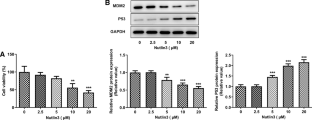
Oral squamous cell carcinoma (OSCC) is an epithelial malignant tumor with great challenges of tumor metastasis and drug resistance. Nutlin-3 is a MDM2 inhibitor that can potently activate tumor suppressor gene p53. However, the exact role of Nutlin-3 in OSCC has not been identified yet. SCC-9 cells were treated with 0, 2.5, 5, 10, 20 μM Nutlin3. MDM2 and p53 protein levels were assessed using western blot analysis. Then, CCK8 assay, clone formation assay, TUNEL staining, wound healing and transwell assays were conducted to analyze the influences of Nutlin3 on the proliferation, apoptosis, migration, and invasion in SCC-9 cells. Moreover, SCC-9 cells were co-treated with 0, 0.5, 1, 2.5, 5 μM cisplatin and Nutlin3 to determine the effect of Nutlin3 on cisplatin chemosensitivity in OSCC. As expected, Nutlin-3 inhibited MDM2 but restored p53 in OSCC in a concentration-dependent manner. Meanwhile, Nutlin-3 suppressed the proliferation, clone formation, migration, invasion and epithelial-mesenchymal transition of SCC-9 cells and both boosted the apoptosis. In addition, Nutlin-3 caused a reduced cell viability and an elevated cell apoptosis rate in cisplatin-treated SCC-9 cells, indicating that Nutlin-3 enhanced cisplatin chemosensitivity in OSCC cells. Taken together, Nutlin-3 may suppress tumorigenesis and progression of OSCC and enhance chemosensitivity to cisplatin in OSCC.
期刊介绍:
The scope of the Journal includes:
1. The derivation, genetic modification and characterization of cell lines, genetic and phenotypic regulation, control of cellular metabolism, cell physiology and biochemistry related to cell function, performance and expression of cell products.
2. Cell culture techniques, substrates, environmental requirements and optimization, cloning, hybridization and molecular biology, including genomic and proteomic tools.
3. Cell culture systems, processes, reactors, scale-up, and industrial production. Descriptions of the design or construction of equipment, media or quality control procedures, that are ancillary to cellular research.
4. The application of animal/human cells in research in the field of stem cell research including maintenance of stemness, differentiation, genetics, and senescence, cancer research, research in immunology, as well as applications in tissue engineering and gene therapy.
5. The use of cell cultures as a substrate for bioassays, biomedical applications and in particular as a replacement for animal models.



 京公网安备 11010802042870号
京ICP备2023020795号-1
京公网安备 11010802042870号
京ICP备2023020795号-1

 分享
分享
 求助内容:
求助内容: 应助结果提醒方式:
 扫码关注我们
