Marzieh Khani, Elizabeth Gibbons, Jose Bras, Rita Guerreiro
{"title":"Challenge accepted: uncovering the role of rare genetic variants in Alzheimer's disease.","authors":"Marzieh Khani, Elizabeth Gibbons, Jose Bras, Rita Guerreiro","doi":"10.1186/s13024-021-00505-9","DOIUrl":null,"url":null,"abstract":"<p><p>The search for rare variants in Alzheimer's disease (AD) is usually deemed a high-risk - high-reward situation. The challenges associated with this endeavor are real. Still, the application of genome-wide technologies to large numbers of cases and controls or to small, well-characterized families has started to be fruitful.Rare variants associated with AD have been shown to increase risk or cause disease, but also to protect against the development of AD. All of these can potentially be targeted for the development of new drugs.Multiple independent studies have now shown associations of rare variants in NOTCH3, TREM2, SORL1, ABCA7, BIN1, CLU, NCK2, AKAP9, UNC5C, PLCG2, and ABI3 with AD and suggested that they may influence disease via multiple mechanisms. These genes have reported functions in the immune system, lipid metabolism, synaptic plasticity, and apoptosis. However, the main pathway emerging from the collective of genes harboring rare variants associated with AD is the Aβ pathway. Associations of rare variants in dozens of other genes have also been proposed, but have not yet been replicated in independent studies. Replication of this type of findings is one of the challenges associated with studying rare variants in complex diseases, such as AD. In this review, we discuss some of these primary challenges as well as possible solutions.Integrative approaches, the availability of large datasets and databases, and the development of new analytical methodologies will continue to produce new genes harboring rare variability impacting AD. In the future, more extensive and more diverse genetic studies, as well as studies of deeply characterized families, will enhance our understanding of disease pathogenesis and put us on the correct path for the development of successful drugs.</p>","PeriodicalId":18800,"journal":{"name":"Molecular Neurodegeneration","volume":"17 1","pages":"3"},"PeriodicalIF":17.5000,"publicationDate":"2022-01-09","publicationTypes":"Journal Article","fieldsOfStudy":null,"isOpenAccess":false,"openAccessPdf":"https://www.ncbi.nlm.nih.gov/pmc/articles/PMC8744312/pdf/","citationCount":"14","resultStr":null,"platform":"Semanticscholar","paperid":null,"PeriodicalName":"Molecular Neurodegeneration","FirstCategoryId":"3","ListUrlMain":"https://doi.org/10.1186/s13024-021-00505-9","RegionNum":1,"RegionCategory":"医学","ArticlePicture":[],"TitleCN":null,"AbstractTextCN":null,"PMCID":null,"EPubDate":"","PubModel":"","JCR":"Q1","JCRName":"NEUROSCIENCES","Score":null,"Total":0}
引用次数: 14
Abstract
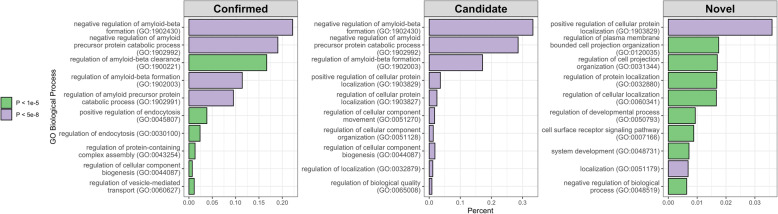
The search for rare variants in Alzheimer's disease (AD) is usually deemed a high-risk - high-reward situation. The challenges associated with this endeavor are real. Still, the application of genome-wide technologies to large numbers of cases and controls or to small, well-characterized families has started to be fruitful.Rare variants associated with AD have been shown to increase risk or cause disease, but also to protect against the development of AD. All of these can potentially be targeted for the development of new drugs.Multiple independent studies have now shown associations of rare variants in NOTCH3, TREM2, SORL1, ABCA7, BIN1, CLU, NCK2, AKAP9, UNC5C, PLCG2, and ABI3 with AD and suggested that they may influence disease via multiple mechanisms. These genes have reported functions in the immune system, lipid metabolism, synaptic plasticity, and apoptosis. However, the main pathway emerging from the collective of genes harboring rare variants associated with AD is the Aβ pathway. Associations of rare variants in dozens of other genes have also been proposed, but have not yet been replicated in independent studies. Replication of this type of findings is one of the challenges associated with studying rare variants in complex diseases, such as AD. In this review, we discuss some of these primary challenges as well as possible solutions.Integrative approaches, the availability of large datasets and databases, and the development of new analytical methodologies will continue to produce new genes harboring rare variability impacting AD. In the future, more extensive and more diverse genetic studies, as well as studies of deeply characterized families, will enhance our understanding of disease pathogenesis and put us on the correct path for the development of successful drugs.
期刊介绍:
Molecular Neurodegeneration, an open-access, peer-reviewed journal, comprehensively covers neurodegeneration research at the molecular and cellular levels.
Neurodegenerative diseases, such as Alzheimer's, Parkinson's, Huntington's, and prion diseases, fall under its purview. These disorders, often linked to advanced aging and characterized by varying degrees of dementia, pose a significant public health concern with the growing aging population. Recent strides in understanding the molecular and cellular mechanisms of these neurodegenerative disorders offer valuable insights into their pathogenesis.



 京公网安备 11010802042870号
京ICP备2023020795号-1
京公网安备 11010802042870号
京ICP备2023020795号-1

 分享
分享
 求助内容:
求助内容: 应助结果提醒方式:
 扫码关注我们
