Huan Yang, Timir Datta-Chaudhuri, Sam J George, Bilal Haider, Jason Wong, Tyler D Hepler, Ulf Andersson, Michael Brines, Kevin J Tracey, Sangeeta S Chavan
{"title":"High-frequency electrical stimulation attenuates neuronal release of inflammatory mediators and ameliorates neuropathic pain.","authors":"Huan Yang, Timir Datta-Chaudhuri, Sam J George, Bilal Haider, Jason Wong, Tyler D Hepler, Ulf Andersson, Michael Brines, Kevin J Tracey, Sangeeta S Chavan","doi":"10.1186/s42234-022-00098-8","DOIUrl":null,"url":null,"abstract":"<p><strong>Background: </strong>Neuroinflammation is an important driver of acute and chronic pain states. Therefore, targeting molecular mediators of neuroinflammation may present an opportunity for developing novel pain therapies. In preclinical models of neuroinflammatory pain, calcitonin gene-related peptide (CGRP), substance P and high mobility group box 1 protein (HMGB1) are molecules synthesized and released by sensory neurons which activate inflammation and pain. High-frequency electrical nerve stimulation (HFES) has achieved clinical success as an analgesic modality, but the underlying mechanism is unknown. Here, we reasoned that HFES inhibits neuroinflammatory mediator release by sensory neurons to reduce pain.</p><p><strong>Methods: </strong>Utilizing in vitro and in vivo assays, we assessed the modulating effects of HFES on neuroinflammatory mediator release by activated sensory neurons. Dorsal root ganglia (DRG) neurons harvested from wildtype or transgenic mice expressing channelrhodopsin-2 (ChR2) were cultured on micro-electrode arrays, and effect of HFES on optogenetic- or capsaicin-induced neuroinflammatory mediator release was determined. Additionally, the effects of HFES on local neuroinflammatory mediator release and hyperalgesia was assessed in vivo using optogenetic paw stimulation and the neuropathic pain model of chronic constriction injury (CCI) of the sciatic nerve.</p><p><strong>Results: </strong>Light- or capsaicin-evoked neuroinflammatory mediator release from cultured transgenic DRG sensory neurons was significantly reduced by concurrent HFES (10 kHz). In agreement with these findings, elevated levels of neuroinflammatory mediators were detected in the affected paw following optogenetic stimulation or CCI and were significantly attenuated using HFES (20.6 kHz for 10 min) delivered once daily for 3 days.</p><p><strong>Conclusion: </strong>These studies reveal a previously unidentified mechanism for the pain-modulating effect of HFES in the setting of acute and chronic nerve injury. The results support the mechanistic insight that HFES may reset sensory neurons into a less pro-inflammatory state via inhibiting the release of neuroinflammatory mediators resulting in reduced inflammation and pain.</p>","PeriodicalId":72363,"journal":{"name":"Bioelectronic medicine","volume":"8 1","pages":"16"},"PeriodicalIF":0.0000,"publicationDate":"2022-10-05","publicationTypes":"Journal Article","fieldsOfStudy":null,"isOpenAccess":false,"openAccessPdf":"https://www.ncbi.nlm.nih.gov/pmc/articles/PMC9533511/pdf/","citationCount":"0","resultStr":null,"platform":"Semanticscholar","paperid":null,"PeriodicalName":"Bioelectronic medicine","FirstCategoryId":"1085","ListUrlMain":"https://doi.org/10.1186/s42234-022-00098-8","RegionNum":0,"RegionCategory":null,"ArticlePicture":[],"TitleCN":null,"AbstractTextCN":null,"PMCID":null,"EPubDate":"","PubModel":"","JCR":"","JCRName":"","Score":null,"Total":0}
引用次数: 0
Abstract
Background: Neuroinflammation is an important driver of acute and chronic pain states. Therefore, targeting molecular mediators of neuroinflammation may present an opportunity for developing novel pain therapies. In preclinical models of neuroinflammatory pain, calcitonin gene-related peptide (CGRP), substance P and high mobility group box 1 protein (HMGB1) are molecules synthesized and released by sensory neurons which activate inflammation and pain. High-frequency electrical nerve stimulation (HFES) has achieved clinical success as an analgesic modality, but the underlying mechanism is unknown. Here, we reasoned that HFES inhibits neuroinflammatory mediator release by sensory neurons to reduce pain.
Methods: Utilizing in vitro and in vivo assays, we assessed the modulating effects of HFES on neuroinflammatory mediator release by activated sensory neurons. Dorsal root ganglia (DRG) neurons harvested from wildtype or transgenic mice expressing channelrhodopsin-2 (ChR2) were cultured on micro-electrode arrays, and effect of HFES on optogenetic- or capsaicin-induced neuroinflammatory mediator release was determined. Additionally, the effects of HFES on local neuroinflammatory mediator release and hyperalgesia was assessed in vivo using optogenetic paw stimulation and the neuropathic pain model of chronic constriction injury (CCI) of the sciatic nerve.
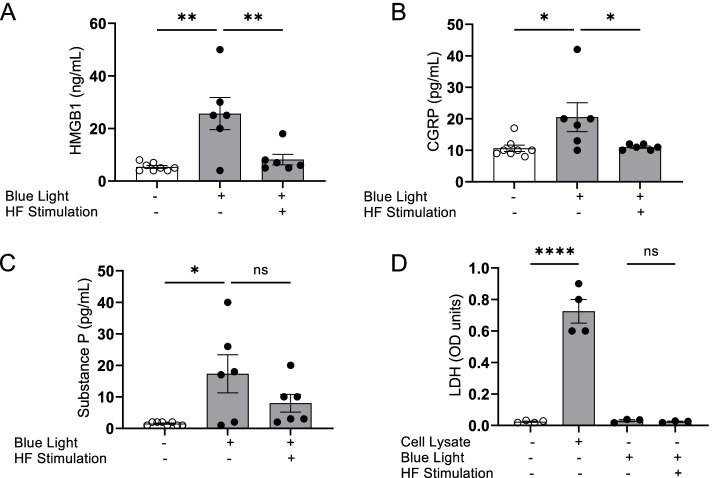
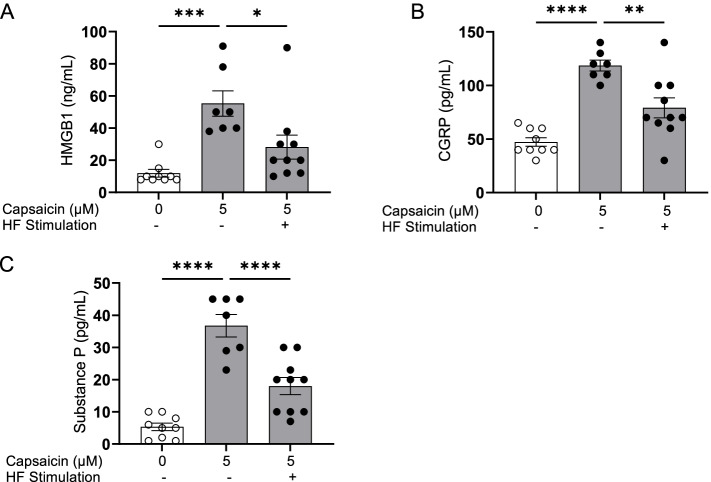
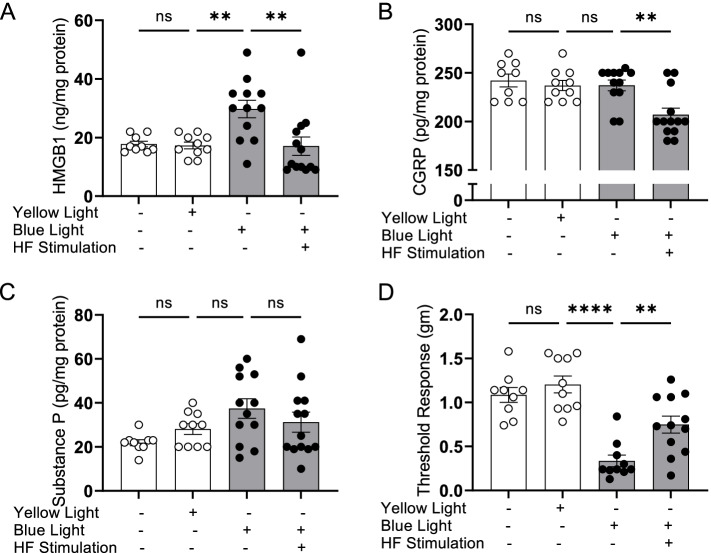
Results: Light- or capsaicin-evoked neuroinflammatory mediator release from cultured transgenic DRG sensory neurons was significantly reduced by concurrent HFES (10 kHz). In agreement with these findings, elevated levels of neuroinflammatory mediators were detected in the affected paw following optogenetic stimulation or CCI and were significantly attenuated using HFES (20.6 kHz for 10 min) delivered once daily for 3 days.
Conclusion: These studies reveal a previously unidentified mechanism for the pain-modulating effect of HFES in the setting of acute and chronic nerve injury. The results support the mechanistic insight that HFES may reset sensory neurons into a less pro-inflammatory state via inhibiting the release of neuroinflammatory mediators resulting in reduced inflammation and pain.



 京公网安备 11010802042870号
京ICP备2023020795号-1
京公网安备 11010802042870号
京ICP备2023020795号-1

 分享
分享

 求助内容:
求助内容: 应助结果提醒方式:
 扫码关注我们
