Vinícius de Oliveira Muniz, Anderson Reis de Sousa, Thiago da Silva Santana, Alisson Dos Anjos Santos, Ramon Evangelista Luz, Eric Santos Almeida, Isabella Félix Meira Araújo, Evanilda Souza de Santana Carvalho
{"title":"Adaptive modes of adult men during COVID-19: qualitative analysis under Roy's model.","authors":"Vinícius de Oliveira Muniz, Anderson Reis de Sousa, Thiago da Silva Santana, Alisson Dos Anjos Santos, Ramon Evangelista Luz, Eric Santos Almeida, Isabella Félix Meira Araújo, Evanilda Souza de Santana Carvalho","doi":"10.17533/udea.iee.v40n3e14","DOIUrl":null,"url":null,"abstract":"<p><strong>Objectives: </strong>This study aims to understand how adult men adapt to the COVID-19 pandemic.</p><p><strong>Methods: </strong>Qualitative study involving 45 adult men residing in Brazil in 2020. Data were obtained from a Web Survey and treated using Reflective Thematic Analysis and interpreted in the light of Callista Roy's Adaptation Model.</p><p><strong>Results: </strong>The COVID-19 pandemic mobilized in men the ways of adaptation that are configured in: mobilization of the physiological-physical and regulatory dimension: adjustments in the sleep pattern, dietary pattern, and maintenance of physical activity; group self-concept identity: managing emotions; role function: self-knowledge and self-care; interdependence: adjustments in the marital relationship, family ties and paternity, investment in training and studies and control of excessive consumption of content on cell phones.</p><p><strong>Conclusions: </strong>The perception of the own vulnerability favored the entry of men into ways of adaptation in search of balance during the pandemic, motivating them to move through practices of taking care of themselves and taking care of others. Markers of psycho-emotional distress alert to adherence to new modes of care capable of promoting healthy transitions in the face of disruptions and uncertainties generated by the pandemic. This evidence can support the establishment of goals for nursing care aimed at men.</p>","PeriodicalId":53477,"journal":{"name":"Investigacion y Educacion en Enfermeria","volume":"40 3","pages":""},"PeriodicalIF":1.6000,"publicationDate":"2022-10-01","publicationTypes":"Journal Article","fieldsOfStudy":null,"isOpenAccess":false,"openAccessPdf":"https://www.ncbi.nlm.nih.gov/pmc/articles/PMC10017138/pdf/","citationCount":"0","resultStr":null,"platform":"Semanticscholar","paperid":null,"PeriodicalName":"Investigacion y Educacion en Enfermeria","FirstCategoryId":"1085","ListUrlMain":"https://doi.org/10.17533/udea.iee.v40n3e14","RegionNum":0,"RegionCategory":null,"ArticlePicture":[],"TitleCN":null,"AbstractTextCN":null,"PMCID":null,"EPubDate":"","PubModel":"","JCR":"Q3","JCRName":"NURSING","Score":null,"Total":0}
引用次数: 0
Abstract
Objectives: This study aims to understand how adult men adapt to the COVID-19 pandemic.
Methods: Qualitative study involving 45 adult men residing in Brazil in 2020. Data were obtained from a Web Survey and treated using Reflective Thematic Analysis and interpreted in the light of Callista Roy's Adaptation Model.
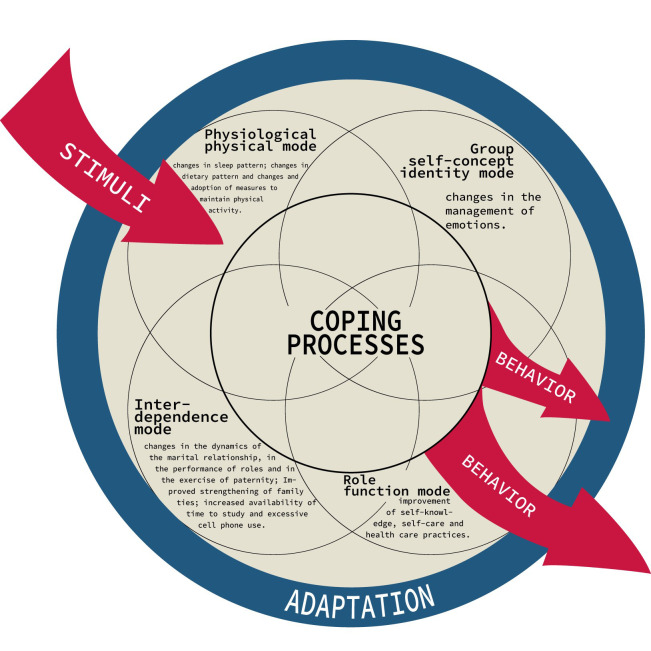
Results: The COVID-19 pandemic mobilized in men the ways of adaptation that are configured in: mobilization of the physiological-physical and regulatory dimension: adjustments in the sleep pattern, dietary pattern, and maintenance of physical activity; group self-concept identity: managing emotions; role function: self-knowledge and self-care; interdependence: adjustments in the marital relationship, family ties and paternity, investment in training and studies and control of excessive consumption of content on cell phones.
Conclusions: The perception of the own vulnerability favored the entry of men into ways of adaptation in search of balance during the pandemic, motivating them to move through practices of taking care of themselves and taking care of others. Markers of psycho-emotional distress alert to adherence to new modes of care capable of promoting healthy transitions in the face of disruptions and uncertainties generated by the pandemic. This evidence can support the establishment of goals for nursing care aimed at men.
期刊介绍:
The mission of the journal of Nursing and Education is to present scientific and technical information about health, illnesses and related topics. The journal serves as the conduit [medium] through which the experiences of our own nursing and social science departments can be shared within Columbia and internationally. It is written primarily for nurses, general health practitioners and other related disciplines but can also be used by students and researchers.





 京公网安备 11010802042870号
京ICP备2023020795号-1
京公网安备 11010802042870号
京ICP备2023020795号-1

 分享
分享
 求助内容:
求助内容: 应助结果提醒方式:
 扫码关注我们
