{"title":"Sphingomyelin reduces melanogenesis in murine B16 melanoma cells through indirect suppression of tyrosinase.","authors":"Yoshihiro Tokudome, Moeko Fukutomi","doi":"10.1007/s10616-022-00562-y","DOIUrl":null,"url":null,"abstract":"<p><p>Growing consumer interest in skin whitening has led to intensive investigations of whitening methods. In this study, we evaluated the effect of sphingomyelin, a component of cell membranes, on melanin production. B16 mouse melanoma cells were treated with lauroyl-sphingomyelin (SM) or its metabolite lauroyl-ceramide (CER) and measured for cell viability, melanin content, and direct and indirect tyrosinase activity. Expression of melanin synthesis-related genes encoding tyrosinase (<i>Tyr</i>), tyrosinase-related proteins <i>(Trp1</i> and <i>Trp2</i>), and microphthalmia-associated transcription factor (<i>Mitf</i>) were quantified by real-time PCR, and SM content in cells was measured by fluorescence high-performance liquid chromatography. SM treatment decreased melanin content in a concentration-dependent manner, without significantly altering the number of viable cells. By contrast, treatment with CER at the same concentrations did not decrease melanin content. SM inhibited the activity of intracellular tyrosinase, but not mushroom-derived tyrosinase. Gene expression levels of <i>Tyr</i> and <i>Mitf</i> were significantly reduced by treatment with SM, while those of <i>Trp2</i> and <i>Mitf</i> were significantly reduced by CER. Fluorescence-labeled SM was converted to fluorescence-labeled CER in cells over time. In conclusion, CER was found to inhibit melanogenesis without inhibiting tyrosinase activity, suggesting that SM is more water soluble than CER, and is more effectively taken up into cells.</p>","PeriodicalId":10890,"journal":{"name":"Cytotechnology","volume":"75 2","pages":"93-101"},"PeriodicalIF":1.7000,"publicationDate":"2023-04-01","publicationTypes":"Journal Article","fieldsOfStudy":null,"isOpenAccess":false,"openAccessPdf":"https://www.ncbi.nlm.nih.gov/pmc/articles/PMC10030692/pdf/","citationCount":"0","resultStr":null,"platform":"Semanticscholar","paperid":null,"PeriodicalName":"Cytotechnology","FirstCategoryId":"99","ListUrlMain":"https://doi.org/10.1007/s10616-022-00562-y","RegionNum":4,"RegionCategory":"生物学","ArticlePicture":[],"TitleCN":null,"AbstractTextCN":null,"PMCID":null,"EPubDate":"2022/11/30 0:00:00","PubModel":"Epub","JCR":"Q3","JCRName":"BIOTECHNOLOGY & APPLIED MICROBIOLOGY","Score":null,"Total":0}
引用次数: 0
Abstract
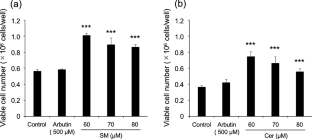
Growing consumer interest in skin whitening has led to intensive investigations of whitening methods. In this study, we evaluated the effect of sphingomyelin, a component of cell membranes, on melanin production. B16 mouse melanoma cells were treated with lauroyl-sphingomyelin (SM) or its metabolite lauroyl-ceramide (CER) and measured for cell viability, melanin content, and direct and indirect tyrosinase activity. Expression of melanin synthesis-related genes encoding tyrosinase (Tyr), tyrosinase-related proteins (Trp1 and Trp2), and microphthalmia-associated transcription factor (Mitf) were quantified by real-time PCR, and SM content in cells was measured by fluorescence high-performance liquid chromatography. SM treatment decreased melanin content in a concentration-dependent manner, without significantly altering the number of viable cells. By contrast, treatment with CER at the same concentrations did not decrease melanin content. SM inhibited the activity of intracellular tyrosinase, but not mushroom-derived tyrosinase. Gene expression levels of Tyr and Mitf were significantly reduced by treatment with SM, while those of Trp2 and Mitf were significantly reduced by CER. Fluorescence-labeled SM was converted to fluorescence-labeled CER in cells over time. In conclusion, CER was found to inhibit melanogenesis without inhibiting tyrosinase activity, suggesting that SM is more water soluble than CER, and is more effectively taken up into cells.
期刊介绍:
The scope of the Journal includes:
1. The derivation, genetic modification and characterization of cell lines, genetic and phenotypic regulation, control of cellular metabolism, cell physiology and biochemistry related to cell function, performance and expression of cell products.
2. Cell culture techniques, substrates, environmental requirements and optimization, cloning, hybridization and molecular biology, including genomic and proteomic tools.
3. Cell culture systems, processes, reactors, scale-up, and industrial production. Descriptions of the design or construction of equipment, media or quality control procedures, that are ancillary to cellular research.
4. The application of animal/human cells in research in the field of stem cell research including maintenance of stemness, differentiation, genetics, and senescence, cancer research, research in immunology, as well as applications in tissue engineering and gene therapy.
5. The use of cell cultures as a substrate for bioassays, biomedical applications and in particular as a replacement for animal models.



 京公网安备 11010802042870号
京ICP备2023020795号-1
京公网安备 11010802042870号
京ICP备2023020795号-1

 分享
分享
 求助内容:
求助内容: 应助结果提醒方式:
 扫码关注我们
