Using a Claims-Based Frailty Index to Investigate Frailty, Survival, and Healthcare Expenditures among Older Adults Hospitalized for COVID-19 at an Academic Medical Center.
T Keeney, M Flom, J Ding, M Sy, K Leung, D H Kim, J Orav, C Vogeli, C S Ritchie
{"title":"Using a Claims-Based Frailty Index to Investigate Frailty, Survival, and Healthcare Expenditures among Older Adults Hospitalized for COVID-19 at an Academic Medical Center.","authors":"T Keeney, M Flom, J Ding, M Sy, K Leung, D H Kim, J Orav, C Vogeli, C S Ritchie","doi":"10.14283/jfa.2023.15","DOIUrl":null,"url":null,"abstract":"<p><strong>Background: </strong>Frailty is associated with mortality in older adults hospitalized with COVID-19, yet few studies have quantified healthcare utilization and spending following COVID-19 hospitalization.</p><p><strong>Objective: </strong>To evaluate whether survival and follow-up healthcare utilization and expenditures varied as a function of claims-based frailty status for older adults hospitalized with COVID-19.</p><p><strong>Design: </strong>Retrospective cohort study.</p><p><strong>Participants: </strong>136 patients aged 65 and older enrolled in an Accountable Care Organization (ACO) risk contract at an academic medical center and hospitalized for COVID-19 between March 11, 2020 - June 3, 2020.</p><p><strong>Measurements: </strong>We linked a COVID-19 Registry with administrative claims data to quantify a frailty index and its relationship to mortality, healthcare utilization, and expenditures over 6 months following hospital discharge. Kaplan Meier curves and Cox Proportional Hazards models were used to evaluate survival by frailty. Kruskal-Wallis tests were used to compare utilization. A generalized linear model with a gamma distribution was used to evaluate differences in monthly Medicare expenditures.</p><p><strong>Results: </strong>Much of the cohort was classified as moderate to severely frail (65.4%), 24.3% mildly frail, and 10.3% robust or pre-frail. Overall, 27.2% (n=37) of the cohort died (n=26 during hospitalization, n=11 after discharge) and survival did not significantly differ by frailty. Among survivors, inpatient hospitalizations during the 6-month follow-up period varied significantly by frailty (p=0.02). Mean cost over follow-up was $856.37 for the mild and $4914.16 for the moderate to severe frailty group, and monthly expenditures increased with higher frailty classification (p <.001).</p><p><strong>Conclusions: </strong>In this cohort, claims-based frailty was not significantly associated with survival but was associated with follow-up hospitalizations and Medicare expenditures.</p>","PeriodicalId":75074,"journal":{"name":"","volume":"12 2","pages":"150-154"},"PeriodicalIF":0.0,"publicationDate":"2023-01-01","publicationTypes":"Journal Article","fieldsOfStudy":null,"isOpenAccess":false,"openAccessPdf":"https://www.ncbi.nlm.nih.gov/pmc/articles/PMC9948774/pdf/","citationCount":"1","resultStr":null,"platform":"Semanticscholar","paperid":null,"PeriodicalName":"","FirstCategoryId":"1085","ListUrlMain":"https://doi.org/10.14283/jfa.2023.15","RegionNum":0,"RegionCategory":null,"ArticlePicture":[],"TitleCN":null,"AbstractTextCN":null,"PMCID":null,"EPubDate":"","PubModel":"","JCR":"","JCRName":"","Score":null,"Total":0}
引用次数: 1
Abstract
Background: Frailty is associated with mortality in older adults hospitalized with COVID-19, yet few studies have quantified healthcare utilization and spending following COVID-19 hospitalization.
Objective: To evaluate whether survival and follow-up healthcare utilization and expenditures varied as a function of claims-based frailty status for older adults hospitalized with COVID-19.
Design: Retrospective cohort study.
Participants: 136 patients aged 65 and older enrolled in an Accountable Care Organization (ACO) risk contract at an academic medical center and hospitalized for COVID-19 between March 11, 2020 - June 3, 2020.
Measurements: We linked a COVID-19 Registry with administrative claims data to quantify a frailty index and its relationship to mortality, healthcare utilization, and expenditures over 6 months following hospital discharge. Kaplan Meier curves and Cox Proportional Hazards models were used to evaluate survival by frailty. Kruskal-Wallis tests were used to compare utilization. A generalized linear model with a gamma distribution was used to evaluate differences in monthly Medicare expenditures.
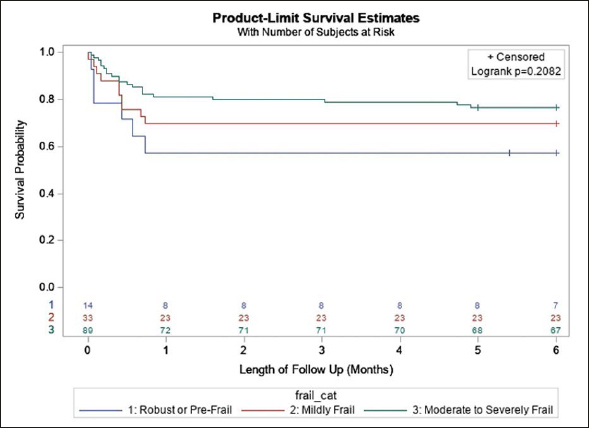
Results: Much of the cohort was classified as moderate to severely frail (65.4%), 24.3% mildly frail, and 10.3% robust or pre-frail. Overall, 27.2% (n=37) of the cohort died (n=26 during hospitalization, n=11 after discharge) and survival did not significantly differ by frailty. Among survivors, inpatient hospitalizations during the 6-month follow-up period varied significantly by frailty (p=0.02). Mean cost over follow-up was $856.37 for the mild and $4914.16 for the moderate to severe frailty group, and monthly expenditures increased with higher frailty classification (p <.001).
Conclusions: In this cohort, claims-based frailty was not significantly associated with survival but was associated with follow-up hospitalizations and Medicare expenditures.





 京公网安备 11010802042870号
京ICP备2023020795号-1
京公网安备 11010802042870号
京ICP备2023020795号-1

 分享
分享
 求助内容:
求助内容: 应助结果提醒方式:
 扫码关注我们
