Gabrielle Stinton , Jane A. Lieviant , Sylvia Kam , Jiin Ying Lim , Jasmine Chew-Yin Goh , Weng Khong Lim , Gareth Baynam , Tele Tan , Duc-Son Pham , Saumya Shekhar Jamuar
{"title":"Clinical free text to HPO codes","authors":"Gabrielle Stinton , Jane A. Lieviant , Sylvia Kam , Jiin Ying Lim , Jasmine Chew-Yin Goh , Weng Khong Lim , Gareth Baynam , Tele Tan , Duc-Son Pham , Saumya Shekhar Jamuar","doi":"10.1016/j.rare.2023.100007","DOIUrl":null,"url":null,"abstract":"<div><p>Leveraging Artificial Intelligence (AI) within the rare disease diagnostic odyssey can facilitate a decrease in diagnostic times and an increase in diagnostic rates. Among the steps involved in the odyssey, this project focused on utilizing AI to automate the standardized capturing of clinical free text into Human Phenotype Ontology (HPO) codes. This research project was conducted at both the KK Women’s and Children’s Hospital (KKH), Singapore and the Rare Care Centre at Perth Children’s Hospital, Western Australia (WA), via the Curtin New Colombo Plan (NCP) Scholarship. The outcome of the project saw the development of a Streamlit web application that utilized two (2) pre-trained AI models – PhenoTagger and PhenoBERT – with a human-in-the-loop design. A case study conducted with ten (10) de-identified clinical reports demonstrated a reduction in the HPO extraction task time from ten (10) to twenty (20) minutes per report to less than five (5) minutes.</p></div>","PeriodicalId":101058,"journal":{"name":"Rare","volume":"1 ","pages":"Article 100007"},"PeriodicalIF":0.0000,"publicationDate":"2023-01-01","publicationTypes":"Journal Article","fieldsOfStudy":null,"isOpenAccess":false,"openAccessPdf":"https://www.sciencedirect.com/science/article/pii/S2950008723000078/pdfft?md5=dfbe25a04a0a3221c87b0b17f2bc30ba&pid=1-s2.0-S2950008723000078-main.pdf","citationCount":"0","resultStr":null,"platform":"Semanticscholar","paperid":null,"PeriodicalName":"Rare","FirstCategoryId":"1085","ListUrlMain":"https://www.sciencedirect.com/science/article/pii/S2950008723000078","RegionNum":0,"RegionCategory":null,"ArticlePicture":[],"TitleCN":null,"AbstractTextCN":null,"PMCID":null,"EPubDate":"","PubModel":"","JCR":"","JCRName":"","Score":null,"Total":0}
引用次数: 0
Abstract
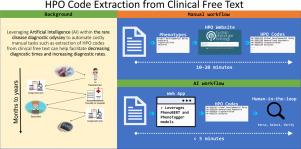
Leveraging Artificial Intelligence (AI) within the rare disease diagnostic odyssey can facilitate a decrease in diagnostic times and an increase in diagnostic rates. Among the steps involved in the odyssey, this project focused on utilizing AI to automate the standardized capturing of clinical free text into Human Phenotype Ontology (HPO) codes. This research project was conducted at both the KK Women’s and Children’s Hospital (KKH), Singapore and the Rare Care Centre at Perth Children’s Hospital, Western Australia (WA), via the Curtin New Colombo Plan (NCP) Scholarship. The outcome of the project saw the development of a Streamlit web application that utilized two (2) pre-trained AI models – PhenoTagger and PhenoBERT – with a human-in-the-loop design. A case study conducted with ten (10) de-identified clinical reports demonstrated a reduction in the HPO extraction task time from ten (10) to twenty (20) minutes per report to less than five (5) minutes.



 京公网安备 11010802042870号
京ICP备2023020795号-1
京公网安备 11010802042870号
京ICP备2023020795号-1

 分享
分享

 求助内容:
求助内容: 应助结果提醒方式:
 扫码关注我们
