{"title":"QuantiFERON-TB Gold Plus and QuantiFERON-TB Gold In-tube assays for detecting latent tuberculosis infection in Thai healthcare workers.","authors":"Janisara Rudeeaneksin, Sopa Srisungngam, Wiphat Klayut, Supranee Bunchoo, Payu Bhakdeenuan, Benjawan Phetsuksiri","doi":"10.1590/S1678-9946202365013","DOIUrl":null,"url":null,"abstract":"<p><p>Detecting latent tuberculosis infection (LTBI) is important, especially in high-risk populations including healthcare workers (HCWs). QuantiFERON-TB Gold Plus (QFT-Plus) is a new version of the interferon-gamma release assays (IGRAs) to replace the QuantiFERON-TB Gold In-tube (QFT-GIT). However, data on the use of QFT-Plus for LTBI detection in high TB-burden countries are limited. This study was conducted in a TB-endemic setting in Thailand. HCWs were enrolled in the study and underwent both tests during the annual health screening. The testing results were compared and the concordance was determined. Of 102 HCWs, 11 (10.78%) were positive according to both tests, and 15 (14.71%) were positive according to QFT-Plus. The overall agreement between assays was 96.08%, with Cohen's kappa coefficient (k) at 0.82. All four discordant results occurred with QFT-GIT negative and QFT-Plus positive. The comparison between QFT-GIT and QFT-Plus based on each antigen tube (TB1 or TB2) exhibited similar concordance with 99.02% and 95.10% agreement, respectively. The intra-comparison between TB1 and TB2 of QFT-Plus also showed good concordance at 96.08%. Among this group of HCWs, the LTBI prevalence of any positive results in both tests was low. Overall, the study showed good agreement between QFT-Plus and QFT-GIT (k = 0.82) with a minimal difference, suggesting similar assay performance to that mainly carried out in TB-low incidence countries. The results support the use of QFT-Plus for detecting LTBI in a format similar to QFT-GIT.</p>","PeriodicalId":54466,"journal":{"name":"Revista Do Instituto De Medicina Tropical De Sao Paulo","volume":"65 ","pages":"e13"},"PeriodicalIF":1.7000,"publicationDate":"2023-01-01","publicationTypes":"Journal Article","fieldsOfStudy":null,"isOpenAccess":false,"openAccessPdf":"https://ftp.ncbi.nlm.nih.gov/pub/pmc/oa_pdf/ac/10/1678-9946-rimtsp-65-S1678-9946202365013.PMC9901577.pdf","citationCount":"1","resultStr":null,"platform":"Semanticscholar","paperid":null,"PeriodicalName":"Revista Do Instituto De Medicina Tropical De Sao Paulo","FirstCategoryId":"3","ListUrlMain":"https://doi.org/10.1590/S1678-9946202365013","RegionNum":4,"RegionCategory":"医学","ArticlePicture":[],"TitleCN":null,"AbstractTextCN":null,"PMCID":null,"EPubDate":"","PubModel":"","JCR":"Q4","JCRName":"INFECTIOUS DISEASES","Score":null,"Total":0}
引用次数: 1
Abstract
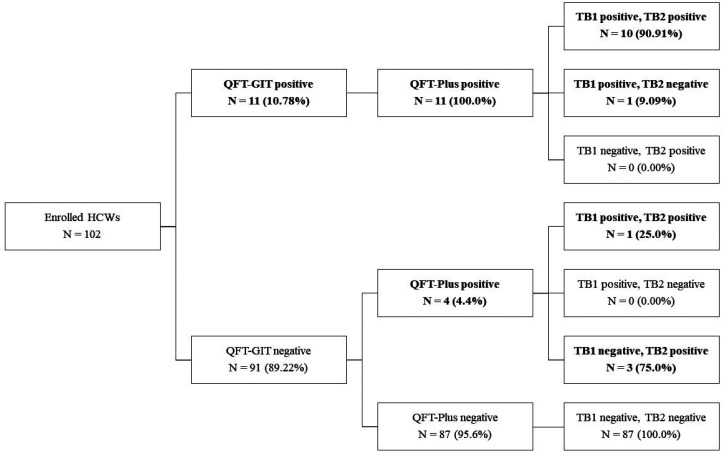
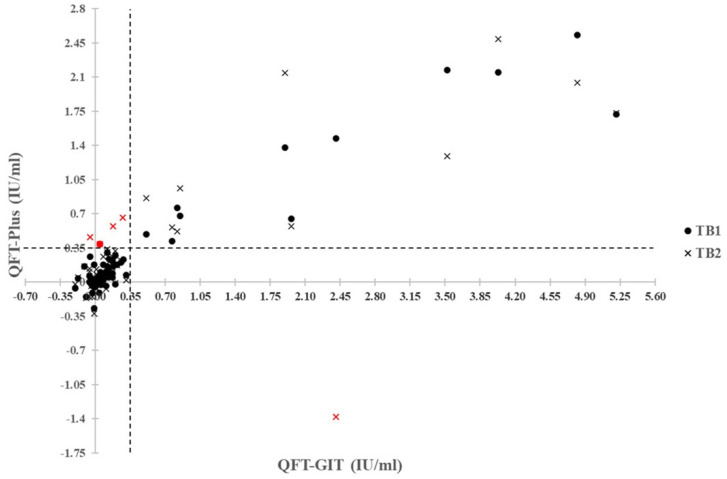
Detecting latent tuberculosis infection (LTBI) is important, especially in high-risk populations including healthcare workers (HCWs). QuantiFERON-TB Gold Plus (QFT-Plus) is a new version of the interferon-gamma release assays (IGRAs) to replace the QuantiFERON-TB Gold In-tube (QFT-GIT). However, data on the use of QFT-Plus for LTBI detection in high TB-burden countries are limited. This study was conducted in a TB-endemic setting in Thailand. HCWs were enrolled in the study and underwent both tests during the annual health screening. The testing results were compared and the concordance was determined. Of 102 HCWs, 11 (10.78%) were positive according to both tests, and 15 (14.71%) were positive according to QFT-Plus. The overall agreement between assays was 96.08%, with Cohen's kappa coefficient (k) at 0.82. All four discordant results occurred with QFT-GIT negative and QFT-Plus positive. The comparison between QFT-GIT and QFT-Plus based on each antigen tube (TB1 or TB2) exhibited similar concordance with 99.02% and 95.10% agreement, respectively. The intra-comparison between TB1 and TB2 of QFT-Plus also showed good concordance at 96.08%. Among this group of HCWs, the LTBI prevalence of any positive results in both tests was low. Overall, the study showed good agreement between QFT-Plus and QFT-GIT (k = 0.82) with a minimal difference, suggesting similar assay performance to that mainly carried out in TB-low incidence countries. The results support the use of QFT-Plus for detecting LTBI in a format similar to QFT-GIT.
期刊介绍:
The Revista do Instituto de Medicina Tropical de São Paulo (Journal of the São Paulo Institute of Tropical Medicine) is a journal devoted to research on different aspects of tropical infectious diseases. The journal welcomes original work on all infectious diseases, provided that data and results are directly linked to human health.
The journal publishes, besides original articles, review articles, case reports, brief communications, and letters to the editor. The journal publishes manuscripts only in English.
From 2016 on, the Revista do Instituto de Medicina Tropical de São Paulo (Journal of the São Paulo Institute of Tropical Medicine) is published online only, maintaining the free access.
For more information visit:
- http://www.scielo.br/rimtsp
- http://www.imt.usp.br/revista-imt/



 京公网安备 11010802042870号
京ICP备2023020795号-1
京公网安备 11010802042870号
京ICP备2023020795号-1

 分享
分享
 求助内容:
求助内容: 应助结果提醒方式:
 扫码关注我们
