Best Laboratory Screening in Diagnosing Secondary Osteoporosis and Fracture Risk Assessment Tool and the National Osteoporosis Guideline Group Performance in Determining Clinical Risk: A Cross-Sectional Evaluation of the Bone Health in Postmenopausal Brazilian Women.
{"title":"Best Laboratory Screening in Diagnosing Secondary Osteoporosis and Fracture Risk Assessment Tool and the National Osteoporosis Guideline Group Performance in Determining Clinical Risk: A Cross-Sectional Evaluation of the Bone Health in Postmenopausal Brazilian Women.","authors":"Marcelo Luis Steiner, Gabriela Polvani Crotti, Juliana Daltrino Teodoro, Raissa Kaori Ikeda, Rodolfo Strufaldi, César Eduardo Fernandes, Luciano de Melo Pompei","doi":"10.11005/jbm.2023.30.1.47","DOIUrl":null,"url":null,"abstract":"Background Identifying postmenopausal women with a high risk of having osteoporosis and fractures is a current challenge. This study aimed to assess the diagnostic performance of biochemical tests in identifying secondary osteoporosis and the fracture risk assessment tool (FRAX) in identifying fracture risk. Methods Data from biochemical tests and bone densitometry of postmenopausal women were analyzed. Additionally, the FRAX result was obtained and the patients were classified according to the National Osteoporosis Guideline Group (NOGG). Results A total of 646 women were evaluated, of whom 201 (31.1%) had osteoporosis or a previous frailty fracture. These women had statistically different parathyroid hormone (PTH) and alkaline phosphatase serum levels (P<0.01 and P=0.02, respectively) than those without osteoporosis or fracture. However, those at high risk had a higher prevalence of hypovitaminosis D (46% vs. 36%) and hypocalciuria (17% vs. 9%). The FRAX showed an area under the curve of 0.757 (P<0.01) and 0.788 (P<0.01) for identifying women at risk for “major fractures” and “hip,” respectively. The NOGG categorization had a sensitivity of 19% to identify high-risk women, a specificity of 91.3% for low-risk women, with a positive predictive value of 57.4% and a negative predictive value of 64.6%. Conclusions The evaluation of PTH, 25-hydroxy-vitamin D, serum calcium, and 24-hr urinary calcium proved adequate for initial osteoporosis screening. The FRAX tool has a regular ability to screen women at risk for fracture, and the NOGG method has high specificity to identify those at low risk.","PeriodicalId":15070,"journal":{"name":"Journal of Bone Metabolism","volume":"30 1","pages":"47-57"},"PeriodicalIF":0.0000,"publicationDate":"2023-02-01","publicationTypes":"Journal Article","fieldsOfStudy":null,"isOpenAccess":false,"openAccessPdf":"https://ftp.ncbi.nlm.nih.gov/pub/pmc/oa_pdf/29/1c/jbm-2023-30-1-47.PMC10036189.pdf","citationCount":"0","resultStr":null,"platform":"Semanticscholar","paperid":null,"PeriodicalName":"Journal of Bone Metabolism","FirstCategoryId":"1085","ListUrlMain":"https://doi.org/10.11005/jbm.2023.30.1.47","RegionNum":0,"RegionCategory":null,"ArticlePicture":[],"TitleCN":null,"AbstractTextCN":null,"PMCID":null,"EPubDate":"","PubModel":"","JCR":"Q2","JCRName":"Medicine","Score":null,"Total":0}
引用次数: 0
Abstract
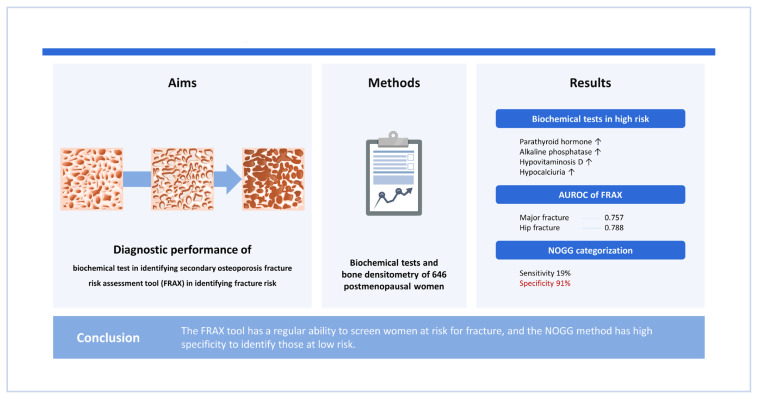
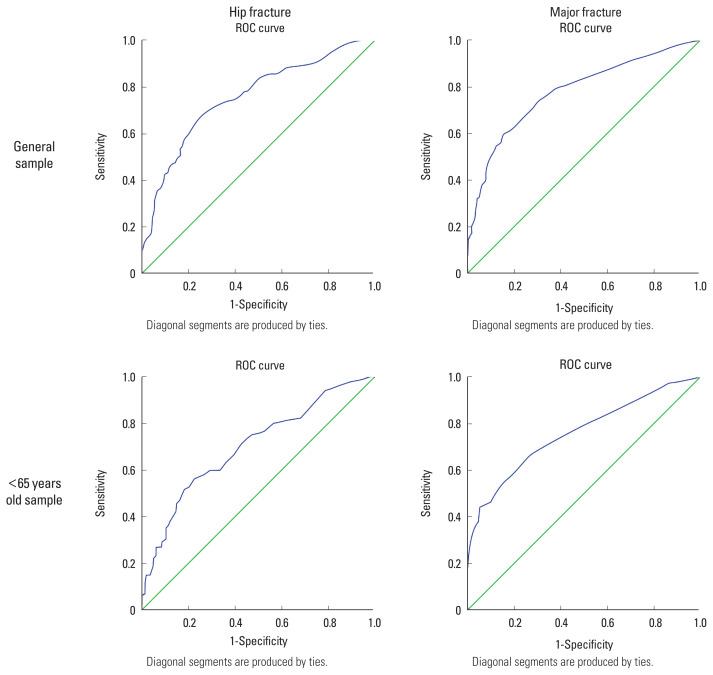
Background Identifying postmenopausal women with a high risk of having osteoporosis and fractures is a current challenge. This study aimed to assess the diagnostic performance of biochemical tests in identifying secondary osteoporosis and the fracture risk assessment tool (FRAX) in identifying fracture risk. Methods Data from biochemical tests and bone densitometry of postmenopausal women were analyzed. Additionally, the FRAX result was obtained and the patients were classified according to the National Osteoporosis Guideline Group (NOGG). Results A total of 646 women were evaluated, of whom 201 (31.1%) had osteoporosis or a previous frailty fracture. These women had statistically different parathyroid hormone (PTH) and alkaline phosphatase serum levels (P<0.01 and P=0.02, respectively) than those without osteoporosis or fracture. However, those at high risk had a higher prevalence of hypovitaminosis D (46% vs. 36%) and hypocalciuria (17% vs. 9%). The FRAX showed an area under the curve of 0.757 (P<0.01) and 0.788 (P<0.01) for identifying women at risk for “major fractures” and “hip,” respectively. The NOGG categorization had a sensitivity of 19% to identify high-risk women, a specificity of 91.3% for low-risk women, with a positive predictive value of 57.4% and a negative predictive value of 64.6%. Conclusions The evaluation of PTH, 25-hydroxy-vitamin D, serum calcium, and 24-hr urinary calcium proved adequate for initial osteoporosis screening. The FRAX tool has a regular ability to screen women at risk for fracture, and the NOGG method has high specificity to identify those at low risk.




 京公网安备 11010802042870号
京ICP备2023020795号-1
京公网安备 11010802042870号
京ICP备2023020795号-1

 分享
分享
 求助内容:
求助内容: 应助结果提醒方式:
 扫码关注我们
