{"title":"Supramolecular Hydrogels Based on DNA Self-Assembly","authors":"Yu Shao, Haoyang Jia, Tianyang Cao, Dongsheng Liu*","doi":"10.1021/acs.accounts.6b00524","DOIUrl":null,"url":null,"abstract":"<p >Extracellular matrix (ECM) provides essential supports three dimensionally to the cells in living organs, including mechanical support and signal, nutrition, oxygen, and waste transportation. Thus, using hydrogels to mimic its function has attracted much attention in recent years, especially in tissue engineering, cell biology, and drug screening. However, a hydrogel system that can merit all parameters of the natural ECM is still a challenge.</p><p >In the past decade, deoxyribonucleic acid (DNA) has arisen as an outstanding building material for the hydrogels, as it has unique properties compared to most synthetic or natural polymers, such as sequence designability, precise recognition, structural rigidity, and minimal toxicity. By simple attachment to polymers as a side chain, DNA has been widely used as cross-links in hydrogel preparation. The formed secondary structures could confer on the hydrogel designable responsiveness, such as response to temperature, pH, metal ions, proteins, DNA, RNA, and small signal molecules like ATP. Moreover, single or multiple DNA restriction enzyme sites could be incorporated into the hydrogels by sequence design and greatly expand the latitude of their responses. Compared with most supramolecular hydrogels, these DNA cross-linked hydrogels could be relatively strong and easily adjustable via sequence variation, but it is noteworthy that these hydrogels still have excellent thixotropic properties and could be easily injected through a needle. In addition, the quick formation of duplex has also enabled the multilayer three-dimensional injection printing of living cells with the hydrogel as matrix. When the matrix is built purely by DNA assembly structures, the hydrogel inherits all the previously described characteristics; however, the long persistence length of DNA structures excluded the small size meshes of the network and made the hydrogel permeable to nutrition for cell proliferation. This unique property greatly expands the cell viability in the three-dimensional matrix to several weeks and also provides an easy way to prepare interpenetrating double network materials.</p><p >In this Account, we outline the stream of hydrogels based on DNA self-assembly and discuss the mechanism that brings outstanding properties to the materials. Unlike most reported hydrogel systems, the all-in-one character of the DNA hydrogel avoids the “cask effect” in the properties. We believe the hydrogel will greatly benefit cell behavior studies especially in the following aspects: (1) stem cell differentiation can be studied with solely tunable mechanical strength of the matrix; (2) the dynamic nature of the network can allow cell migration through the hydrogel, which will help to build a more realistic model to observe the migration of cancer cells <i>in vivo</i>; (3) combination with rapidly developing three-dimension printing technology, the hydrogel will boost the construction of three-dimensional tissues and artificial organs.</p>","PeriodicalId":1,"journal":{"name":"Accounts of Chemical Research","volume":"50 4","pages":"659–668"},"PeriodicalIF":17.7000,"publicationDate":"2017-03-16","publicationTypes":"Journal Article","fieldsOfStudy":null,"isOpenAccess":false,"openAccessPdf":"https://sci-hub-pdf.com/10.1021/acs.accounts.6b00524","citationCount":"230","resultStr":null,"platform":"Semanticscholar","paperid":null,"PeriodicalName":"Accounts of Chemical Research","FirstCategoryId":"92","ListUrlMain":"https://pubs.acs.org/doi/10.1021/acs.accounts.6b00524","RegionNum":1,"RegionCategory":"化学","ArticlePicture":[],"TitleCN":null,"AbstractTextCN":null,"PMCID":null,"EPubDate":"","PubModel":"","JCR":"Q1","JCRName":"CHEMISTRY, MULTIDISCIPLINARY","Score":null,"Total":0}
引用次数: 230
Abstract
Extracellular matrix (ECM) provides essential supports three dimensionally to the cells in living organs, including mechanical support and signal, nutrition, oxygen, and waste transportation. Thus, using hydrogels to mimic its function has attracted much attention in recent years, especially in tissue engineering, cell biology, and drug screening. However, a hydrogel system that can merit all parameters of the natural ECM is still a challenge.
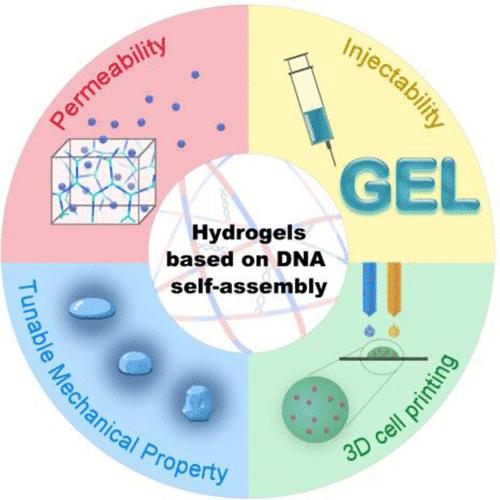
In the past decade, deoxyribonucleic acid (DNA) has arisen as an outstanding building material for the hydrogels, as it has unique properties compared to most synthetic or natural polymers, such as sequence designability, precise recognition, structural rigidity, and minimal toxicity. By simple attachment to polymers as a side chain, DNA has been widely used as cross-links in hydrogel preparation. The formed secondary structures could confer on the hydrogel designable responsiveness, such as response to temperature, pH, metal ions, proteins, DNA, RNA, and small signal molecules like ATP. Moreover, single or multiple DNA restriction enzyme sites could be incorporated into the hydrogels by sequence design and greatly expand the latitude of their responses. Compared with most supramolecular hydrogels, these DNA cross-linked hydrogels could be relatively strong and easily adjustable via sequence variation, but it is noteworthy that these hydrogels still have excellent thixotropic properties and could be easily injected through a needle. In addition, the quick formation of duplex has also enabled the multilayer three-dimensional injection printing of living cells with the hydrogel as matrix. When the matrix is built purely by DNA assembly structures, the hydrogel inherits all the previously described characteristics; however, the long persistence length of DNA structures excluded the small size meshes of the network and made the hydrogel permeable to nutrition for cell proliferation. This unique property greatly expands the cell viability in the three-dimensional matrix to several weeks and also provides an easy way to prepare interpenetrating double network materials.
In this Account, we outline the stream of hydrogels based on DNA self-assembly and discuss the mechanism that brings outstanding properties to the materials. Unlike most reported hydrogel systems, the all-in-one character of the DNA hydrogel avoids the “cask effect” in the properties. We believe the hydrogel will greatly benefit cell behavior studies especially in the following aspects: (1) stem cell differentiation can be studied with solely tunable mechanical strength of the matrix; (2) the dynamic nature of the network can allow cell migration through the hydrogel, which will help to build a more realistic model to observe the migration of cancer cells in vivo; (3) combination with rapidly developing three-dimension printing technology, the hydrogel will boost the construction of three-dimensional tissues and artificial organs.
期刊介绍:
Accounts of Chemical Research presents short, concise and critical articles offering easy-to-read overviews of basic research and applications in all areas of chemistry and biochemistry. These short reviews focus on research from the author’s own laboratory and are designed to teach the reader about a research project. In addition, Accounts of Chemical Research publishes commentaries that give an informed opinion on a current research problem. Special Issues online are devoted to a single topic of unusual activity and significance.
Accounts of Chemical Research replaces the traditional article abstract with an article "Conspectus." These entries synopsize the research affording the reader a closer look at the content and significance of an article. Through this provision of a more detailed description of the article contents, the Conspectus enhances the article's discoverability by search engines and the exposure for the research.




 京公网安备 11010802042870号
京ICP备2023020795号-1
京公网安备 11010802042870号
京ICP备2023020795号-1

 分享
分享
 求助内容:
求助内容: 应助结果提醒方式:
 扫码关注我们
