{"title":"Systematic Review of Suicidal Behaviors Related to Methylphenidate and Atomoxetine in Patients With Attention Deficit Hyperactivity Disorder.","authors":"Jae Heon Kim, Suyeon Park, Yeon Jung Lee","doi":"10.5765/jkacap.220040","DOIUrl":null,"url":null,"abstract":"<p><strong>Objectives: </strong>This study investigated the relationship between suicidal behavior and the use of methylphenidate (MPH) or atomoxetine (ATX) in patients with attention deficit hyperactivity disorder (ADHD).</p><p><strong>Methods: </strong>The Preferred Reporting Items for Systematic Review and Meta-Analysis guidelines were used to conduct a meta-analysis. The Physiotherapy Evidence Database scale was used to score the quality of the studies.</p><p><strong>Results: </strong>Nine studies were included in this quantitative analysis. The analysis included 602864 patients with ADHD (521125 and 81739 patients were taking methylphenidate [MPH group] and atomoxetine [ATX group], respectively) and 19230 healthy controls. The overall estimates were in the order of the control, MPH, and ATX groups; however, no statistically significant between-group difference was observed in the incidence of events (p=0.553 for control vs. MPH; p=1.000 for control vs. ATX; p=1.000 for MPH vs. ATX).</p><p><strong>Conclusion: </strong>The rate of suicidal behavior was higher in the ADHD groups treated with MPH and ATX than in the control group. However, no statistically significant difference was observed between the ADHD groups treated with MPH and ATX, and the control group. Therefore, MPH and ATX did not increase suicidal behavior.</p>","PeriodicalId":74820,"journal":{"name":"","volume":"34 2","pages":"125-132"},"PeriodicalIF":0.0,"publicationDate":"2023-04-01","publicationTypes":"Journal Article","fieldsOfStudy":null,"isOpenAccess":false,"openAccessPdf":"https://ftp.ncbi.nlm.nih.gov/pub/pmc/oa_pdf/60/0e/jkacap-34-2-125.PMC10080256.pdf","citationCount":"0","resultStr":null,"platform":"Semanticscholar","paperid":null,"PeriodicalName":"","FirstCategoryId":"1085","ListUrlMain":"https://doi.org/10.5765/jkacap.220040","RegionNum":0,"RegionCategory":null,"ArticlePicture":[],"TitleCN":null,"AbstractTextCN":null,"PMCID":null,"EPubDate":"","PubModel":"","JCR":"","JCRName":"","Score":null,"Total":0}
引用次数: 0
Abstract
Objectives: This study investigated the relationship between suicidal behavior and the use of methylphenidate (MPH) or atomoxetine (ATX) in patients with attention deficit hyperactivity disorder (ADHD).
Methods: The Preferred Reporting Items for Systematic Review and Meta-Analysis guidelines were used to conduct a meta-analysis. The Physiotherapy Evidence Database scale was used to score the quality of the studies.
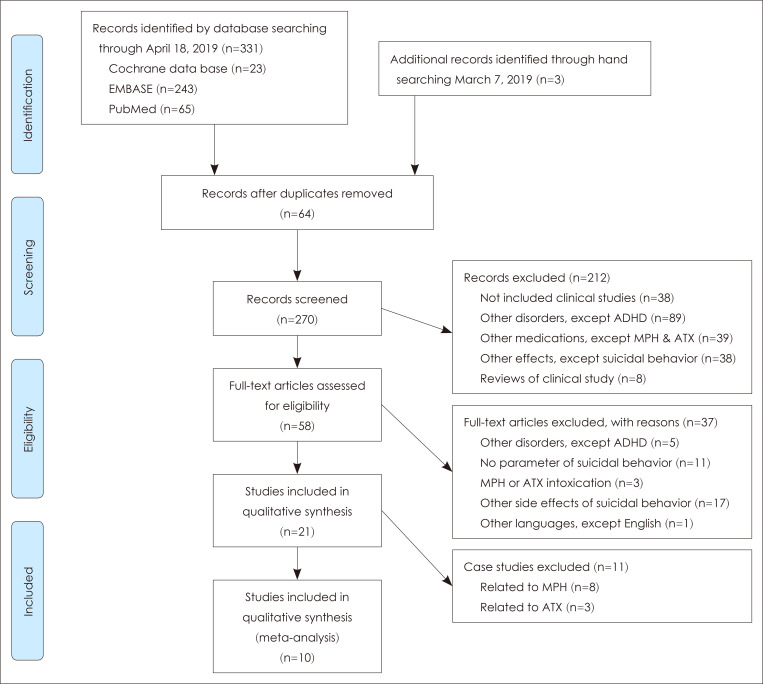
Results: Nine studies were included in this quantitative analysis. The analysis included 602864 patients with ADHD (521125 and 81739 patients were taking methylphenidate [MPH group] and atomoxetine [ATX group], respectively) and 19230 healthy controls. The overall estimates were in the order of the control, MPH, and ATX groups; however, no statistically significant between-group difference was observed in the incidence of events (p=0.553 for control vs. MPH; p=1.000 for control vs. ATX; p=1.000 for MPH vs. ATX).
Conclusion: The rate of suicidal behavior was higher in the ADHD groups treated with MPH and ATX than in the control group. However, no statistically significant difference was observed between the ADHD groups treated with MPH and ATX, and the control group. Therefore, MPH and ATX did not increase suicidal behavior.
目的:本研究探讨自杀行为与注意缺陷多动障碍(ADHD)患者使用哌醋甲酯(MPH)或托莫西汀(ATX)之间的关系。方法:采用系统评价和荟萃分析指南首选报告项目进行荟萃分析。使用物理治疗证据数据库量表对研究质量进行评分。结果:本定量分析纳入9项研究。分析纳入602864例ADHD患者(分别服用哌甲酯[MPH组]和托莫西汀[ATX组]的患者分别为521125例和81739例)和19230名健康对照。总体估计值依次为对照组、MPH组和ATX组;然而,在事件发生率方面,组间无统计学差异(对照组与MPH组p=0.553;对照与ATX的p=1.000;p=1.000 MPH vs. ATX)。结论:治疗组自杀行为发生率高于对照组。然而,使用MPH和ATX治疗的ADHD组与对照组之间没有统计学差异。因此,MPH和ATX并没有增加自杀行为。



 京公网安备 11010802042870号
京ICP备2023020795号-1
京公网安备 11010802042870号
京ICP备2023020795号-1

 分享
分享
 求助内容:
求助内容: 应助结果提醒方式:
 扫码关注我们
