Fang Wu, Han-Jun Zuo, Xue-Qi Ren, Peng-Xiang Wang, Fan Li, Juan-Juan Li
{"title":"Gastrodin Regulates the Notch-1 Signal Pathway via Renin-Angiotensin System in Activated Microglia.","authors":"Fang Wu, Han-Jun Zuo, Xue-Qi Ren, Peng-Xiang Wang, Fan Li, Juan-Juan Li","doi":"10.1007/s12017-022-08714-1","DOIUrl":null,"url":null,"abstract":"<p><p>Notch-1 and renin angiotensin system (RAS) are involved in microglia activation. It has been reported that gastrodin inhibited inflammatory responses mediated by activated microglia. This study explored the possible interaction between this two pathways, and to determine whether gastrodin would exert its effects on both of them. Expression of RAS, Notch-1 signaling and proinflammatory mediators in lipopolysaccharide (LPS) activated BV-2 microglia subjected to various treatments was determined by Western blot and immunofluorescence. The protein expression of RAS, Notch-1 pathway and TNF-α and IL-1β was significantly increased in activated microglia. Exogenous Ang II markedly enhanced the expression of these biomarkers. Meanwhile, Azilsartan [a specific inhibitor of AT<sub>1</sub> (AT<sub>1</sub>I)] inhibited the expression of Notch-1 pathway and proinflammatory cytokines. When Notch-1 signaling was inhibited with DAPT, ACE and AT<sub>1</sub> expression remained unaffected, indicating that RAS can regulate the Notch-1 pathway in activated microglia but not reciprocally. Additionally, we showed here that gastrodin inhibited the RAS, Notch-1 pathway and inflammatory response. Remarkably, gastrodin did not exert any effect on expression of Notch-1 signaling when RAS was blocked by AT<sub>1</sub>I, suggesting that gastrodin acts on the RAS directly, not through the Notch-1 pathway. Furthermore, TNF-α and IL-1β expression was significantly increased in activated microglia treated with exogenous Ang II; the expression, however, was suppressed by gastrodin. Of note, expression of proinflammatory cytokines was further decreased in gastrodin and AT<sub>1</sub>I combination treatment. The results suggest that gastrodin acts via the RAS which regulates the Notch-1 signaling and inflammation in LPS-induced microglia.</p>","PeriodicalId":19304,"journal":{"name":"NeuroMolecular Medicine","volume":"25 1","pages":"40-52"},"PeriodicalIF":3.9000,"publicationDate":"2023-03-01","publicationTypes":"Journal Article","fieldsOfStudy":null,"isOpenAccess":false,"openAccessPdf":"","citationCount":"5","resultStr":null,"platform":"Semanticscholar","paperid":null,"PeriodicalName":"NeuroMolecular Medicine","FirstCategoryId":"3","ListUrlMain":"https://doi.org/10.1007/s12017-022-08714-1","RegionNum":4,"RegionCategory":"医学","ArticlePicture":[],"TitleCN":null,"AbstractTextCN":null,"PMCID":null,"EPubDate":"","PubModel":"","JCR":"Q2","JCRName":"NEUROSCIENCES","Score":null,"Total":0}
引用次数: 5
Abstract
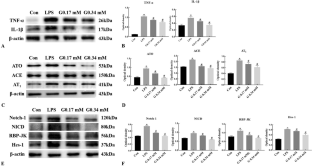
Notch-1 and renin angiotensin system (RAS) are involved in microglia activation. It has been reported that gastrodin inhibited inflammatory responses mediated by activated microglia. This study explored the possible interaction between this two pathways, and to determine whether gastrodin would exert its effects on both of them. Expression of RAS, Notch-1 signaling and proinflammatory mediators in lipopolysaccharide (LPS) activated BV-2 microglia subjected to various treatments was determined by Western blot and immunofluorescence. The protein expression of RAS, Notch-1 pathway and TNF-α and IL-1β was significantly increased in activated microglia. Exogenous Ang II markedly enhanced the expression of these biomarkers. Meanwhile, Azilsartan [a specific inhibitor of AT1 (AT1I)] inhibited the expression of Notch-1 pathway and proinflammatory cytokines. When Notch-1 signaling was inhibited with DAPT, ACE and AT1 expression remained unaffected, indicating that RAS can regulate the Notch-1 pathway in activated microglia but not reciprocally. Additionally, we showed here that gastrodin inhibited the RAS, Notch-1 pathway and inflammatory response. Remarkably, gastrodin did not exert any effect on expression of Notch-1 signaling when RAS was blocked by AT1I, suggesting that gastrodin acts on the RAS directly, not through the Notch-1 pathway. Furthermore, TNF-α and IL-1β expression was significantly increased in activated microglia treated with exogenous Ang II; the expression, however, was suppressed by gastrodin. Of note, expression of proinflammatory cytokines was further decreased in gastrodin and AT1I combination treatment. The results suggest that gastrodin acts via the RAS which regulates the Notch-1 signaling and inflammation in LPS-induced microglia.
期刊介绍:
NeuroMolecular Medicine publishes cutting-edge original research articles and critical reviews on the molecular and biochemical basis of neurological disorders. Studies range from genetic analyses of human populations to animal and cell culture models of neurological disorders. Emerging findings concerning the identification of genetic aberrancies and their pathogenic mechanisms at the molecular and cellular levels will be included. Also covered are experimental analyses of molecular cascades involved in the development and adult plasticity of the nervous system, in neurological dysfunction, and in neuronal degeneration and repair. NeuroMolecular Medicine encompasses basic research in the fields of molecular genetics, signal transduction, plasticity, and cell death. The information published in NEMM will provide a window into the future of molecular medicine for the nervous system.



 京公网安备 11010802042870号
京ICP备2023020795号-1
京公网安备 11010802042870号
京ICP备2023020795号-1

 分享
分享
 求助内容:
求助内容: 应助结果提醒方式:
 扫码关注我们
