Chenjie Yu, Han Chen, Linli Zhu, Yan Song, Qifan Jiang, Yaming Zhang, Qurban Ali, Qin Gu, Xuewen Gao, Rainer Borriss, Suomeng Dong, Huijun Wu
{"title":"Profiling of Antimicrobial Metabolites Synthesized by the Endophytic and Genetically Amenable Biocontrol Strain Bacillus velezensis DMW1.","authors":"Chenjie Yu, Han Chen, Linli Zhu, Yan Song, Qifan Jiang, Yaming Zhang, Qurban Ali, Qin Gu, Xuewen Gao, Rainer Borriss, Suomeng Dong, Huijun Wu","doi":"10.1128/spectrum.00038-23","DOIUrl":null,"url":null,"abstract":"<p><p>The genus <i>Bacillus</i> is one of the most important genera for the biological control of plant diseases that are caused by various phytopathogens. The endophytic <i>Bacillus</i> strain DMW1 was isolated from the inner tissues of potato tubers and exhibited strong biocontrol activity. Based on its whole-genome sequence, DMW1 belongs to the Bacillus velezensis species, and it is similar to the model strain <i>B. velezensis</i> FZB42. 12 secondary metabolite biosynthetic gene clusters (BGCs), including two unknown function BGCs, were detected in the DMW1 genome. The strain was shown to be genetically amenable, and seven secondary metabolites acting antagonistically against plant pathogens were identified by a combined genetic and chemical approach. Strain DMW1 did significantly improve the growth of tomato and soybean seedlings, and it was able to control the Phytophthora sojae and Ralstonia solanacearum that were present in the plant seedlings. Due to these properties, the endophytic strain DMW1 appears to be a promising candidate for comparative investigations performed together with the Gram-positive model rhizobacterium FZB42, which is only able to colonize the rhizoplane. <b>IMPORTANCE</b> Phytopathogens are responsible for the wide spread of plant diseases as well as for great losses of crop yields. At present, the strategies used to control plant disease, including the development of resistant cultivars and chemical control, may become ineffective due to the adaptive evolution of pathogens. Therefore, the use of beneficial microorganisms to deal with plant diseases attracts great attention. In the present study, a new strain DMW1, belonging to the species <i>B. velezensis</i>, was discovered with outstanding biocontrol properties. It showed plant growth promotion and disease control abilities that are comparable with those of <i>B. velezensis</i> FZB42 under greenhouse conditions. According to a genomic analysis and a bioactive metabolites analysis, genes that are responsible for promoting plant growth were detected, and metabolites with different antagonistic activities were identified. Our data provide a basis for DMW1 to be further developed and applied as a biopesticide, which is similar to the closely related model strain FZB42.</p>","PeriodicalId":18670,"journal":{"name":"Microbiology spectrum","volume":" ","pages":"e0003823"},"PeriodicalIF":3.8000,"publicationDate":"2023-02-21","publicationTypes":"Journal Article","fieldsOfStudy":null,"isOpenAccess":false,"openAccessPdf":"https://www.ncbi.nlm.nih.gov/pmc/articles/PMC10100683/pdf/","citationCount":"0","resultStr":null,"platform":"Semanticscholar","paperid":null,"PeriodicalName":"Microbiology spectrum","FirstCategoryId":"99","ListUrlMain":"https://doi.org/10.1128/spectrum.00038-23","RegionNum":2,"RegionCategory":"生物学","ArticlePicture":[],"TitleCN":null,"AbstractTextCN":null,"PMCID":null,"EPubDate":"","PubModel":"","JCR":"Q2","JCRName":"MICROBIOLOGY","Score":null,"Total":0}
引用次数: 0
Abstract
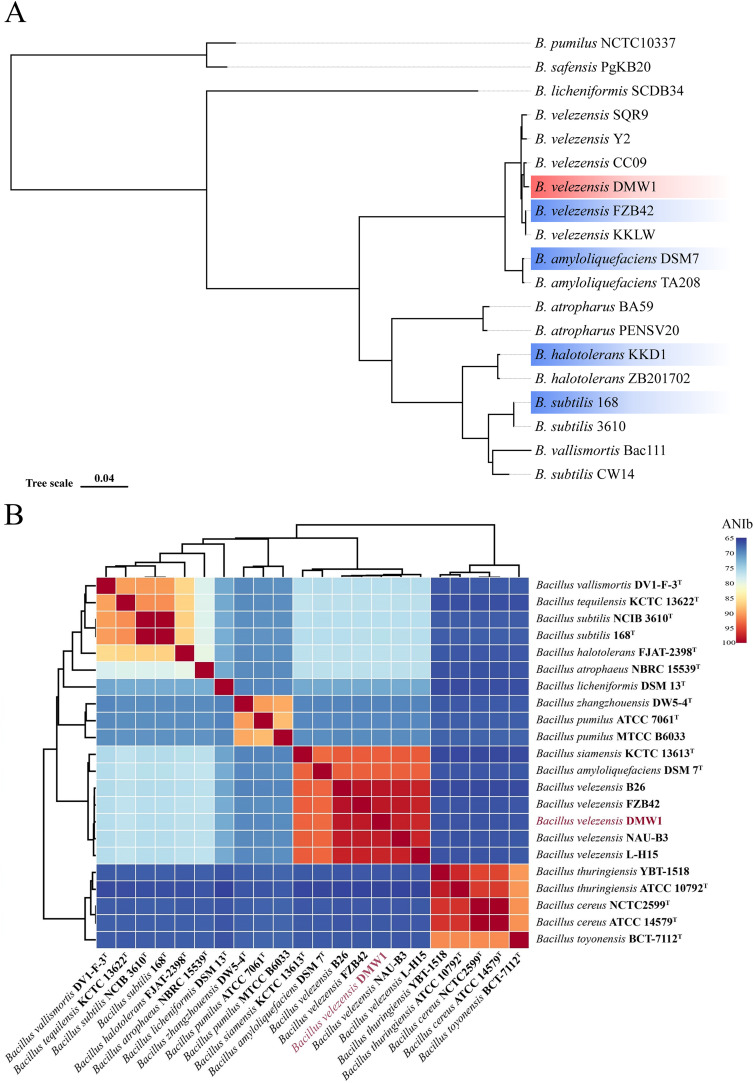
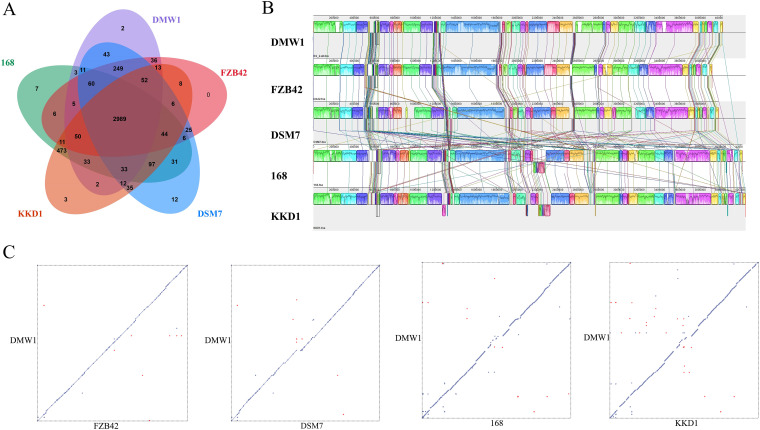
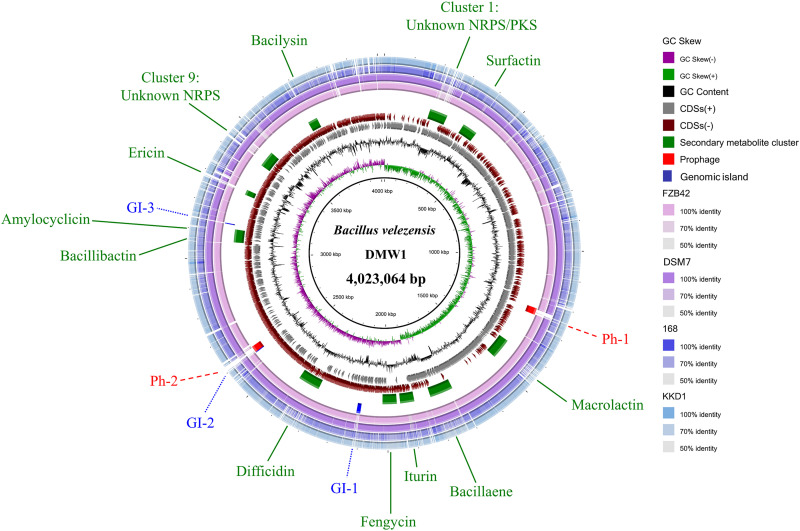
The genus Bacillus is one of the most important genera for the biological control of plant diseases that are caused by various phytopathogens. The endophytic Bacillus strain DMW1 was isolated from the inner tissues of potato tubers and exhibited strong biocontrol activity. Based on its whole-genome sequence, DMW1 belongs to the Bacillus velezensis species, and it is similar to the model strain B. velezensis FZB42. 12 secondary metabolite biosynthetic gene clusters (BGCs), including two unknown function BGCs, were detected in the DMW1 genome. The strain was shown to be genetically amenable, and seven secondary metabolites acting antagonistically against plant pathogens were identified by a combined genetic and chemical approach. Strain DMW1 did significantly improve the growth of tomato and soybean seedlings, and it was able to control the Phytophthora sojae and Ralstonia solanacearum that were present in the plant seedlings. Due to these properties, the endophytic strain DMW1 appears to be a promising candidate for comparative investigations performed together with the Gram-positive model rhizobacterium FZB42, which is only able to colonize the rhizoplane. IMPORTANCE Phytopathogens are responsible for the wide spread of plant diseases as well as for great losses of crop yields. At present, the strategies used to control plant disease, including the development of resistant cultivars and chemical control, may become ineffective due to the adaptive evolution of pathogens. Therefore, the use of beneficial microorganisms to deal with plant diseases attracts great attention. In the present study, a new strain DMW1, belonging to the species B. velezensis, was discovered with outstanding biocontrol properties. It showed plant growth promotion and disease control abilities that are comparable with those of B. velezensis FZB42 under greenhouse conditions. According to a genomic analysis and a bioactive metabolites analysis, genes that are responsible for promoting plant growth were detected, and metabolites with different antagonistic activities were identified. Our data provide a basis for DMW1 to be further developed and applied as a biopesticide, which is similar to the closely related model strain FZB42.
期刊介绍:
Microbiology Spectrum publishes commissioned review articles on topics in microbiology representing ten content areas: Archaea; Food Microbiology; Bacterial Genetics, Cell Biology, and Physiology; Clinical Microbiology; Environmental Microbiology and Ecology; Eukaryotic Microbes; Genomics, Computational, and Synthetic Microbiology; Immunology; Pathogenesis; and Virology. Reviews are interrelated, with each review linking to other related content. A large board of Microbiology Spectrum editors aids in the development of topics for potential reviews and in the identification of an editor, or editors, who shepherd each collection.



 京公网安备 11010802042870号
京ICP备2023020795号-1
京公网安备 11010802042870号
京ICP备2023020795号-1

 分享
分享
 求助内容:
求助内容: 应助结果提醒方式:
 扫码关注我们
