Wesley
G. Cochrane, Marie L. Malone, Vuong Q. Dang, Valerie Cavett, Alexander L. Satz*, Brian M. Paegel*
{"title":"Activity-Based DNA-Encoded Library Screening","authors":"Wesley\r\nG. Cochrane, Marie L. Malone, Vuong Q. Dang, Valerie Cavett, Alexander L. Satz*, Brian M. Paegel*","doi":"10.1021/acscombsci.9b00037","DOIUrl":null,"url":null,"abstract":"<p >Robotic high-throughput compound screening (HTS) and, increasingly, DNA-encoded library (DEL) screening are driving bioactive chemical matter discovery in the postgenomic era. HTS enables activity-based investigation of highly complex targets using static compound libraries. Conversely, DEL grants efficient access to novel chemical diversity, although screening is limited to affinity-based selections. Here, we describe an integrated droplet-based microfluidic circuit that directly screens solid-phase DELs for activity. An example screen of a 67?100-member library for inhibitors of the phosphodiesterase autotaxin yielded 35 high-priority structures for nanomole-scale synthesis and validation (20 active), guiding candidate selection for synthesis at scale (5/5 compounds with IC<sub>50</sub> values of 4–10 μM). We further compared activity-based hits with those of an analogous affinity-based DEL selection. This miniaturized screening platform paves the way toward applying DELs to more complex targets (signaling pathways, cellular response) and represents a distributable approach to small molecule discovery.</p>","PeriodicalId":14,"journal":{"name":"ACS Combinatorial Science","volume":"21 5","pages":"425–435"},"PeriodicalIF":3.7840,"publicationDate":"2019-03-18","publicationTypes":"Journal Article","fieldsOfStudy":null,"isOpenAccess":false,"openAccessPdf":"https://sci-hub-pdf.com/10.1021/acscombsci.9b00037","citationCount":"47","resultStr":null,"platform":"Semanticscholar","paperid":null,"PeriodicalName":"ACS Combinatorial Science","FirstCategoryId":"92","ListUrlMain":"https://pubs.acs.org/doi/10.1021/acscombsci.9b00037","RegionNum":3,"RegionCategory":"化学","ArticlePicture":[],"TitleCN":null,"AbstractTextCN":null,"PMCID":null,"EPubDate":"","PubModel":"","JCR":"Q1","JCRName":"Chemistry","Score":null,"Total":0}
引用次数: 47
Abstract
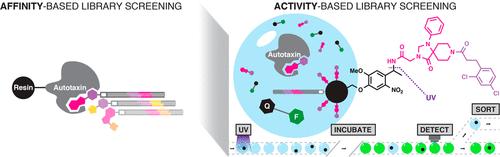
Robotic high-throughput compound screening (HTS) and, increasingly, DNA-encoded library (DEL) screening are driving bioactive chemical matter discovery in the postgenomic era. HTS enables activity-based investigation of highly complex targets using static compound libraries. Conversely, DEL grants efficient access to novel chemical diversity, although screening is limited to affinity-based selections. Here, we describe an integrated droplet-based microfluidic circuit that directly screens solid-phase DELs for activity. An example screen of a 67?100-member library for inhibitors of the phosphodiesterase autotaxin yielded 35 high-priority structures for nanomole-scale synthesis and validation (20 active), guiding candidate selection for synthesis at scale (5/5 compounds with IC50 values of 4–10 μM). We further compared activity-based hits with those of an analogous affinity-based DEL selection. This miniaturized screening platform paves the way toward applying DELs to more complex targets (signaling pathways, cellular response) and represents a distributable approach to small molecule discovery.
期刊介绍:
The Journal of Combinatorial Chemistry has been relaunched as ACS Combinatorial Science under the leadership of new Editor-in-Chief M.G. Finn of The Scripps Research Institute. The journal features an expanded scope and will build upon the legacy of the Journal of Combinatorial Chemistry, a highly cited leader in the field.




 京公网安备 11010802042870号
京ICP备2023020795号-1
京公网安备 11010802042870号
京ICP备2023020795号-1

 分享
分享
 求助内容:
求助内容: 应助结果提醒方式:
 扫码关注我们
