Hui-Yeng Y Yap, Mohammad Farhan Ariffeen Rosli, Soon-Hao Tan, Boon-Hong Kong, Shin-Yee Fung
{"title":"The Wound Healing Potential of <i>Lignosus rhinocerus</i> and Other Ethno-myco Wound Healing Agents.","authors":"Hui-Yeng Y Yap, Mohammad Farhan Ariffeen Rosli, Soon-Hao Tan, Boon-Hong Kong, Shin-Yee Fung","doi":"10.1080/12298093.2022.2164641","DOIUrl":null,"url":null,"abstract":"<p><p>Wound care has become increasingly important over the years. Various synthetic products for wound care treatment have been reported to cause toxic side effects and therefore natural products are in significant demand as they have minimal side effects. The presence of bioactive compounds in medicinal mushrooms contributes to various biological activities which assist in the early inflammatory phase, keratinocyte proliferation, and its migration enhancement which are pertinent to wound rehabilitation. <i>Lignosus rhinocerus</i> (tiger milk mushroom) can reduce the inflammation phase in wound healing by fighting off bacterial infection and modulating pro-inflammatory cytokines expression in the early stage to avoid prolonged inflammation and tissue damage. The antibacterial, immunomodulating, and anti-inflammatory activities exhibited by most macrofungi play a key role in enhancing wound healing. Several antibacterial and antifungal compounds sourced from traditional botanicals/products may prevent further complications and reoccurrence of injury to a wounded site. Scientific studies are actively underway to ascertain the potential use of macrofungi as a wound healing agent.</p>","PeriodicalId":18825,"journal":{"name":"Mycobiology","volume":"51 1","pages":"1-15"},"PeriodicalIF":2.0000,"publicationDate":"2023-01-01","publicationTypes":"Journal Article","fieldsOfStudy":null,"isOpenAccess":false,"openAccessPdf":"https://ftp.ncbi.nlm.nih.gov/pub/pmc/oa_pdf/df/54/TMYB_51_2164641.PMC9946334.pdf","citationCount":"2","resultStr":null,"platform":"Semanticscholar","paperid":null,"PeriodicalName":"Mycobiology","FirstCategoryId":"99","ListUrlMain":"https://doi.org/10.1080/12298093.2022.2164641","RegionNum":4,"RegionCategory":"生物学","ArticlePicture":[],"TitleCN":null,"AbstractTextCN":null,"PMCID":null,"EPubDate":"","PubModel":"","JCR":"Q2","JCRName":"AGRONOMY","Score":null,"Total":0}
引用次数: 2
Abstract
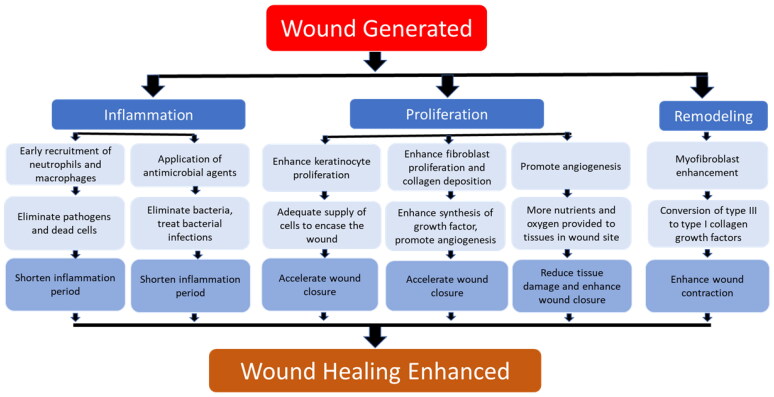
Wound care has become increasingly important over the years. Various synthetic products for wound care treatment have been reported to cause toxic side effects and therefore natural products are in significant demand as they have minimal side effects. The presence of bioactive compounds in medicinal mushrooms contributes to various biological activities which assist in the early inflammatory phase, keratinocyte proliferation, and its migration enhancement which are pertinent to wound rehabilitation. Lignosus rhinocerus (tiger milk mushroom) can reduce the inflammation phase in wound healing by fighting off bacterial infection and modulating pro-inflammatory cytokines expression in the early stage to avoid prolonged inflammation and tissue damage. The antibacterial, immunomodulating, and anti-inflammatory activities exhibited by most macrofungi play a key role in enhancing wound healing. Several antibacterial and antifungal compounds sourced from traditional botanicals/products may prevent further complications and reoccurrence of injury to a wounded site. Scientific studies are actively underway to ascertain the potential use of macrofungi as a wound healing agent.
期刊介绍:
Mycobiology is an international journal devoted to the publication of fundamental and applied investigations on all aspects of mycology and their traditional allies. It is published quarterly and is the official publication of the Korean Society of Mycology. Mycobiology publishes reports of basic research on fungi and fungus-like organisms, including yeasts, filamentous fungi, lichen fungi, oomycetes, moulds, and mushroom. Topics also include molecular and cellular biology, biochemistry, metabolism, developmental biology, environmental mycology, evolution, ecology, taxonomy and systematics, genetics/genomics, fungal pathogen and disease control, physiology, and industrial biotechnology using fungi.



 京公网安备 11010802042870号
京ICP备2023020795号-1
京公网安备 11010802042870号
京ICP备2023020795号-1

 分享
分享
 求助内容:
求助内容: 应助结果提醒方式:
 扫码关注我们
