Roberta Tufi , Emily H. Clark , Tamaki Hoshikawa, Christiana Tsagkaraki, Jack Stanley, Kunitoshi Takeda, James M. Staddon, Thomas Briston
{"title":"High-content phenotypic screen to identify small molecule enhancers of Parkin-dependent ubiquitination and mitophagy","authors":"Roberta Tufi , Emily H. Clark , Tamaki Hoshikawa, Christiana Tsagkaraki, Jack Stanley, Kunitoshi Takeda, James M. Staddon, Thomas Briston","doi":"10.1016/j.slasd.2022.12.004","DOIUrl":null,"url":null,"abstract":"<div><p>Mitochondrial dysfunction and aberrant mitochondrial homeostasis are key aspects of Parkinson's disease (PD) pathophysiology. Mutations in PINK1 and Parkin proteins lead to autosomal recessive PD, suggesting that defective mitochondrial clearance via mitophagy is key in PD etiology. Accelerating the identification and/or removal of dysfunctional mitochondria could therefore provide a disease-modifying approach to treatment. To that end, we performed a high-content phenotypic screen (HCS) of ∼125,000 small molecules to identify compounds that positively modulate mitochondrial accumulation of the PINK1-Parkin-dependent mitophagy initiation marker p-Ser65-Ub in Parkin haploinsufficiency (Parkin <sup>+/R275W</sup>) human fibroblasts. Following confirmatory counter-screening and orthogonal assays, we selected compounds of interest that enhance mitophagy-related biochemical and functional endpoints in patient-derived fibroblasts. Identification of inhibitors of the ubiquitin-specific peptidase and negative regulator of mitophagy USP30 within our hits further validated our approach. The compounds identified in this work provide a novel starting point for further investigation and optimization.</p></div>","PeriodicalId":21764,"journal":{"name":"SLAS Discovery","volume":"28 3","pages":"Pages 73-87"},"PeriodicalIF":2.7000,"publicationDate":"2023-04-01","publicationTypes":"Journal Article","fieldsOfStudy":null,"isOpenAccess":false,"openAccessPdf":"","citationCount":"0","resultStr":null,"platform":"Semanticscholar","paperid":null,"PeriodicalName":"SLAS Discovery","FirstCategoryId":"99","ListUrlMain":"https://www.sciencedirect.com/science/article/pii/S2472555222137160","RegionNum":4,"RegionCategory":"生物学","ArticlePicture":[],"TitleCN":null,"AbstractTextCN":null,"PMCID":null,"EPubDate":"","PubModel":"","JCR":"Q2","JCRName":"BIOCHEMICAL RESEARCH METHODS","Score":null,"Total":0}
引用次数: 0
Abstract
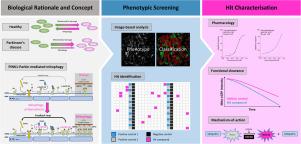
Mitochondrial dysfunction and aberrant mitochondrial homeostasis are key aspects of Parkinson's disease (PD) pathophysiology. Mutations in PINK1 and Parkin proteins lead to autosomal recessive PD, suggesting that defective mitochondrial clearance via mitophagy is key in PD etiology. Accelerating the identification and/or removal of dysfunctional mitochondria could therefore provide a disease-modifying approach to treatment. To that end, we performed a high-content phenotypic screen (HCS) of ∼125,000 small molecules to identify compounds that positively modulate mitochondrial accumulation of the PINK1-Parkin-dependent mitophagy initiation marker p-Ser65-Ub in Parkin haploinsufficiency (Parkin +/R275W) human fibroblasts. Following confirmatory counter-screening and orthogonal assays, we selected compounds of interest that enhance mitophagy-related biochemical and functional endpoints in patient-derived fibroblasts. Identification of inhibitors of the ubiquitin-specific peptidase and negative regulator of mitophagy USP30 within our hits further validated our approach. The compounds identified in this work provide a novel starting point for further investigation and optimization.
期刊介绍:
Advancing Life Sciences R&D: SLAS Discovery reports how scientists develop and utilize novel technologies and/or approaches to provide and characterize chemical and biological tools to understand and treat human disease.
SLAS Discovery is a peer-reviewed journal that publishes scientific reports that enable and improve target validation, evaluate current drug discovery technologies, provide novel research tools, and incorporate research approaches that enhance depth of knowledge and drug discovery success.
SLAS Discovery emphasizes scientific and technical advances in target identification/validation (including chemical probes, RNA silencing, gene editing technologies); biomarker discovery; assay development; virtual, medium- or high-throughput screening (biochemical and biological, biophysical, phenotypic, toxicological, ADME); lead generation/optimization; chemical biology; and informatics (data analysis, image analysis, statistics, bio- and chemo-informatics). Review articles on target biology, new paradigms in drug discovery and advances in drug discovery technologies.
SLAS Discovery is of particular interest to those involved in analytical chemistry, applied microbiology, automation, biochemistry, bioengineering, biomedical optics, biotechnology, bioinformatics, cell biology, DNA science and technology, genetics, information technology, medicinal chemistry, molecular biology, natural products chemistry, organic chemistry, pharmacology, spectroscopy, and toxicology.
SLAS Discovery is a member of the Committee on Publication Ethics (COPE) and was published previously (1996-2016) as the Journal of Biomolecular Screening (JBS).



 京公网安备 11010802042870号
京ICP备2023020795号-1
京公网安备 11010802042870号
京ICP备2023020795号-1

 分享
分享
 求助内容:
求助内容: 应助结果提醒方式:
 扫码关注我们
