{"title":"Morphological and Phylogenetic Analyses Reveal a New Species of Genus <i>Monochaetia</i> Belonging to the Family Sporocadaceae in Korea.","authors":"Seong-Keun Lim, Kallol Das, Soo-Min Hong, Sang Jae Suh, Seung-Yeol Lee, Hee-Young Jung","doi":"10.1080/12298093.2023.2195735","DOIUrl":null,"url":null,"abstract":"<p><p>The fungal strain belonging to the genus <i>Monochaetia</i> of the family Sporocadaceae was isolated from hairy long-horned toad beetle (<i>Moechotypa diphysis</i>) during the screening of microfungi associated with insects from Gangwon Province, Korea. The strain KNUF-6L2F produced white, light brown to dirty black surface, and olivaceous green colonies with the higher growth, while the closest strain <i>M. ilicis</i> KUMCC 15-0520<sup>T</sup> were light brown to brown, and <i>M. schimae</i> SAUCC 212201<sup>T</sup> light brown to brown toward center. The strain KNUF-6L2F produced shorter (5.7-14.0 μm) apical appendages than <i>M. ilicis</i> (6.0-24.0 μm), but similar to <i>M. schimae</i> (7.0-12.5 μm). Three median cells of KNUF-6L2F were light brown to olivaceous green, whereas brown and olivaceous cells were observed from <i>M. ilicis</i> and <i>M. schimae</i>, respectively. And the strain KNUF-6L2F produced larger conidiogenous cells than <i>M. ilicis</i> and <i>M. schimae</i>. Additionally, phylogenetic analyses based on molecular datasets of internal transcribed spacer (ITS) regions, translation elongation factor 1-alpha (<i>TEF1α</i>), and β-tubulin (<i>TUB2</i>) genes corroborated the strain's originality. Thus, the strain is different from other known <i>Monochaetia</i> species, according to molecular phylogeny and morophology, hence we suggested the new species <i>Monochaetia mediana</i> sp. nov. and provided a descriptive illustration.</p>","PeriodicalId":18825,"journal":{"name":"Mycobiology","volume":"51 2","pages":"87-93"},"PeriodicalIF":2.0000,"publicationDate":"2023-01-01","publicationTypes":"Journal Article","fieldsOfStudy":null,"isOpenAccess":false,"openAccessPdf":"https://ftp.ncbi.nlm.nih.gov/pub/pmc/oa_pdf/24/fa/TMYB_51_2195735.PMC10142316.pdf","citationCount":"1","resultStr":null,"platform":"Semanticscholar","paperid":null,"PeriodicalName":"Mycobiology","FirstCategoryId":"99","ListUrlMain":"https://doi.org/10.1080/12298093.2023.2195735","RegionNum":4,"RegionCategory":"生物学","ArticlePicture":[],"TitleCN":null,"AbstractTextCN":null,"PMCID":null,"EPubDate":"","PubModel":"","JCR":"Q2","JCRName":"AGRONOMY","Score":null,"Total":0}
引用次数: 1
Abstract
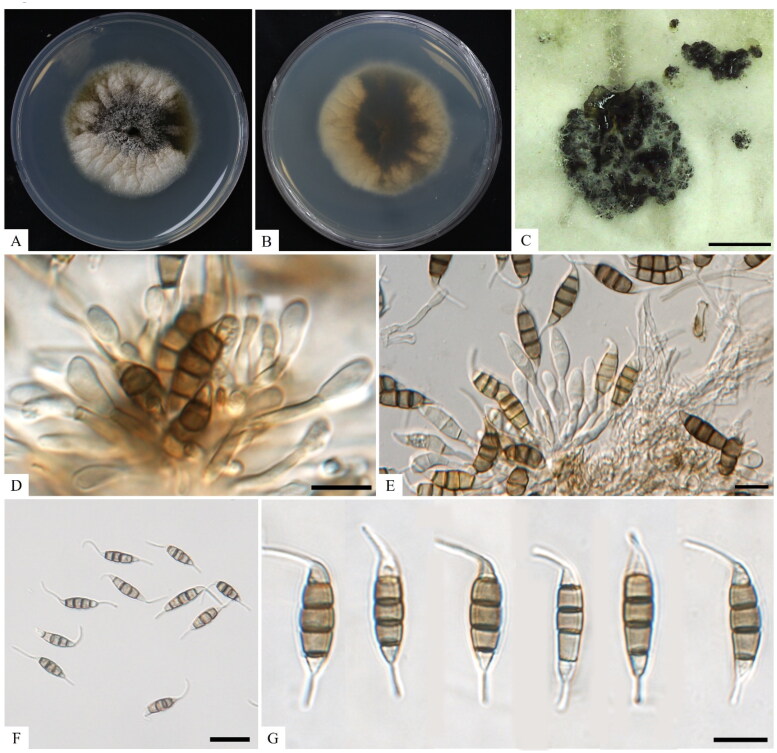
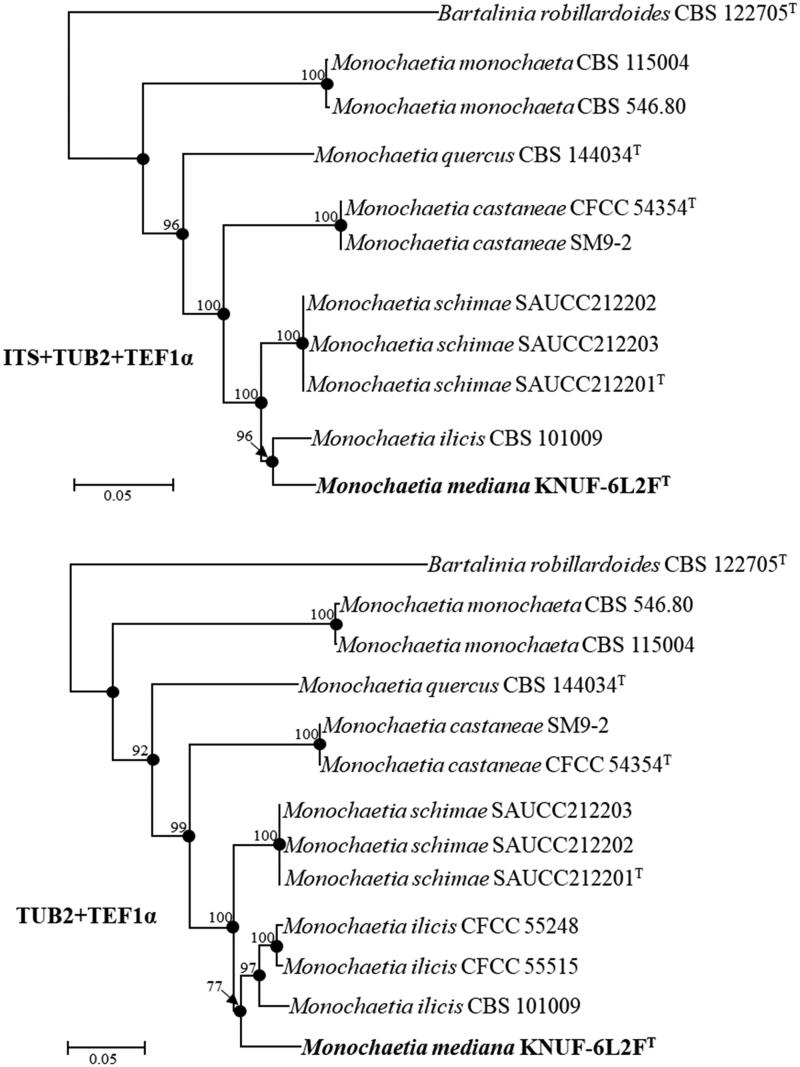
The fungal strain belonging to the genus Monochaetia of the family Sporocadaceae was isolated from hairy long-horned toad beetle (Moechotypa diphysis) during the screening of microfungi associated with insects from Gangwon Province, Korea. The strain KNUF-6L2F produced white, light brown to dirty black surface, and olivaceous green colonies with the higher growth, while the closest strain M. ilicis KUMCC 15-0520T were light brown to brown, and M. schimae SAUCC 212201T light brown to brown toward center. The strain KNUF-6L2F produced shorter (5.7-14.0 μm) apical appendages than M. ilicis (6.0-24.0 μm), but similar to M. schimae (7.0-12.5 μm). Three median cells of KNUF-6L2F were light brown to olivaceous green, whereas brown and olivaceous cells were observed from M. ilicis and M. schimae, respectively. And the strain KNUF-6L2F produced larger conidiogenous cells than M. ilicis and M. schimae. Additionally, phylogenetic analyses based on molecular datasets of internal transcribed spacer (ITS) regions, translation elongation factor 1-alpha (TEF1α), and β-tubulin (TUB2) genes corroborated the strain's originality. Thus, the strain is different from other known Monochaetia species, according to molecular phylogeny and morophology, hence we suggested the new species Monochaetia mediana sp. nov. and provided a descriptive illustration.
期刊介绍:
Mycobiology is an international journal devoted to the publication of fundamental and applied investigations on all aspects of mycology and their traditional allies. It is published quarterly and is the official publication of the Korean Society of Mycology. Mycobiology publishes reports of basic research on fungi and fungus-like organisms, including yeasts, filamentous fungi, lichen fungi, oomycetes, moulds, and mushroom. Topics also include molecular and cellular biology, biochemistry, metabolism, developmental biology, environmental mycology, evolution, ecology, taxonomy and systematics, genetics/genomics, fungal pathogen and disease control, physiology, and industrial biotechnology using fungi.



 京公网安备 11010802042870号
京ICP备2023020795号-1
京公网安备 11010802042870号
京ICP备2023020795号-1

 分享
分享
 求助内容:
求助内容: 应助结果提醒方式:
 扫码关注我们
