Ahmed N Alshammari, Khalid A Alshammari, Salman N Alshammari, Saad Y Aldhaifi, Abdulaziz S Alqahtani
{"title":"The Psychological Impact of COVID-19 Pandemic on Persons with Multiple Sclerosis in Saudi Arabia.","authors":"Ahmed N Alshammari, Khalid A Alshammari, Salman N Alshammari, Saad Y Aldhaifi, Abdulaziz S Alqahtani","doi":"10.17712/nsj.2023.2.20110104","DOIUrl":null,"url":null,"abstract":"<p><strong>Objectives: </strong>To evaluate, in a Saudi Arabian context, how the COVID-19 pandemic psychologically impacted persons with multiple sclerosis (PwMS).</p><p><strong>Methods: </strong>A cross-sectional study was undertaken during the period from October 2021 to March 2022. 738 participants resident in the Kingdom of Saudi Arabia (KSA) completed a self-administered online questionnaire. The research focused on persons diagnosed with MS.</p><p><strong>Results: </strong>Participant ages spanned from 18 to over 55. The mean was 36.1±12.9 years old. Four hundred eighty-nine (66.3%) of the 738 participants were female. Two hundred sixty-four (35.8%) were single. Four hundred twelve (55.8%) were married. Six hundred eighty-five (92.8%) had received a COVID-19 vaccine. Regarding MS duration, 117 (15.9%) had been diagnosed for less than 2 years, 171 (23.2%) for 2-5 years, while 251 (34%) had the condition for 10 or more years. Regarding psychological health, 11.2% of participants complained of minimal/no depression, 33.3% of mild depression, 28.3% of moderate depression, and 27.1% of moderately severe to severe depression symptoms. Concerning anxiety, 17.2% of participants reported minimal anxiety, 36.9% mild, 23.3% moderate, while 22.6% suffered from severe anxiety symptoms.</p><p><strong>Conclusion: </strong>A high prevalence of depression and anxiety was found, along with high prevalence of co-occurrence of these disorders among PwMS.</p>","PeriodicalId":74297,"journal":{"name":"","volume":"28 2","pages":"108-115"},"PeriodicalIF":0.0,"publicationDate":"2023-04-01","publicationTypes":"Journal Article","fieldsOfStudy":null,"isOpenAccess":false,"openAccessPdf":"https://ftp.ncbi.nlm.nih.gov/pub/pmc/oa_pdf/1b/9d/Neurosciences-28-2-108.PMC10155471.pdf","citationCount":"0","resultStr":null,"platform":"Semanticscholar","paperid":null,"PeriodicalName":"","FirstCategoryId":"3","ListUrlMain":"https://doi.org/10.17712/nsj.2023.2.20110104","RegionNum":0,"RegionCategory":null,"ArticlePicture":[],"TitleCN":null,"AbstractTextCN":null,"PMCID":null,"EPubDate":"","PubModel":"","JCR":"","JCRName":"","Score":null,"Total":0}
引用次数: 0
Abstract
Objectives: To evaluate, in a Saudi Arabian context, how the COVID-19 pandemic psychologically impacted persons with multiple sclerosis (PwMS).
Methods: A cross-sectional study was undertaken during the period from October 2021 to March 2022. 738 participants resident in the Kingdom of Saudi Arabia (KSA) completed a self-administered online questionnaire. The research focused on persons diagnosed with MS.
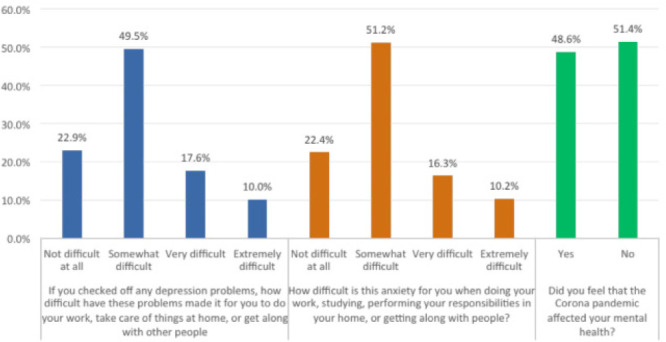
Results: Participant ages spanned from 18 to over 55. The mean was 36.1±12.9 years old. Four hundred eighty-nine (66.3%) of the 738 participants were female. Two hundred sixty-four (35.8%) were single. Four hundred twelve (55.8%) were married. Six hundred eighty-five (92.8%) had received a COVID-19 vaccine. Regarding MS duration, 117 (15.9%) had been diagnosed for less than 2 years, 171 (23.2%) for 2-5 years, while 251 (34%) had the condition for 10 or more years. Regarding psychological health, 11.2% of participants complained of minimal/no depression, 33.3% of mild depression, 28.3% of moderate depression, and 27.1% of moderately severe to severe depression symptoms. Concerning anxiety, 17.2% of participants reported minimal anxiety, 36.9% mild, 23.3% moderate, while 22.6% suffered from severe anxiety symptoms.
Conclusion: A high prevalence of depression and anxiety was found, along with high prevalence of co-occurrence of these disorders among PwMS.



 京公网安备 11010802042870号
京ICP备2023020795号-1
京公网安备 11010802042870号
京ICP备2023020795号-1

 分享
分享
 求助内容:
求助内容: 应助结果提醒方式:
 扫码关注我们
