Nicole I. Wenzel, Natascha Chavain, Yulin Wang, Wolfgang Friebolin, Louis Maes, Bruno Pradines, Michael Lanzer, Vanessa Yardley, Reto Brun, Christel Herold-Mende, Christophe Biot, Katalin Tóth*, Elisabeth Davioud-Charvet*
{"title":"Antimalarial versus Cytotoxic Properties of Dual Drugs Derived From 4-Aminoquinolines and Mannich Bases: Interaction with DNA","authors":"Nicole I. Wenzel, Natascha Chavain, Yulin Wang, Wolfgang Friebolin, Louis Maes, Bruno Pradines, Michael Lanzer, Vanessa Yardley, Reto Brun, Christel Herold-Mende, Christophe Biot, Katalin Tóth*, Elisabeth Davioud-Charvet*","doi":"10.1021/jm9018383","DOIUrl":null,"url":null,"abstract":"<p >The synthesis and biological evaluation of new organic and organometallic dual drugs designed as potential antimalarial agents are reported. A series of 4-aminoquinoline-based Mannich bases with variations in the aliphatic amino side chain were prepared via a three-steps synthesis. These compounds were also tested against chloroquine-susceptible and chloroquine-resistant strains of <i>Plasmodium falciparum</i> and assayed for their ability to inhibit the formation of β-hematin in vitro using a colorimetric β-hematin inhibition assay. Several compounds showed a marked antimalarial activity, with IC<sub>50</sub> and IC<sub>90</sub> values in the low nM range but also a high cytotoxicity against mammalian cells, in particular a highly drug-resistant glioblastoma cell line. The newly designed compounds revealed high DNA binding properties, especially for the GC-rich domains. Altogether, these dual drugs seem to be more appropriate to be developed as antiproliferative agents against mammalian cancer cells than <i>Plasmodium</i> parasites.</p>","PeriodicalId":46,"journal":{"name":"Journal of Medicinal Chemistry","volume":"53 8","pages":"3214–3226"},"PeriodicalIF":6.8000,"publicationDate":"2010-03-23","publicationTypes":"Journal Article","fieldsOfStudy":null,"isOpenAccess":false,"openAccessPdf":"https://sci-hub-pdf.com/10.1021/jm9018383","citationCount":"68","resultStr":null,"platform":"Semanticscholar","paperid":null,"PeriodicalName":"Journal of Medicinal Chemistry","FirstCategoryId":"3","ListUrlMain":"https://pubs.acs.org/doi/10.1021/jm9018383","RegionNum":1,"RegionCategory":"医学","ArticlePicture":[],"TitleCN":null,"AbstractTextCN":null,"PMCID":null,"EPubDate":"","PubModel":"","JCR":"Q1","JCRName":"CHEMISTRY, MEDICINAL","Score":null,"Total":0}
引用次数: 68
Abstract
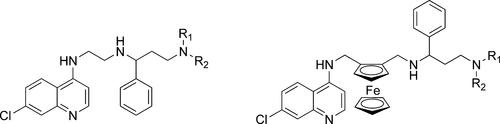
The synthesis and biological evaluation of new organic and organometallic dual drugs designed as potential antimalarial agents are reported. A series of 4-aminoquinoline-based Mannich bases with variations in the aliphatic amino side chain were prepared via a three-steps synthesis. These compounds were also tested against chloroquine-susceptible and chloroquine-resistant strains of Plasmodium falciparum and assayed for their ability to inhibit the formation of β-hematin in vitro using a colorimetric β-hematin inhibition assay. Several compounds showed a marked antimalarial activity, with IC50 and IC90 values in the low nM range but also a high cytotoxicity against mammalian cells, in particular a highly drug-resistant glioblastoma cell line. The newly designed compounds revealed high DNA binding properties, especially for the GC-rich domains. Altogether, these dual drugs seem to be more appropriate to be developed as antiproliferative agents against mammalian cancer cells than Plasmodium parasites.
期刊介绍:
The Journal of Medicinal Chemistry is a prestigious biweekly peer-reviewed publication that focuses on the multifaceted field of medicinal chemistry. Since its inception in 1959 as the Journal of Medicinal and Pharmaceutical Chemistry, it has evolved to become a cornerstone in the dissemination of research findings related to the design, synthesis, and development of therapeutic agents.
The Journal of Medicinal Chemistry is recognized for its significant impact in the scientific community, as evidenced by its 2022 impact factor of 7.3. This metric reflects the journal's influence and the importance of its content in shaping the future of drug discovery and development. The journal serves as a vital resource for chemists, pharmacologists, and other researchers interested in the molecular mechanisms of drug action and the optimization of therapeutic compounds.



 京公网安备 11010802042870号
京ICP备2023020795号-1
京公网安备 11010802042870号
京ICP备2023020795号-1

 分享
分享
 求助内容:
求助内容: 应助结果提醒方式:
 扫码关注我们
