Anti-predator strategies of adult male Central Himalayan Langurs (Semnopithecus schistaceus) in response to domestic dogs in a human-dominated landscape.
Himani Nautiyal, Hiroyuki Tanaka, Michael A Huffman
{"title":"Anti-predator strategies of adult male Central Himalayan Langurs (Semnopithecus schistaceus) in response to domestic dogs in a human-dominated landscape.","authors":"Himani Nautiyal, Hiroyuki Tanaka, Michael A Huffman","doi":"10.1007/s10329-023-01061-0","DOIUrl":null,"url":null,"abstract":"<p><p>The evolution of predator-prey relationships is an important topic in primatology. Many aspects of primate society have been explained as a response to predation pressure. While predation has been discussed in broad theoretical terms, few systematically collected data exist on the subject. Furthermore, little information exists regarding the inter-male variation in responses to predators. To address this data gap, predatory dog-primate interactions were studied in a 78-member group of habituated, individually recognized Central Himalayan Langurs (CHL) (Semnopithecus schistaceus) living in a high-altitude subsistence agricultural landscape of northern India. We recorded 312 langur-dog interactions over 2 years. These predation events resulted in 15 serious attacks on adult females, infants, juveniles and sub-adults, in eight of which the prey was killed and consumed on the spot. In response to dog predation, adult males performed three types of anti-predator response behaviors: direct fighting with a predator, emitting alarm calls, fleeing and/or freezing. Differences were noted in each male's response to village dogs. The results showed that the likelihood of CHL adult males engaging in more costly counterattacks or attention getting alarm calls were better predicted by the level of investment in the group (genetic relatedness, duration of residency, social relationships), but not rank and mating rate. Long-duration resident adult males performed high and/or intermediate cost behaviors to protect vulnerable members of the group; their potential offspring, maternal siblings or cousins, and adult female social partners. Short-term residents or recent immigrant males exhibited two less energetically costly, more self-preserving behaviors, depending on their rank: (1) high-ranking short-tenure duration males, with high mating frequencies, performed flee and freeze responses; (2) low-ranking, low-mating-frequency males performed more alarm calls. Counterattacks and alarm calls were performed by adult males with relatively more experience with village dogs and were directed towards dogs with predatory histories significantly more often than dogs with non-predatory histories. Natural selection and kin selection have both contributed to the evolution of CHL anti-predator tactics.</p>","PeriodicalId":20468,"journal":{"name":"Primates","volume":"64 3","pages":"361-379"},"PeriodicalIF":1.5000,"publicationDate":"2023-05-01","publicationTypes":"Journal Article","fieldsOfStudy":null,"isOpenAccess":false,"openAccessPdf":"","citationCount":"2","resultStr":null,"platform":"Semanticscholar","paperid":null,"PeriodicalName":"Primates","FirstCategoryId":"99","ListUrlMain":"https://doi.org/10.1007/s10329-023-01061-0","RegionNum":4,"RegionCategory":"生物学","ArticlePicture":[],"TitleCN":null,"AbstractTextCN":null,"PMCID":null,"EPubDate":"","PubModel":"","JCR":"Q2","JCRName":"ZOOLOGY","Score":null,"Total":0}
引用次数: 2
Abstract
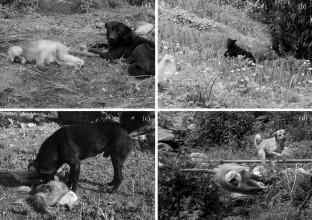
The evolution of predator-prey relationships is an important topic in primatology. Many aspects of primate society have been explained as a response to predation pressure. While predation has been discussed in broad theoretical terms, few systematically collected data exist on the subject. Furthermore, little information exists regarding the inter-male variation in responses to predators. To address this data gap, predatory dog-primate interactions were studied in a 78-member group of habituated, individually recognized Central Himalayan Langurs (CHL) (Semnopithecus schistaceus) living in a high-altitude subsistence agricultural landscape of northern India. We recorded 312 langur-dog interactions over 2 years. These predation events resulted in 15 serious attacks on adult females, infants, juveniles and sub-adults, in eight of which the prey was killed and consumed on the spot. In response to dog predation, adult males performed three types of anti-predator response behaviors: direct fighting with a predator, emitting alarm calls, fleeing and/or freezing. Differences were noted in each male's response to village dogs. The results showed that the likelihood of CHL adult males engaging in more costly counterattacks or attention getting alarm calls were better predicted by the level of investment in the group (genetic relatedness, duration of residency, social relationships), but not rank and mating rate. Long-duration resident adult males performed high and/or intermediate cost behaviors to protect vulnerable members of the group; their potential offspring, maternal siblings or cousins, and adult female social partners. Short-term residents or recent immigrant males exhibited two less energetically costly, more self-preserving behaviors, depending on their rank: (1) high-ranking short-tenure duration males, with high mating frequencies, performed flee and freeze responses; (2) low-ranking, low-mating-frequency males performed more alarm calls. Counterattacks and alarm calls were performed by adult males with relatively more experience with village dogs and were directed towards dogs with predatory histories significantly more often than dogs with non-predatory histories. Natural selection and kin selection have both contributed to the evolution of CHL anti-predator tactics.
期刊介绍:
Primates is an international journal of primatology whose aim is to provide a forum for the elucidation of all aspects of primates. The oldest primatological journal, Primates publishes original papers that advance the scientific study of primates, and its scope embraces work in diverse fields covering biological bases of behavior, socio-ecology, learning and cognition, social processes, systematics, evolution, and medicine. Contributions relevant to conservation of natural populations and welfare of captive primates are welcome. Studies focusing on nonprimate species may be considered if their relevance to primatology is clear. Original Articles as well as Review Articles, News and Perspectives, and Book Reviews are included. All manuscripts received are initially screened for suitability by members of the Editorial Board, taking into account style and ethical issues, leading to a swift decision about whether to send the manuscript for external review.



 京公网安备 11010802042870号
京ICP备2023020795号-1
京公网安备 11010802042870号
京ICP备2023020795号-1

 分享
分享
 求助内容:
求助内容: 应助结果提醒方式:
 扫码关注我们
