{"title":"Contraception ends the genetic maintenance of human same-sex sexual behavior.","authors":"Siliang Song, Jianzhi Zhang","doi":"10.1073/pnas.2303418120","DOIUrl":null,"url":null,"abstract":"<p><p>Because human same-sex sexual behavior (SSB) is heritable and leads to fewer offspring, it is puzzling why SSB-associated alleles have not been selectively purged. Current evidence supports the antagonistic pleiotropy hypothesis that SSB-associated alleles benefit individuals exclusively performing opposite-sex sexual behavior by increasing their number of sexual partners and consequently their number of offspring. However, by analyzing the UK Biobank, here, we show that having more sexual partners no longer predicts more offspring since the availability of oral contraceptives in the 1960s and that SSB is now genetically negatively correlated with the number of offspring, suggesting a loss of SSB's genetic maintenance in modern societies.</p>","PeriodicalId":20548,"journal":{"name":"Proceedings of the National Academy of Sciences of the United States of America","volume":"120 21","pages":"e2303418120"},"PeriodicalIF":9.1000,"publicationDate":"2023-05-23","publicationTypes":"Journal Article","fieldsOfStudy":null,"isOpenAccess":false,"openAccessPdf":"https://ftp.ncbi.nlm.nih.gov/pub/pmc/oa_pdf/82/a4/pnas.202303418.PMC10214190.pdf","citationCount":"0","resultStr":null,"platform":"Semanticscholar","paperid":null,"PeriodicalName":"Proceedings of the National Academy of Sciences of the United States of America","FirstCategoryId":"103","ListUrlMain":"https://doi.org/10.1073/pnas.2303418120","RegionNum":1,"RegionCategory":"综合性期刊","ArticlePicture":[],"TitleCN":null,"AbstractTextCN":null,"PMCID":null,"EPubDate":"2023/5/15 0:00:00","PubModel":"Epub","JCR":"Q1","JCRName":"MULTIDISCIPLINARY SCIENCES","Score":null,"Total":0}
引用次数: 0
Abstract
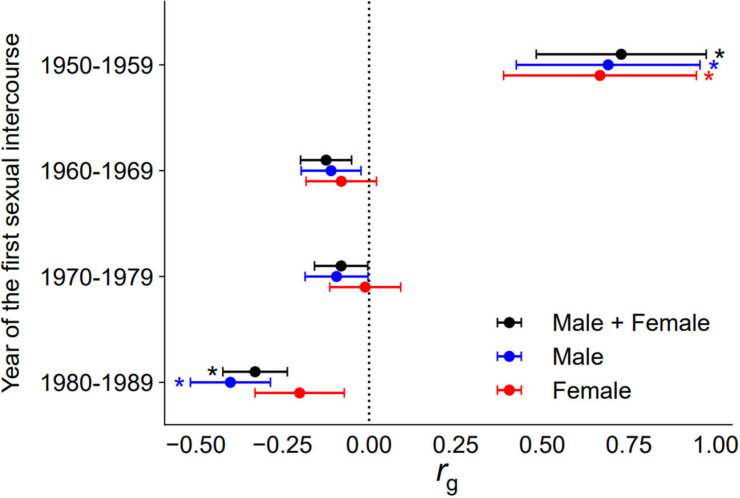
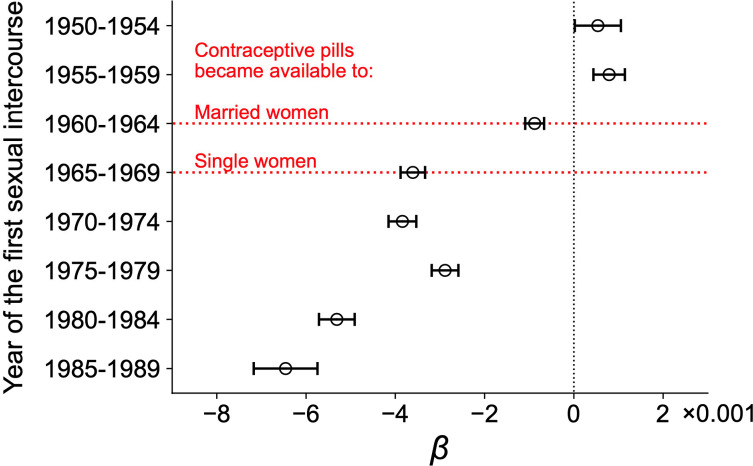
Because human same-sex sexual behavior (SSB) is heritable and leads to fewer offspring, it is puzzling why SSB-associated alleles have not been selectively purged. Current evidence supports the antagonistic pleiotropy hypothesis that SSB-associated alleles benefit individuals exclusively performing opposite-sex sexual behavior by increasing their number of sexual partners and consequently their number of offspring. However, by analyzing the UK Biobank, here, we show that having more sexual partners no longer predicts more offspring since the availability of oral contraceptives in the 1960s and that SSB is now genetically negatively correlated with the number of offspring, suggesting a loss of SSB's genetic maintenance in modern societies.
期刊介绍:
The Proceedings of the National Academy of Sciences (PNAS), a peer-reviewed journal of the National Academy of Sciences (NAS), serves as an authoritative source for high-impact, original research across the biological, physical, and social sciences. With a global scope, the journal welcomes submissions from researchers worldwide, making it an inclusive platform for advancing scientific knowledge.



 京公网安备 11010802042870号
京ICP备2023020795号-1
京公网安备 11010802042870号
京ICP备2023020795号-1

 分享
分享
 求助内容:
求助内容: 应助结果提醒方式:
 扫码关注我们
