{"title":"Great apes reach momentary altered mental states by spinning.","authors":"Adriano R Lameira, Marcus Perlman","doi":"10.1007/s10329-023-01056-x","DOIUrl":null,"url":null,"abstract":"<p><p>Among animals, humans stand out in their consummate propensity to self-induce altered states of mind. Archaeology, history and ethnography show these activities have taken place since the beginnings of civilization, yet their role in the emergence and evolution of the human mind itself remains debatable. The means through which modern humans actively alter their experience of self and reality frequently depend on psychoactive substances, but it is uncertain whether psychedelics or other drugs were part of the ecology or culture of pre-human ancestors. Moreover, (nonhuman) great apes in captivity are currently being retired from medical research, rendering comparative approaches thus far impracticable. Here, we circumvent this limitation by harnessing the breadth of publicly available YouTube data to show that apes engage in rope spinning during solitary play. When spinning, the apes achieved speeds sufficient to alter self-perception and situational awareness that were comparable to those tapped for transcendent experiences in humans (e.g. Sufi whirling), and the number of revolutions spun predicted behavioural evidence for dizziness. Thus, spinning serves as a self-sufficient means of changing body-mind responsiveness in hominids. A proclivity for such experiences is shared between humans and great apes, and provides an entry point for the comparative study of the mechanisms, functions, and adaptive value of altered states of mind in human evolution.</p>","PeriodicalId":20468,"journal":{"name":"Primates","volume":"64 3","pages":"319-323"},"PeriodicalIF":1.5000,"publicationDate":"2023-05-01","publicationTypes":"Journal Article","fieldsOfStudy":null,"isOpenAccess":false,"openAccessPdf":"https://www.ncbi.nlm.nih.gov/pmc/articles/PMC10185630/pdf/","citationCount":"0","resultStr":null,"platform":"Semanticscholar","paperid":null,"PeriodicalName":"Primates","FirstCategoryId":"99","ListUrlMain":"https://doi.org/10.1007/s10329-023-01056-x","RegionNum":4,"RegionCategory":"生物学","ArticlePicture":[],"TitleCN":null,"AbstractTextCN":null,"PMCID":null,"EPubDate":"2023/3/14 0:00:00","PubModel":"Epub","JCR":"Q2","JCRName":"ZOOLOGY","Score":null,"Total":0}
引用次数: 0
Abstract
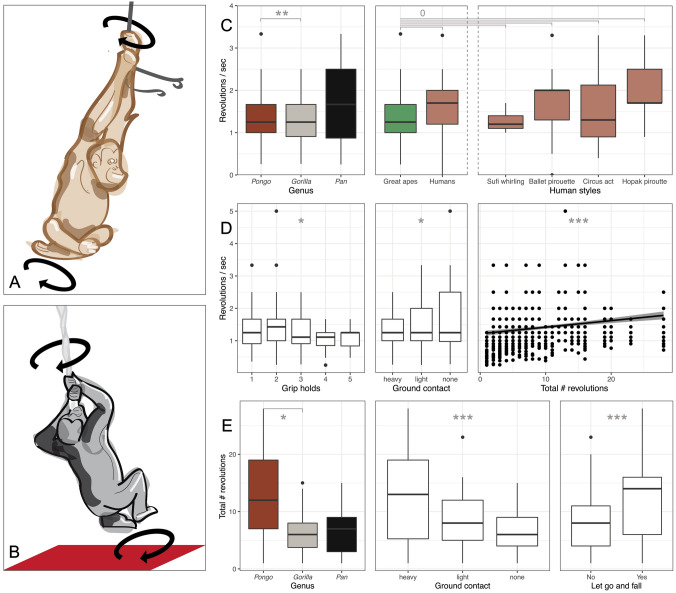
Among animals, humans stand out in their consummate propensity to self-induce altered states of mind. Archaeology, history and ethnography show these activities have taken place since the beginnings of civilization, yet their role in the emergence and evolution of the human mind itself remains debatable. The means through which modern humans actively alter their experience of self and reality frequently depend on psychoactive substances, but it is uncertain whether psychedelics or other drugs were part of the ecology or culture of pre-human ancestors. Moreover, (nonhuman) great apes in captivity are currently being retired from medical research, rendering comparative approaches thus far impracticable. Here, we circumvent this limitation by harnessing the breadth of publicly available YouTube data to show that apes engage in rope spinning during solitary play. When spinning, the apes achieved speeds sufficient to alter self-perception and situational awareness that were comparable to those tapped for transcendent experiences in humans (e.g. Sufi whirling), and the number of revolutions spun predicted behavioural evidence for dizziness. Thus, spinning serves as a self-sufficient means of changing body-mind responsiveness in hominids. A proclivity for such experiences is shared between humans and great apes, and provides an entry point for the comparative study of the mechanisms, functions, and adaptive value of altered states of mind in human evolution.
期刊介绍:
Primates is an international journal of primatology whose aim is to provide a forum for the elucidation of all aspects of primates. The oldest primatological journal, Primates publishes original papers that advance the scientific study of primates, and its scope embraces work in diverse fields covering biological bases of behavior, socio-ecology, learning and cognition, social processes, systematics, evolution, and medicine. Contributions relevant to conservation of natural populations and welfare of captive primates are welcome. Studies focusing on nonprimate species may be considered if their relevance to primatology is clear. Original Articles as well as Review Articles, News and Perspectives, and Book Reviews are included. All manuscripts received are initially screened for suitability by members of the Editorial Board, taking into account style and ethical issues, leading to a swift decision about whether to send the manuscript for external review.



 京公网安备 11010802042870号
京ICP备2023020795号-1
京公网安备 11010802042870号
京ICP备2023020795号-1

 分享
分享
 求助内容:
求助内容: 应助结果提醒方式:
 扫码关注我们
