Sezin Ateş Tatar, Burak Karadağ, Ceyda Karadağ, Gökçe Duranoğlu Turgut, Selim Karataş, Barış Mülayim
{"title":"Barbed versus conventional suture in laparoscopic myomectomy: A randomized controlled study.","authors":"Sezin Ateş Tatar, Burak Karadağ, Ceyda Karadağ, Gökçe Duranoğlu Turgut, Selim Karataş, Barış Mülayim","doi":"10.4274/tjod.galenos.2023.21208","DOIUrl":null,"url":null,"abstract":"<p><strong>Objective: </strong>To compare the surgical and clinical results of traditional absorbable polyglactin 910 and barbed sutures in laparoscopic myomectomy.</p><p><strong>Materials and methods: </strong>This single-center randomized study included 75 women who underwent laparoscopic myomectomy. The uterine wall defects were closed with a continuous conventional absorbable polyglactin 910 suture (Vicryl; Ethicon, Somerville, NJ, USA) in 41 women and with a unidirectional barbed suture (V-Loc 180; Covidien, Mansfield, MA, USA) in 34 women.</p><p><strong>Results: </strong>The time required to suture the uterine wall defect was lower in the V-Loc group than in the Vicryl group (p=0.007). However, no significant difference was observed in the operative time between the two study groups. The intraoperative blood loss and need for postoperative blood transfusion were significantly lower in the barbed group than in the Vicryl group (p=0.018 and p=0.048, respectively).</p><p><strong>Conclusion: </strong>In laparoscopic myomectomy cases, the unidirectional barbed suture is more effective than the conventional absorbable suture. Barbed sutures facilitate the suturing process and reduce the time required to suture the uterine wall defect, blood loss, and the need for postoperative blood transfusion.</p>","PeriodicalId":45340,"journal":{"name":"Turkish Journal of Obstetrics and Gynecology","volume":"20 2","pages":"126-130"},"PeriodicalIF":1.3000,"publicationDate":"2023-06-01","publicationTypes":"Journal Article","fieldsOfStudy":null,"isOpenAccess":false,"openAccessPdf":"https://ftp.ncbi.nlm.nih.gov/pub/pmc/oa_pdf/fb/72/TJOG-20-126.PMC10236233.pdf","citationCount":"0","resultStr":null,"platform":"Semanticscholar","paperid":null,"PeriodicalName":"Turkish Journal of Obstetrics and Gynecology","FirstCategoryId":"1085","ListUrlMain":"https://doi.org/10.4274/tjod.galenos.2023.21208","RegionNum":0,"RegionCategory":null,"ArticlePicture":[],"TitleCN":null,"AbstractTextCN":null,"PMCID":null,"EPubDate":"","PubModel":"","JCR":"Q4","JCRName":"OBSTETRICS & GYNECOLOGY","Score":null,"Total":0}
引用次数: 0
Abstract
Objective: To compare the surgical and clinical results of traditional absorbable polyglactin 910 and barbed sutures in laparoscopic myomectomy.
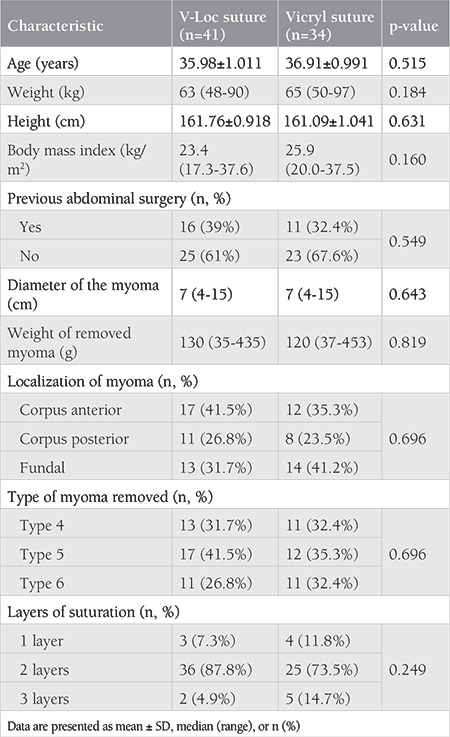
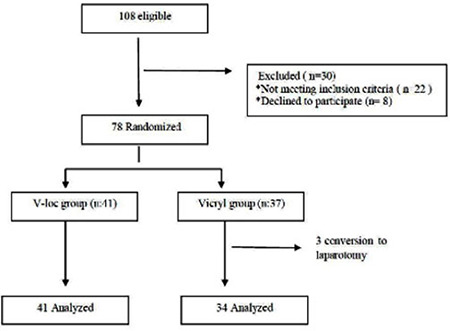
Materials and methods: This single-center randomized study included 75 women who underwent laparoscopic myomectomy. The uterine wall defects were closed with a continuous conventional absorbable polyglactin 910 suture (Vicryl; Ethicon, Somerville, NJ, USA) in 41 women and with a unidirectional barbed suture (V-Loc 180; Covidien, Mansfield, MA, USA) in 34 women.
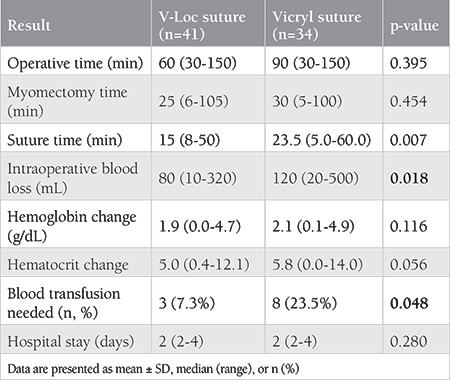
Results: The time required to suture the uterine wall defect was lower in the V-Loc group than in the Vicryl group (p=0.007). However, no significant difference was observed in the operative time between the two study groups. The intraoperative blood loss and need for postoperative blood transfusion were significantly lower in the barbed group than in the Vicryl group (p=0.018 and p=0.048, respectively).
Conclusion: In laparoscopic myomectomy cases, the unidirectional barbed suture is more effective than the conventional absorbable suture. Barbed sutures facilitate the suturing process and reduce the time required to suture the uterine wall defect, blood loss, and the need for postoperative blood transfusion.




 京公网安备 11010802042870号
京ICP备2023020795号-1
京公网安备 11010802042870号
京ICP备2023020795号-1

 分享
分享
 求助内容:
求助内容: 应助结果提醒方式:
 扫码关注我们
