{"title":"Sophorolipid inhibits histamine-induced itch by decreasing PLC/IP3R signaling pathway activation and modulating TRPV1 activity.","authors":"Rui-Qi Xu, Ling Ma, Timson Chen, Wei-Xiong Zhang, Kuan Chang, Jing Wang","doi":"10.1038/s41598-023-35158-9","DOIUrl":null,"url":null,"abstract":"<p><p>Biosurfactants are attracting much interest due to their potential application as therapeutic agents in the medical and cosmetic field. Previous studies have demonstrated that biosurfactant such as sophorolipid (SL) exhibits immunomodulatory effects. In this article, we found the potential of sophorolipid for inhibiting histamine-induced itch and preliminarily explored its molecular basis. First, behavioral tests indicated that SL can remit the histamine-induced scratching behaviors of mice. Second, SL can suppress the the calcium influx induced by histamine, HTMT and VUF8430 in HaCaT cells. RT-PCR analysis showed that the histamine-induced upregulation of mRNA levels of phospholipase Cγ1, 1,4,5-trisphosphate receptor (IP3R), and protein kinase Cα can be inhibted by SL, suggesting that SL may impede the PLC/IP3R signaling pathway activated by histamine. In further tests, the capsaicin-induced calcium influx can also be inhibited by SL. The immunofluorescence and molecular docking analysis indicated that SL acts as an inhibitor of transient receptor potential vanilloid-1 (TRPV1) activation to decrease calcium influx against stimuli. In summary, these results revealed that SL may inhibit histamine-induced itch by decreasing PLC/IP3R signaling pathway activation and modulating TRPV1 activity. This paper indicates that SL can be a useful treatment for histamine-dependent itch.</p>","PeriodicalId":21811,"journal":{"name":"Scientific Reports","volume":"13 1","pages":"7957"},"PeriodicalIF":3.9000,"publicationDate":"2023-05-17","publicationTypes":"Journal Article","fieldsOfStudy":null,"isOpenAccess":false,"openAccessPdf":"https://www.ncbi.nlm.nih.gov/pmc/articles/PMC10192390/pdf/","citationCount":"1","resultStr":null,"platform":"Semanticscholar","paperid":null,"PeriodicalName":"Scientific Reports","FirstCategoryId":"103","ListUrlMain":"https://doi.org/10.1038/s41598-023-35158-9","RegionNum":2,"RegionCategory":"综合性期刊","ArticlePicture":[],"TitleCN":null,"AbstractTextCN":null,"PMCID":null,"EPubDate":"","PubModel":"","JCR":"Q1","JCRName":"MULTIDISCIPLINARY SCIENCES","Score":null,"Total":0}
引用次数: 1
Abstract
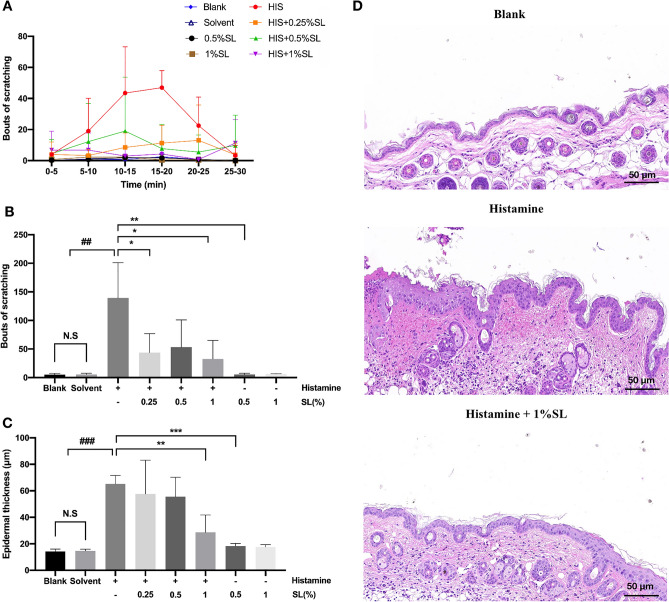
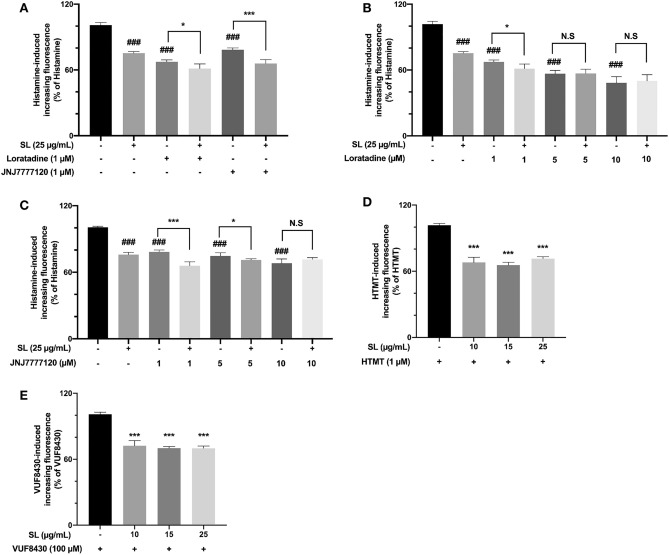
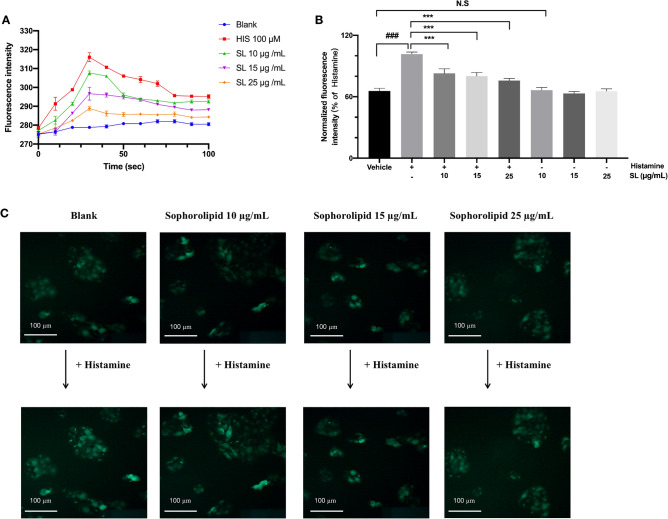
Biosurfactants are attracting much interest due to their potential application as therapeutic agents in the medical and cosmetic field. Previous studies have demonstrated that biosurfactant such as sophorolipid (SL) exhibits immunomodulatory effects. In this article, we found the potential of sophorolipid for inhibiting histamine-induced itch and preliminarily explored its molecular basis. First, behavioral tests indicated that SL can remit the histamine-induced scratching behaviors of mice. Second, SL can suppress the the calcium influx induced by histamine, HTMT and VUF8430 in HaCaT cells. RT-PCR analysis showed that the histamine-induced upregulation of mRNA levels of phospholipase Cγ1, 1,4,5-trisphosphate receptor (IP3R), and protein kinase Cα can be inhibted by SL, suggesting that SL may impede the PLC/IP3R signaling pathway activated by histamine. In further tests, the capsaicin-induced calcium influx can also be inhibited by SL. The immunofluorescence and molecular docking analysis indicated that SL acts as an inhibitor of transient receptor potential vanilloid-1 (TRPV1) activation to decrease calcium influx against stimuli. In summary, these results revealed that SL may inhibit histamine-induced itch by decreasing PLC/IP3R signaling pathway activation and modulating TRPV1 activity. This paper indicates that SL can be a useful treatment for histamine-dependent itch.
期刊介绍:
We publish original research from all areas of the natural sciences, psychology, medicine and engineering. You can learn more about what we publish by browsing our specific scientific subject areas below or explore Scientific Reports by browsing all articles and collections.
Scientific Reports has a 2-year impact factor: 4.380 (2021), and is the 6th most-cited journal in the world, with more than 540,000 citations in 2020 (Clarivate Analytics, 2021).
•Engineering
Engineering covers all aspects of engineering, technology, and applied science. It plays a crucial role in the development of technologies to address some of the world''s biggest challenges, helping to save lives and improve the way we live.
•Physical sciences
Physical sciences are those academic disciplines that aim to uncover the underlying laws of nature — often written in the language of mathematics. It is a collective term for areas of study including astronomy, chemistry, materials science and physics.
•Earth and environmental sciences
Earth and environmental sciences cover all aspects of Earth and planetary science and broadly encompass solid Earth processes, surface and atmospheric dynamics, Earth system history, climate and climate change, marine and freshwater systems, and ecology. It also considers the interactions between humans and these systems.
•Biological sciences
Biological sciences encompass all the divisions of natural sciences examining various aspects of vital processes. The concept includes anatomy, physiology, cell biology, biochemistry and biophysics, and covers all organisms from microorganisms, animals to plants.
•Health sciences
The health sciences study health, disease and healthcare. This field of study aims to develop knowledge, interventions and technology for use in healthcare to improve the treatment of patients.



 京公网安备 11010802042870号
京ICP备2023020795号-1
京公网安备 11010802042870号
京ICP备2023020795号-1

 分享
分享
 求助内容:
求助内容: 应助结果提醒方式:
 扫码关注我们
