Marian E. Williams, Ashley M. Rediker, Kathleen Mulrooney
{"title":"Clinical use and implementation of the diagnostic classification of mental health and developmental disorders of infancy and early childhood","authors":"Marian E. Williams, Ashley M. Rediker, Kathleen Mulrooney","doi":"10.1002/imhj.22054","DOIUrl":null,"url":null,"abstract":"<p>The <i>Diagnostic Classification of Mental Health and Developmental Disorders of Infancy and Early Childhood (DC: 0–5</i>) was developed to provide a framework for diagnosis of infants and young children, and a training curriculum supports implementation of the manual in clinical practice. This study surveyed 100 mental health clinicians (93% female and 53% Latinx/Hispanic) who had completed training in the DC: 0–5 classification system and worked with infants/young children and their families primarily in urban, public insurance-funded, community mental health settings in the United States. The survey explored their use of the diagnostic manual in clinical practice as well as supports and barriers to implementation. Survey results indicated a high level of adoption of the manual in clinical practice, although all five axes and the cultural formulation were used less often than the Axis I Clinical Disorders section. Barriers to implementation included systemic issues such as agency and billing requirements necessitating simultaneous use of other diagnostic manuals, lack of supports and expertise within their agency, and difficulty making time to fully utilize the manual. The findings suggest that policy and systems changes may be needed to enable clinicians to fully integrate the DC: 0–5 into their case conceptualizations.</p>","PeriodicalId":48026,"journal":{"name":"Infant Mental Health Journal","volume":"44 3","pages":"362-371"},"PeriodicalIF":2.0000,"publicationDate":"2023-03-23","publicationTypes":"Journal Article","fieldsOfStudy":null,"isOpenAccess":false,"openAccessPdf":"https://onlinelibrary.wiley.com/doi/epdf/10.1002/imhj.22054","citationCount":"1","resultStr":null,"platform":"Semanticscholar","paperid":null,"PeriodicalName":"Infant Mental Health Journal","FirstCategoryId":"102","ListUrlMain":"https://onlinelibrary.wiley.com/doi/10.1002/imhj.22054","RegionNum":3,"RegionCategory":"心理学","ArticlePicture":[],"TitleCN":null,"AbstractTextCN":null,"PMCID":null,"EPubDate":"","PubModel":"","JCR":"Q3","JCRName":"PSYCHOLOGY, DEVELOPMENTAL","Score":null,"Total":0}
引用次数: 1
Abstract
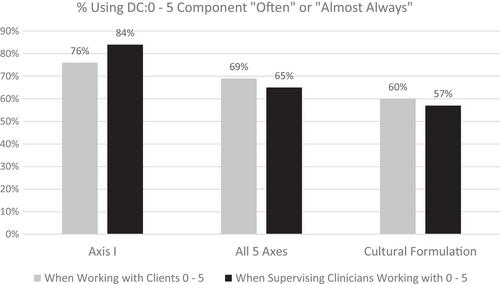
The Diagnostic Classification of Mental Health and Developmental Disorders of Infancy and Early Childhood (DC: 0–5) was developed to provide a framework for diagnosis of infants and young children, and a training curriculum supports implementation of the manual in clinical practice. This study surveyed 100 mental health clinicians (93% female and 53% Latinx/Hispanic) who had completed training in the DC: 0–5 classification system and worked with infants/young children and their families primarily in urban, public insurance-funded, community mental health settings in the United States. The survey explored their use of the diagnostic manual in clinical practice as well as supports and barriers to implementation. Survey results indicated a high level of adoption of the manual in clinical practice, although all five axes and the cultural formulation were used less often than the Axis I Clinical Disorders section. Barriers to implementation included systemic issues such as agency and billing requirements necessitating simultaneous use of other diagnostic manuals, lack of supports and expertise within their agency, and difficulty making time to fully utilize the manual. The findings suggest that policy and systems changes may be needed to enable clinicians to fully integrate the DC: 0–5 into their case conceptualizations.
期刊介绍:
The Infant Mental Health Journal (IMHJ) is the official publication of the World Association for Infant Mental Health (WAIMH) and the Michigan Association for Infant Mental Health (MI-AIMH) and is copyrighted by MI-AIMH. The Infant Mental Health Journal publishes peer-reviewed research articles, literature reviews, program descriptions/evaluations, theoretical/conceptual papers and brief reports (clinical case studies and novel pilot studies) that focus on early social and emotional development and characteristics that influence social-emotional development from relationship-based perspectives. Examples of such influences include attachment relationships, early relationship development, caregiver-infant interactions, infant and early childhood mental health services, contextual and cultural influences on infant/toddler/child and family development, including parental/caregiver psychosocial characteristics and attachment history, prenatal experiences, and biological characteristics in interaction with relational environments that promote optimal social-emotional development or place it at higher risk. Research published in IMHJ focuses on the prenatal-age 5 period and employs relationship-based perspectives in key research questions and interpretation and implications of findings.




 京公网安备 11010802042870号
京ICP备2023020795号-1
京公网安备 11010802042870号
京ICP备2023020795号-1

 分享
分享
 求助内容:
求助内容: 应助结果提醒方式:
 扫码关注我们
