Aida Iancu, Florina Buleu, Dana Simona Chita, Adrian Tutelca, Raluca Tudor, Silviu Brad
{"title":"Early Hemorrhagic Transformation after Reperfusion Therapy in Patients with Acute Ischemic Stroke: Analysis of Risk Factors and Predictors.","authors":"Aida Iancu, Florina Buleu, Dana Simona Chita, Adrian Tutelca, Raluca Tudor, Silviu Brad","doi":"10.3390/brainsci13050840","DOIUrl":null,"url":null,"abstract":"<p><p><b><i>Background</i></b>: The standard reperfusion therapy for acute ischemic stroke (AIS) is considered to be thrombolysis, but its application is limited by the high risk of hemorrhagic transformation (HT). This study aimed to analyze risk factors and predictors of early HT after reperfusion therapy (intravenous thrombolysis or mechanical thrombectomy). <b><i>Material and methods</i></b>: Patients with acute ischemic stroke who developed HT in the first 24 h after receiving rtPA thrombolysis or performing mechanical thrombectomy were retrospectively reviewed. They were divided into two groups, respectively, the early-HT group and the without-early-HT group based on cranial computed tomography performed at 24 h, regardless of the type of hemorrhagic transformation. <b><i>Results</i></b>: A total of 211 consecutive patients were enrolled in this study. Among these patients, 20.37% (<i>n</i> = 43; age: median 70.00 years; 51.2% males) had early HT. Multivariate analysis of independent risk factors associated with early HT found that male gender increased the risk by 2.7-fold, the presence of baseline high blood pressure by 2.4-fold, and high glycemic values by 1.2-fold. Higher values of NIHSS at 24 h increased the risk of hemorrhagic transformation by 1.18-fold, while higher values of ASPECTS at 24 h decreased the risk of hemorrhagic transformation by 0.6-fold. <b><i>Conclusions</i></b>: In our study, male gender, baseline high blood pressure, and high glycemic values, along with higher values of NIHSS were associated with the increased risk of early HT. Furthermore, the identification of early-HT predictors is critical in patients with AIS for the clinical outcome after reperfusion therapy. Predictive models to be used in the future to select more careful patients with a low risk of early HT need to be developed in order to minimize the impact of HT associated with reperfusion techniques.</p>","PeriodicalId":9095,"journal":{"name":"Brain Sciences","volume":"13 5","pages":""},"PeriodicalIF":2.8000,"publicationDate":"2023-05-22","publicationTypes":"Journal Article","fieldsOfStudy":null,"isOpenAccess":false,"openAccessPdf":"https://www.ncbi.nlm.nih.gov/pmc/articles/PMC10216637/pdf/","citationCount":"5","resultStr":null,"platform":"Semanticscholar","paperid":null,"PeriodicalName":"Brain Sciences","FirstCategoryId":"3","ListUrlMain":"https://doi.org/10.3390/brainsci13050840","RegionNum":3,"RegionCategory":"医学","ArticlePicture":[],"TitleCN":null,"AbstractTextCN":null,"PMCID":null,"EPubDate":"","PubModel":"","JCR":"Q3","JCRName":"NEUROSCIENCES","Score":null,"Total":0}
引用次数: 5
Abstract
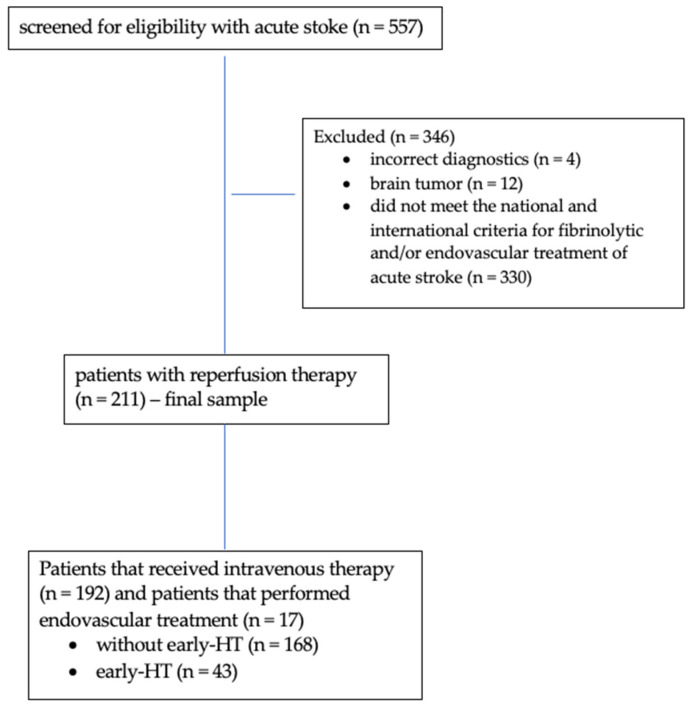
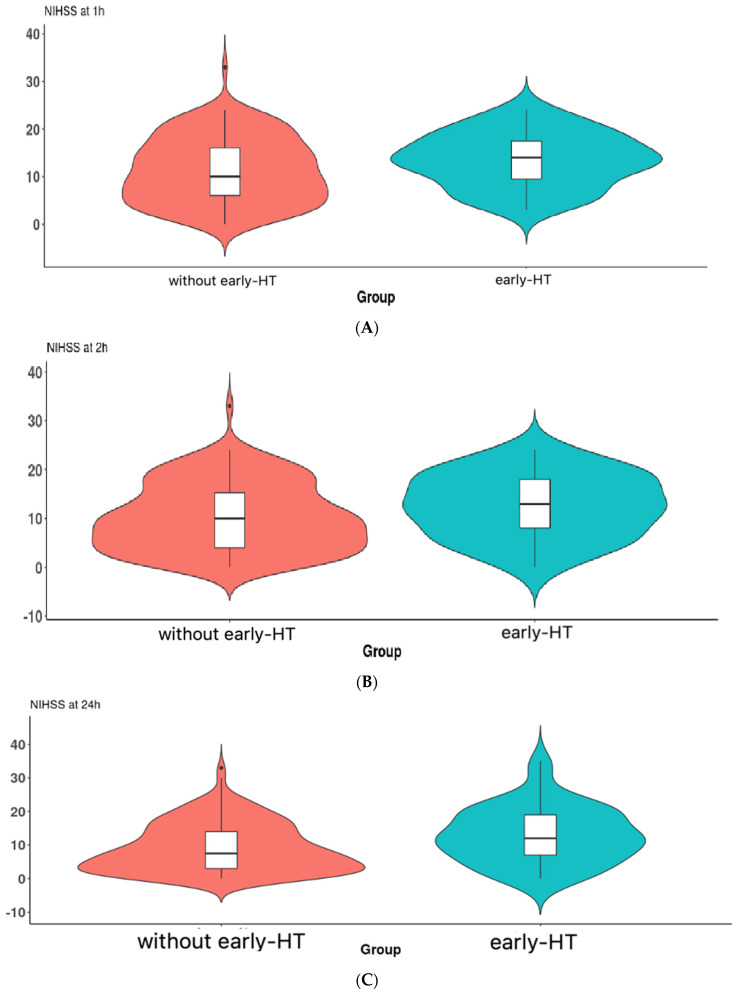
Background: The standard reperfusion therapy for acute ischemic stroke (AIS) is considered to be thrombolysis, but its application is limited by the high risk of hemorrhagic transformation (HT). This study aimed to analyze risk factors and predictors of early HT after reperfusion therapy (intravenous thrombolysis or mechanical thrombectomy). Material and methods: Patients with acute ischemic stroke who developed HT in the first 24 h after receiving rtPA thrombolysis or performing mechanical thrombectomy were retrospectively reviewed. They were divided into two groups, respectively, the early-HT group and the without-early-HT group based on cranial computed tomography performed at 24 h, regardless of the type of hemorrhagic transformation. Results: A total of 211 consecutive patients were enrolled in this study. Among these patients, 20.37% (n = 43; age: median 70.00 years; 51.2% males) had early HT. Multivariate analysis of independent risk factors associated with early HT found that male gender increased the risk by 2.7-fold, the presence of baseline high blood pressure by 2.4-fold, and high glycemic values by 1.2-fold. Higher values of NIHSS at 24 h increased the risk of hemorrhagic transformation by 1.18-fold, while higher values of ASPECTS at 24 h decreased the risk of hemorrhagic transformation by 0.6-fold. Conclusions: In our study, male gender, baseline high blood pressure, and high glycemic values, along with higher values of NIHSS were associated with the increased risk of early HT. Furthermore, the identification of early-HT predictors is critical in patients with AIS for the clinical outcome after reperfusion therapy. Predictive models to be used in the future to select more careful patients with a low risk of early HT need to be developed in order to minimize the impact of HT associated with reperfusion techniques.
期刊介绍:
Brain Sciences (ISSN 2076-3425) is a peer-reviewed scientific journal that publishes original articles, critical reviews, research notes and short communications in the areas of cognitive neuroscience, developmental neuroscience, molecular and cellular neuroscience, neural engineering, neuroimaging, neurolinguistics, neuropathy, systems neuroscience, and theoretical and computational neuroscience. Our aim is to encourage scientists to publish their experimental and theoretical results in as much detail as possible. There is no restriction on the length of the papers. The full experimental details must be provided so that the results can be reproduced. Electronic files or software regarding the full details of the calculation and experimental procedure, if unable to be published in a normal way, can be deposited as supplementary material.



 京公网安备 11010802042870号
京ICP备2023020795号-1
京公网安备 11010802042870号
京ICP备2023020795号-1

 分享
分享
 求助内容:
求助内容: 应助结果提醒方式:
 扫码关注我们
