Edwin Lok Yan Wong, Jessie Ho-Yin Yau, Lesley Cai Yin Sze, Hotinpo Sky Kanagawa, Dara Kiu Yi Leung, Tianyin Liu, Gloria Hoi Yan Wong, Terry Yat Sang Lum
{"title":"A core competency framework for mental health peer supporters of older adults in a Chinese community: cross-culturally informed Delphi study.","authors":"Edwin Lok Yan Wong, Jessie Ho-Yin Yau, Lesley Cai Yin Sze, Hotinpo Sky Kanagawa, Dara Kiu Yi Leung, Tianyin Liu, Gloria Hoi Yan Wong, Terry Yat Sang Lum","doi":"10.1192/bjb.2023.45","DOIUrl":null,"url":null,"abstract":"<p><strong>Aims and method: </strong>Non-Western literature on the core competencies of mental health peer supporters remains limited. Therefore, we used a three-round Delphi study with peer supporters, service users (i.e. someone using peer support services) and mental health professionals to develop a core competency framework for peer supporters in the Chinese context.</p><p><strong>Results: </strong>The final framework included 35 core competencies, the conceptual origins of which were local (14.3%), Western (20%) and both local and Western (65.7%). They were grouped into five categories in ascending peer supporter role specificity: (1) self-care and self-development, (2) general work ethics, (3) work with others, (4) work with service users and (5) peer support knowledge.</p><p><strong>Clinical implications: </strong>A culturally valid mental health peer support competency framework can minimise role confusion and refine training and practice guidelines. In a Chinese context, peer supporters were valued as generic support companions, whereas functions highlighted in the West, such as role modelling, were perceived as less critical.</p>","PeriodicalId":8883,"journal":{"name":"BJPsych Bulletin","volume":" ","pages":"92-99"},"PeriodicalIF":2.0000,"publicationDate":"2024-04-01","publicationTypes":"Journal Article","fieldsOfStudy":null,"isOpenAccess":false,"openAccessPdf":"https://www.ncbi.nlm.nih.gov/pmc/articles/PMC10985733/pdf/","citationCount":"0","resultStr":null,"platform":"Semanticscholar","paperid":null,"PeriodicalName":"BJPsych Bulletin","FirstCategoryId":"1085","ListUrlMain":"https://doi.org/10.1192/bjb.2023.45","RegionNum":0,"RegionCategory":null,"ArticlePicture":[],"TitleCN":null,"AbstractTextCN":null,"PMCID":null,"EPubDate":"","PubModel":"","JCR":"Q3","JCRName":"PSYCHIATRY","Score":null,"Total":0}
引用次数: 0
Abstract
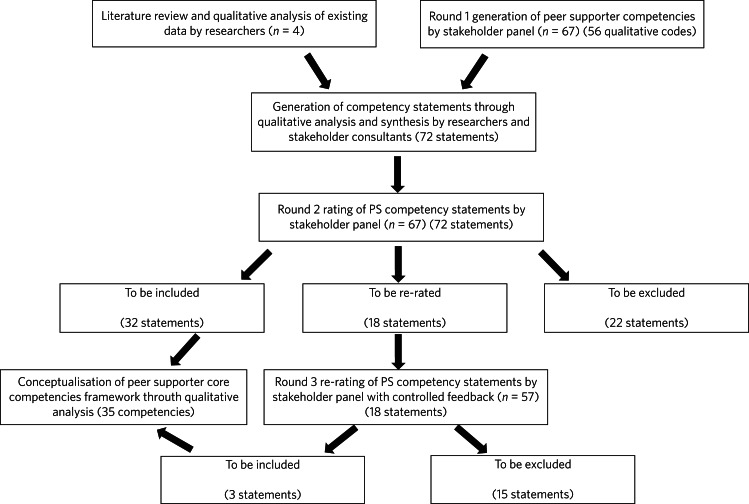
Aims and method: Non-Western literature on the core competencies of mental health peer supporters remains limited. Therefore, we used a three-round Delphi study with peer supporters, service users (i.e. someone using peer support services) and mental health professionals to develop a core competency framework for peer supporters in the Chinese context.
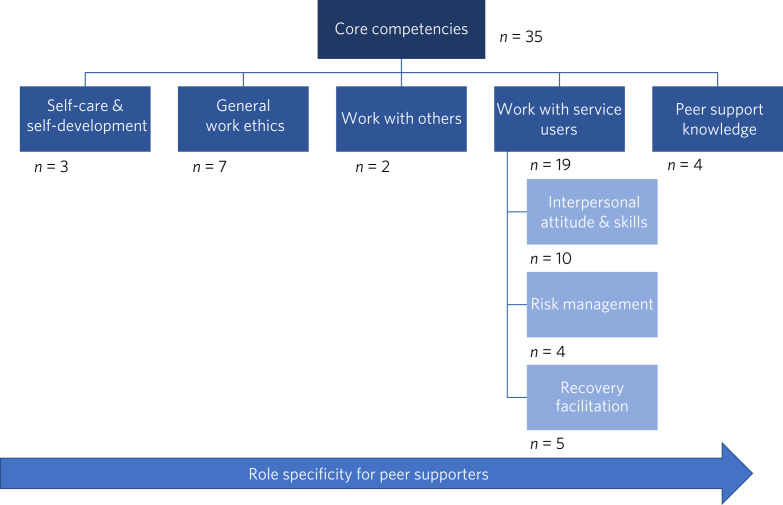
Results: The final framework included 35 core competencies, the conceptual origins of which were local (14.3%), Western (20%) and both local and Western (65.7%). They were grouped into five categories in ascending peer supporter role specificity: (1) self-care and self-development, (2) general work ethics, (3) work with others, (4) work with service users and (5) peer support knowledge.
Clinical implications: A culturally valid mental health peer support competency framework can minimise role confusion and refine training and practice guidelines. In a Chinese context, peer supporters were valued as generic support companions, whereas functions highlighted in the West, such as role modelling, were perceived as less critical.
期刊介绍:
BJPsych Bulletin prioritises research, opinion and informed reflection on the state of psychiatry, management of psychiatric services, and education and training in psychiatry. It provides essential reading and practical value to psychiatrists and anyone involved in the management and provision of mental healthcare.




 京公网安备 11010802042870号
京ICP备2023020795号-1
京公网安备 11010802042870号
京ICP备2023020795号-1

 分享
分享
 求助内容:
求助内容: 应助结果提醒方式:
 扫码关注我们
