Ruixue Song, Kuan-Yu Pan, Hui Xu, Xiuying Qi, Aron S. Buchman, David A. Bennett, Weili Xu
{"title":"Association of cardiovascular risk burden with risk of dementia and brain pathologies: A population-based cohort study","authors":"Ruixue Song, Kuan-Yu Pan, Hui Xu, Xiuying Qi, Aron S. Buchman, David A. Bennett, Weili Xu","doi":"10.1002/alz.12343","DOIUrl":null,"url":null,"abstract":"<div>\n \n \n <section>\n \n <h3> Introduction</h3>\n \n <p>The impact of cardiovascular risk burden on brain pathologies remains unclear. We aimed to examine the association of the Framingham General Cardiovascular Risk Score (FGCRS) with dementia risk, and brain pathologies.</p>\n </section>\n \n <section>\n \n <h3> Methods</h3>\n \n <p>Within the Rush Memory and Aging Project, 1588 dementia-free participants were assessed on FGCRS at baseline and followed up to 21 years. During the follow-up, 621 participants died and underwent autopsies.</p>\n </section>\n \n <section>\n \n <h3> Results</h3>\n \n <p>The multi-adjusted hazard ratios (HRs) (95% confidence intervals [CIs]) of FGCRS were 1.03 (1.00–1.07) for dementia and 1.04 (1.01–1.07) for Alzheimer's disease (AD) dementia. Further, a higher FGCRS was associated with higher gross chronic cerebral infarctions (odds ratio [OR] 1.08, 95% CI 1.02–1.14), cerebral atherosclerosis (OR 1.10, 95% CI 1.03–1.17), and global AD pathology (OR 1.06, 95% CI 1.01–1.12).</p>\n </section>\n \n <section>\n \n <h3> Conclusions</h3>\n \n <p>A higher FGCRS is associated with an increased risk of dementia and AD dementia. Both vascular and AD pathologies in the brain may underlie this association.</p>\n </section>\n </div>","PeriodicalId":7471,"journal":{"name":"Alzheimer's & Dementia","volume":"17 12","pages":"1914-1922"},"PeriodicalIF":11.1000,"publicationDate":"2021-07-26","publicationTypes":"Journal Article","fieldsOfStudy":null,"isOpenAccess":false,"openAccessPdf":"https://sci-hub-pdf.com/10.1002/alz.12343","citationCount":"17","resultStr":null,"platform":"Semanticscholar","paperid":null,"PeriodicalName":"Alzheimer's & Dementia","FirstCategoryId":"3","ListUrlMain":"https://onlinelibrary.wiley.com/doi/10.1002/alz.12343","RegionNum":1,"RegionCategory":"医学","ArticlePicture":[],"TitleCN":null,"AbstractTextCN":null,"PMCID":null,"EPubDate":"","PubModel":"","JCR":"Q1","JCRName":"CLINICAL NEUROLOGY","Score":null,"Total":0}
引用次数: 17
Abstract
Introduction
The impact of cardiovascular risk burden on brain pathologies remains unclear. We aimed to examine the association of the Framingham General Cardiovascular Risk Score (FGCRS) with dementia risk, and brain pathologies.
Methods
Within the Rush Memory and Aging Project, 1588 dementia-free participants were assessed on FGCRS at baseline and followed up to 21 years. During the follow-up, 621 participants died and underwent autopsies.
Results
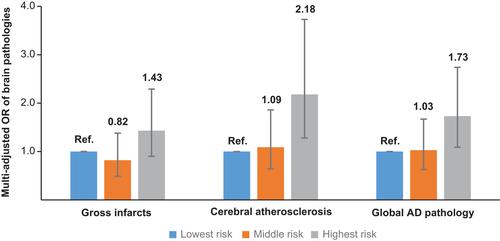
The multi-adjusted hazard ratios (HRs) (95% confidence intervals [CIs]) of FGCRS were 1.03 (1.00–1.07) for dementia and 1.04 (1.01–1.07) for Alzheimer's disease (AD) dementia. Further, a higher FGCRS was associated with higher gross chronic cerebral infarctions (odds ratio [OR] 1.08, 95% CI 1.02–1.14), cerebral atherosclerosis (OR 1.10, 95% CI 1.03–1.17), and global AD pathology (OR 1.06, 95% CI 1.01–1.12).
Conclusions
A higher FGCRS is associated with an increased risk of dementia and AD dementia. Both vascular and AD pathologies in the brain may underlie this association.
心血管风险负担对脑病理的影响尚不清楚。我们的目的是研究Framingham General Cardiovascular Risk Score (FGCRS)与痴呆风险和脑部病理的关系。方法在Rush记忆和衰老项目中,1588名无痴呆的参与者在基线时进行FGCRS评估,并随访21年。在随访期间,621名参与者死亡并进行了尸检。结果FGCRS的多因素校正风险比(HRs)(95%可信区间[ci])在老年痴呆症中为1.03(1.00-1.07),在阿尔茨海默病(AD)痴呆中为1.04(1.01-1.07)。此外,较高的FGCRS与较高的总体慢性脑梗死(比值比[OR] 1.08, 95% CI 1.02-1.14)、脑动脉粥样硬化(OR 1.10, 95% CI 1.03-1.17)和整体AD病理(OR 1.06, 95% CI 1.01-1.12)相关。结论:FGCRS升高与痴呆和AD痴呆风险增加相关。大脑中的血管和AD病理都可能是这种联系的基础。
期刊介绍:
Alzheimer's & Dementia is a peer-reviewed journal that aims to bridge knowledge gaps in dementia research by covering the entire spectrum, from basic science to clinical trials to social and behavioral investigations. It provides a platform for rapid communication of new findings and ideas, optimal translation of research into practical applications, increasing knowledge across diverse disciplines for early detection, diagnosis, and intervention, and identifying promising new research directions. In July 2008, Alzheimer's & Dementia was accepted for indexing by MEDLINE, recognizing its scientific merit and contribution to Alzheimer's research.



 京公网安备 11010802042870号
京ICP备2023020795号-1
京公网安备 11010802042870号
京ICP备2023020795号-1

 分享
分享
 求助内容:
求助内容: 应助结果提醒方式:
 扫码关注我们
