Sergio Machado, Leandro de Oliveira Sant'Ana, Bruno Travassos, Diogo Monteiro
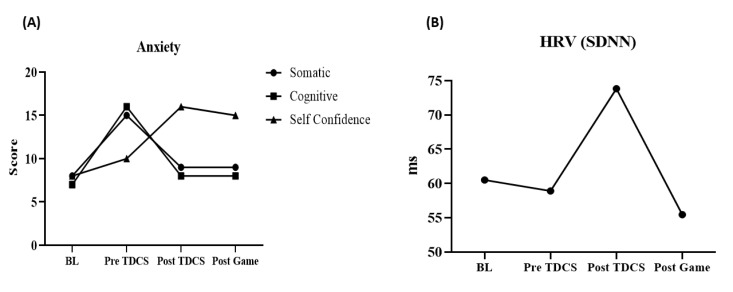
{"title":"Anodal Transcranial Direct Current Stimulation Reduces Competitive Anxiety and Modulates Heart Rate Variability in an eSports Player.","authors":"Sergio Machado, Leandro de Oliveira Sant'Ana, Bruno Travassos, Diogo Monteiro","doi":"10.2174/17450179-v18-e2209270","DOIUrl":null,"url":null,"abstract":"<p><p>Previous research has recently shown that high cognitive and somatic anxiety and low self-confidence, before and during sport competitions have a significant correlation with heart rate variability (HRV) changes and can reduce overall athletic performance. Therefore, interventions, such as transcranial direct current stimulation (tDCS), can be a potential tool to reduce psychophysiological anxiety-related and enhance athletic performance. We present a case of a male professional athlete of eSports. We explored the effects of a single session of anodal tDCS (a-tDCS) at 2mA over the dosrsolateral prefrontal cortex (DLPFC) on competitive anxiety and HRV assessed in baseline (BL), pre-tDCS, post-tDCS and post-game moments and compared between moments. Here, we found a decrease in somatic and cognitive anxiety, as well as an increase in self-confidence and in SDNN index in the post-tDCS moment compared with BL, pre-tDCS and post-game moments. These findings can be a result of an acute change in the attentional state, influencing the processing of threatening information essential for cognitive anxiety and of a self-regulatory process, which can regulate physiological arousal response, such as HRV.</p>","PeriodicalId":72621,"journal":{"name":"","volume":"18 ","pages":"e174501792209270"},"PeriodicalIF":0.0,"publicationDate":"2022-01-01","publicationTypes":"Journal Article","fieldsOfStudy":null,"isOpenAccess":false,"openAccessPdf":"https://www.ncbi.nlm.nih.gov/pmc/articles/PMC10156019/pdf/","citationCount":"9","resultStr":null,"platform":"Semanticscholar","paperid":null,"PeriodicalName":"","FirstCategoryId":"1085","ListUrlMain":"https://doi.org/10.2174/17450179-v18-e2209270","RegionNum":0,"RegionCategory":null,"ArticlePicture":[],"TitleCN":null,"AbstractTextCN":null,"PMCID":null,"EPubDate":"","PubModel":"","JCR":"","JCRName":"","Score":null,"Total":0}
引用次数: 9
Abstract
Previous research has recently shown that high cognitive and somatic anxiety and low self-confidence, before and during sport competitions have a significant correlation with heart rate variability (HRV) changes and can reduce overall athletic performance. Therefore, interventions, such as transcranial direct current stimulation (tDCS), can be a potential tool to reduce psychophysiological anxiety-related and enhance athletic performance. We present a case of a male professional athlete of eSports. We explored the effects of a single session of anodal tDCS (a-tDCS) at 2mA over the dosrsolateral prefrontal cortex (DLPFC) on competitive anxiety and HRV assessed in baseline (BL), pre-tDCS, post-tDCS and post-game moments and compared between moments. Here, we found a decrease in somatic and cognitive anxiety, as well as an increase in self-confidence and in SDNN index in the post-tDCS moment compared with BL, pre-tDCS and post-game moments. These findings can be a result of an acute change in the attentional state, influencing the processing of threatening information essential for cognitive anxiety and of a self-regulatory process, which can regulate physiological arousal response, such as HRV.



 京公网安备 11010802042870号
京ICP备2023020795号-1
京公网安备 11010802042870号
京ICP备2023020795号-1

 分享
分享
 求助内容:
求助内容: 应助结果提醒方式:
 扫码关注我们
