Nadir Yalçın, Merve Kaşıkcı, Hasan Tolga Çelik, Kutay Demirkan, Şule Yiğit, Murat Yurdakök
{"title":"Development and validation of machine learning-based clinical decision support tool for identifying malnutrition in NICU patients.","authors":"Nadir Yalçın, Merve Kaşıkcı, Hasan Tolga Çelik, Kutay Demirkan, Şule Yiğit, Murat Yurdakök","doi":"10.1038/s41598-023-32570-z","DOIUrl":null,"url":null,"abstract":"<p><p>Hospitalized newborns have an increased risk of malnutrition and, especially preterm infants, often experience malnutrition-related extrauterine growth restriction (EUGR). The aim of this study was to predict the discharge weight and the presence of weight gain at discharge with machine learning (ML) algorithms. The demographic and clinical parameters were used to develop the models using fivefold cross-validation in the software-R with a neonatal nutritional screening tool (NNST). A total of 512 NICU patients were prospectively included in the study. Length of hospital stay (LOS), parenteral nutrition treatment (PN), postnatal age (PNA), surgery, and sodium were the most important variables in predicting the presence of weight gain at discharge with a random forest classification (AUROC:0.847). The AUROC of NNST-Plus, which was improved by adding LOS, PN, PNA, surgery, and sodium to NNST, increased by 16.5%. In addition, weight at admission, LOS, gestation-adjusted age at admission (> 40 weeks), sex, gestational age, birth weight, PNA, SGA, complications of labor and delivery, multiple birth, serum creatinine, and PN treatment were the most important variables in predicting discharge weight with an elastic net regression (R<sup>2</sup> = 0.748). This is the first study on the early prediction of EUGR with promising clinical performance based on ML algorithms. It is estimated that the incidence of EUGR can be improved with the implementation of this ML-based web tool ( http://www.softmed.hacettepe.edu.tr/NEO-DEER/ ) in clinical practice.</p>","PeriodicalId":21811,"journal":{"name":"Scientific Reports","volume":"13 1","pages":"5227"},"PeriodicalIF":3.9000,"publicationDate":"2023-03-30","publicationTypes":"Journal Article","fieldsOfStudy":null,"isOpenAccess":false,"openAccessPdf":"https://www.ncbi.nlm.nih.gov/pmc/articles/PMC10063679/pdf/","citationCount":"0","resultStr":null,"platform":"Semanticscholar","paperid":null,"PeriodicalName":"Scientific Reports","FirstCategoryId":"103","ListUrlMain":"https://doi.org/10.1038/s41598-023-32570-z","RegionNum":2,"RegionCategory":"综合性期刊","ArticlePicture":[],"TitleCN":null,"AbstractTextCN":null,"PMCID":null,"EPubDate":"","PubModel":"","JCR":"Q1","JCRName":"MULTIDISCIPLINARY SCIENCES","Score":null,"Total":0}
引用次数: 0
Abstract
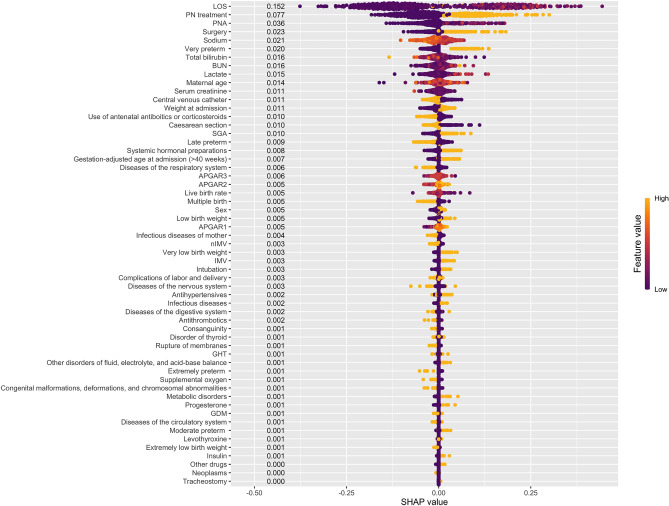
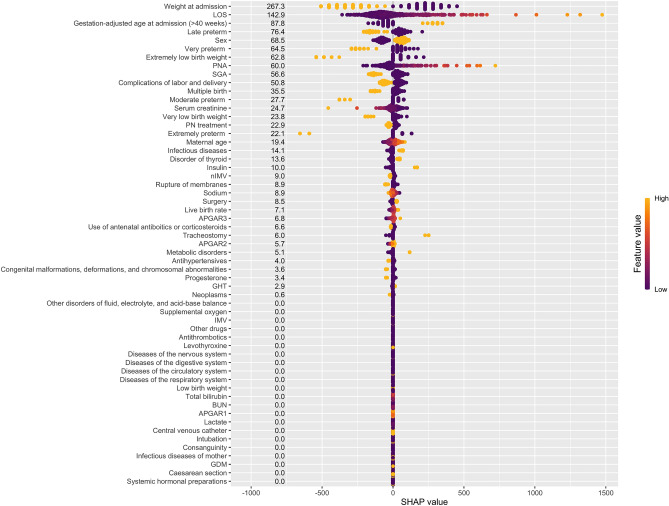
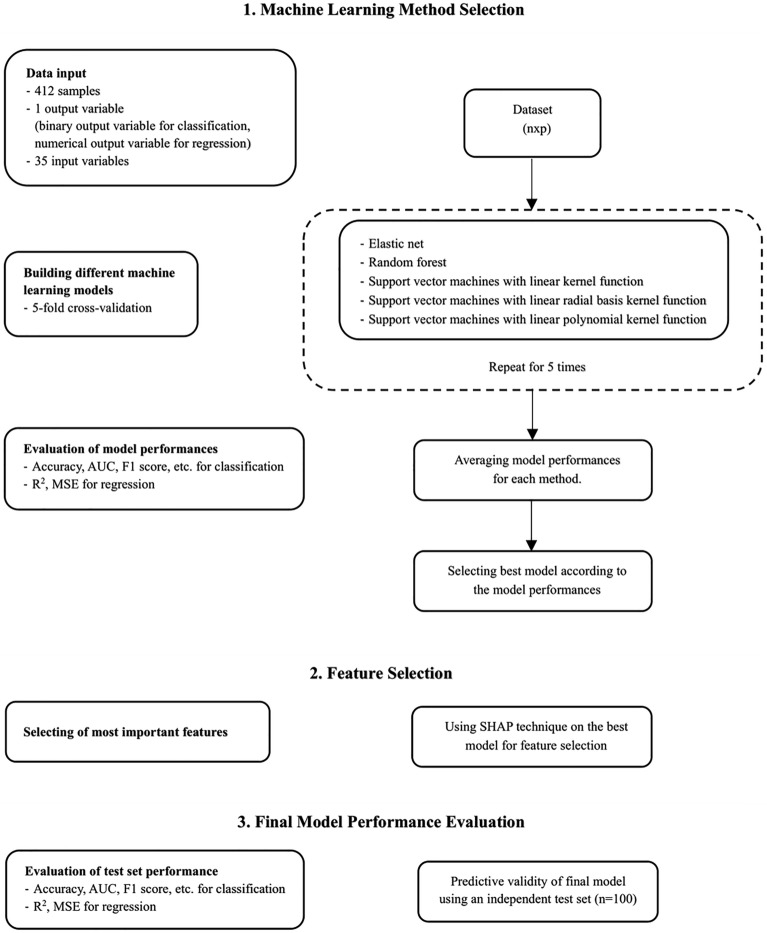
Hospitalized newborns have an increased risk of malnutrition and, especially preterm infants, often experience malnutrition-related extrauterine growth restriction (EUGR). The aim of this study was to predict the discharge weight and the presence of weight gain at discharge with machine learning (ML) algorithms. The demographic and clinical parameters were used to develop the models using fivefold cross-validation in the software-R with a neonatal nutritional screening tool (NNST). A total of 512 NICU patients were prospectively included in the study. Length of hospital stay (LOS), parenteral nutrition treatment (PN), postnatal age (PNA), surgery, and sodium were the most important variables in predicting the presence of weight gain at discharge with a random forest classification (AUROC:0.847). The AUROC of NNST-Plus, which was improved by adding LOS, PN, PNA, surgery, and sodium to NNST, increased by 16.5%. In addition, weight at admission, LOS, gestation-adjusted age at admission (> 40 weeks), sex, gestational age, birth weight, PNA, SGA, complications of labor and delivery, multiple birth, serum creatinine, and PN treatment were the most important variables in predicting discharge weight with an elastic net regression (R2 = 0.748). This is the first study on the early prediction of EUGR with promising clinical performance based on ML algorithms. It is estimated that the incidence of EUGR can be improved with the implementation of this ML-based web tool ( http://www.softmed.hacettepe.edu.tr/NEO-DEER/ ) in clinical practice.
期刊介绍:
We publish original research from all areas of the natural sciences, psychology, medicine and engineering. You can learn more about what we publish by browsing our specific scientific subject areas below or explore Scientific Reports by browsing all articles and collections.
Scientific Reports has a 2-year impact factor: 4.380 (2021), and is the 6th most-cited journal in the world, with more than 540,000 citations in 2020 (Clarivate Analytics, 2021).
•Engineering
Engineering covers all aspects of engineering, technology, and applied science. It plays a crucial role in the development of technologies to address some of the world''s biggest challenges, helping to save lives and improve the way we live.
•Physical sciences
Physical sciences are those academic disciplines that aim to uncover the underlying laws of nature — often written in the language of mathematics. It is a collective term for areas of study including astronomy, chemistry, materials science and physics.
•Earth and environmental sciences
Earth and environmental sciences cover all aspects of Earth and planetary science and broadly encompass solid Earth processes, surface and atmospheric dynamics, Earth system history, climate and climate change, marine and freshwater systems, and ecology. It also considers the interactions between humans and these systems.
•Biological sciences
Biological sciences encompass all the divisions of natural sciences examining various aspects of vital processes. The concept includes anatomy, physiology, cell biology, biochemistry and biophysics, and covers all organisms from microorganisms, animals to plants.
•Health sciences
The health sciences study health, disease and healthcare. This field of study aims to develop knowledge, interventions and technology for use in healthcare to improve the treatment of patients.



 京公网安备 11010802042870号
京ICP备2023020795号-1
京公网安备 11010802042870号
京ICP备2023020795号-1

 分享
分享
 求助内容:
求助内容: 应助结果提醒方式:
 扫码关注我们
